Top Web3 AI Agent Builders for Enterprises
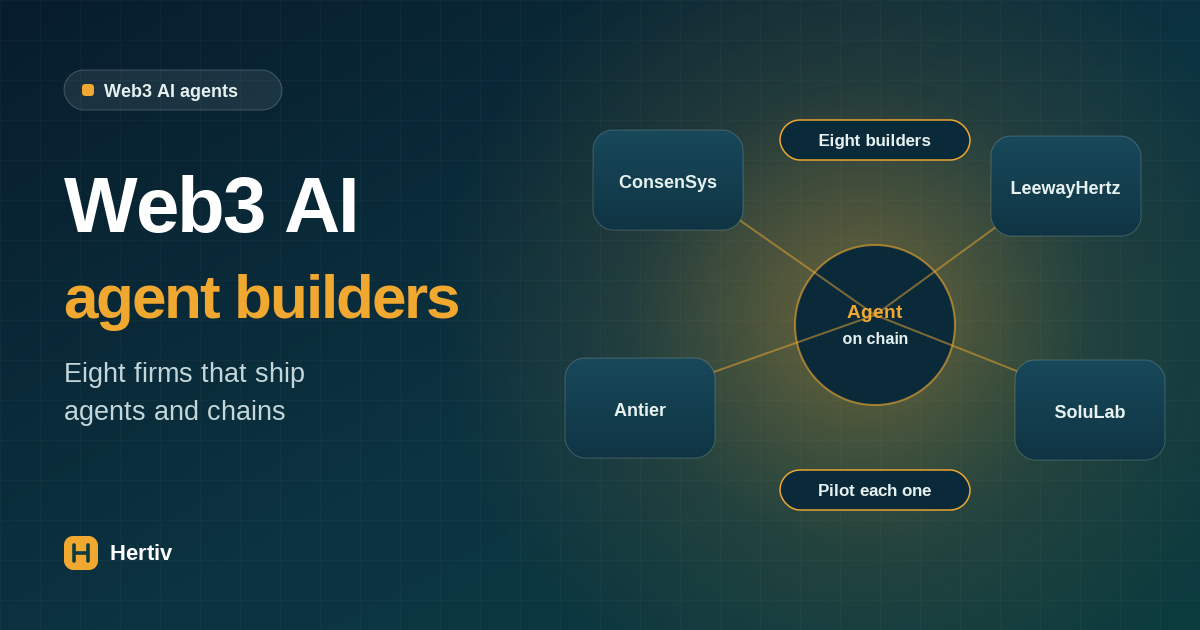
The Web3 AI agent builders to shortlist are firms that have shipped both agents and blockchain systems. This list compares eight of them on what each does best.
On this page
Short answer
The Web3 AI agent builders worth shortlisting are firms that have shipped both agents that plan and act and blockchain systems that hold funds and records, and the right one is the firm that proves both on a small pilot with your own workflow.
Which Web3 AI agent builders are worth shortlisting?
The Web3 AI agent builders worth shortlisting are the firms that have shipped both sides of the job: agents that plan and act, and blockchain systems that hold funds and records. A firm that only builds chatbots will struggle with keys and contracts, and a firm that only builds contracts will struggle with agent behaviour.
Use this comparison to shortlist. Pricing is not listed because these firms price by scope; the honest answer for each is to check the vendor site.
| Company | Best for | Agent plus chain | Enterprise fit |
|---|---|---|---|
| ConsenSys | Ethereum-native agent systems | Yes | High |
| LeewayHertz | Custom AI agents on Web3 | Yes | High |
| Antier Solutions | Token and DeFi agent products | Yes | Medium |
| SoluLab | Enterprise Web3 agent pilots | Yes | High |
| Blockchain App Factory | Full product builds | Yes | Medium |
| HashCash Consultants | Regulated finance agent systems | Yes | High |
| Maticz | Fast Web3 agent prototypes | Yes | Medium |
| ChainSafe | Infrastructure-grade agent systems | Yes | High |
Shortlist two or three firms and run the same small pilot with each. The pilot, not the sales call, is what separates a builder that can ship from one that can only describe the work.
<h3>1. ConsenSys: best for Ethereum-native agent systems</h3>
ConsenSys builds Ethereum-native software, and its teams work on wallets, developer tools and enterprise blockchain systems. For an enterprise that wants AI agents that read and write to Ethereum, that background matters, because the agent must sign transactions, check balances and respect smart contract rules.
The firm is a good fit when your agent system lives on Ethereum or an Ethereum-compatible network and needs production-grade key handling. It is less suited to a quick pilot on a chain it does not work with, or to a project where the agent work is small and the blockchain part is the whole job.
Pros
- Ethereum-native engineering and tooling
- Enterprise delivery experience
- Strong security and audit culture
Cons
- Ethereum focus, not multi-chain by default
- Enterprise pricing, see vendor site
- Longer onboarding for small pilots
2. LeewayHertz: best for custom AI agents on Web3
LeewayHertz builds custom AI agents and Web3 systems for enterprises, including agents that connect to wallets, contracts and off-chain data. Its teams work across the agent and the chain, which is the hard part of this kind of project: the agent must plan, call tools, and settle results on chain without leaking keys or funds.
It fits teams that want one partner for both the agent and the blockchain work, with a pilot that proves the loop end to end. It is less suited to a project that needs only a smart contract, or only a chatbot with no chain connection.
Pros
- One team for agents and blockchain
- Pilot-first approach with measurable steps
- Experience across chains and use cases
Cons
- Custom work, so pricing varies, see vendor site
- Smaller than the largest consultancies
- Needs a clear use case to start well
<h3>3. Antier Solutions: best for token and DeFi agent products</h3>
Antier Solutions builds token, exchange and DeFi products, and its teams also build AI-driven features around them. For an enterprise that wants agents that trade, stake or manage token positions under rules, that combination of token engineering and automation is the point.
It fits teams building agent features into a token or DeFi product, where the agent must follow strict limits on amounts, timing and approvals. It is less suited to a general enterprise agent with no token or payment element.
Pros
- Token and DeFi product experience
- Agent features inside financial flows
- Delivery across several chains
Cons
- Financial products need extra compliance review
- Pricing depends on scope, see vendor site
- Best for token-linked work, not general agents
4. SoluLab: best for enterprise Web3 agent pilots
SoluLab builds Web3 and AI systems for enterprises, including agents that work with contracts, wallets and business data. Its teams run pilots that connect an agent to a real workflow, such as checking a record on chain before approving a step, rather than building a demo that never touches production data.
It fits enterprises that want a bounded pilot with a clear pass mark, run by a team that handles both the agent and the chain. It is less suited to a project with no defined workflow, or to one that needs a large platform rather than a pilot.
Pros
- Pilot-focused delivery with a pass mark
- Agent and chain work in one team
- Enterprise process and documentation
Cons
- Pilot scope must be agreed up front
- Pricing varies by scope, see vendor site
- Smaller bench than the global firms
<h3>5. Blockchain App Factory: best for full product builds</h3>
Blockchain App Factory builds complete blockchain products, from wallets and exchanges to token platforms, and adds AI features where the product needs them. For an enterprise that wants a whole product rather than a single agent, that end-to-end scope is the draw.
It fits teams that need a product built, launched and supported, with agents as one feature inside it. It is less suited to a narrow agent pilot, or to a project where the enterprise already has a product team and only needs agent help.
Pros
- Full product builds, not just features
- Wide range of chains and product types
- Launch and support included
Cons
- Full builds take longer than pilots
- Pricing depends on product scope, see vendor site
- Agent work is one part of a larger build
6. HashCash Consultants: best for regulated finance agent systems
HashCash Consultants builds blockchain systems for banks and financial firms, including payment, custody and exchange products. Its teams work in settings where rules, audits and reporting shape every design choice, which is the reality for an enterprise agent that moves money or touches customer funds.
It fits financial enterprises that need agents inside regulated flows, with the controls and records that auditors expect. It is less suited to a consumer product with no regulatory element, or to a fast pilot with no compliance review.
Pros
- Financial and regulatory experience
- Payment and custody product background
- Audit-ready documentation habits
Cons
- Regulated work moves more slowly
- Pricing varies, see vendor site
- Finance focus, not general enterprise
<h3>7. Maticz: best for fast Web3 agent prototypes</h3>
Maticz builds Web3 products and AI features for startups and enterprises, and its teams move quickly on prototypes. For an enterprise that wants to see an agent working against a contract within weeks, rather than after a long planning phase, that speed is the point.
It fits teams with a clear idea and a short window to prove it, where a working prototype decides whether to invest further. It is less suited to a large, multi-year platform, or to a project that needs deep enterprise governance from day one.
Pros
- Fast prototypes with working agents
- Wide Web3 product range
- Clear fixed-scope offers for pilots
Cons
- Prototype quality needs a follow-on build
- Pricing varies, see vendor site
- Less suited to large platforms
8. ChainSafe: best for infrastructure-grade agent systems
ChainSafe builds blockchain infrastructure, including clients, bridges and developer tools, and its engineering culture is close to the protocol layer. For an enterprise that needs agents to work reliably against chain infrastructure, that depth matters, because the agent depends on the node, the bridge and the data feed being correct.
It fits teams building agent systems on serious infrastructure, where reliability and correctness outrank speed to demo. It is less suited to a business-facing pilot with no infrastructure question, or to a team that needs product design more than protocol work.
Pros
- Deep infrastructure and protocol experience
- Reliability and correctness focus
- Open-source engineering culture
Cons
- Infrastructure focus, not product design
- Pricing varies, see vendor site
- Needs a technical counterpart on your side
How to choose a Web3 AI agent builder
You choose a Web3 AI agent builder by testing it on your own workflow, with your own chain and your own data, and by checking how it handles keys, failures and costs.
- Write the job down. Describe the agent task, the chain it touches, and what a wrong action would cost.
- Check both sides. Ask for a live agent deployment and a live blockchain deployment, not one of each in a demo.
- Run a small pilot. Give the firm a bounded task with a pass mark, such as handling 100 real cases with a human review step.
- Check the controls. Ask how keys are stored, who approves on-chain actions, and what happens when the agent fails.
- Compare the totals. Ask for build, running and support costs in writing, and check the vendor site where figures are not public.
A builder that resists a small pilot is telling you about its confidence. For the agent side of the test, AI agents use cases shows the tasks that already work in production.
The pilot itself deserves the same discipline as any AI build, and how to build an AI proof of concept covers that discipline in more depth.
What are the common mistakes?
The most common mistakes when hiring a Web3 AI agent builder are trusting a demo, letting the agent touch funds without limits, and skipping the pilot.
- Trusting the demo. A recorded agent run proves nothing about your data, your chain or your failure modes.
- No limits on agent actions. An agent that can move funds or sign contracts needs amount limits, approval steps and a kill switch.
- Skipping the pilot. Without a small live test, you cannot measure accuracy, cost or failure rate.
- Ignoring key handling. Who holds the keys, and how they are protected, is the first security question, not the last.
- One vendor for everything. Some teams need a builder for the agent and a separate auditor for the contracts; one firm doing both is a risk to check.
- No cost ceiling. Agent and chain fees grow with volume, so agree a monthly ceiling and an alert before it is hit.
For a wider view of firms that build blockchain products, top blockchain developers compares vendors on the same kind of evidence: live deployments, not promises.
Key takeaways
- Shortlist firms that have shipped both agents and blockchain systems
- Run the same small pilot with two or three firms before you sign
- Put amount limits, approval steps and a kill switch on any agent that touches funds
- Check key handling and audit trails before you check the price
- Agree build, running and support costs in writing, with a monthly ceiling
Frequently asked questions
What is a Web3 AI agent builder?
It is a firm that builds AI agents that work with blockchains: reading records, calling smart contracts and settling results on chain. The work needs both agent engineering and blockchain engineering, which is why few firms do both well.
How much does a custom Web3 AI agent cost?
There is no standard price, because cost depends on the agent task, the chains involved, the controls needed and the support level. Ask each firm for a written breakdown, and check the vendor site where figures are not public.
Should the agent hold its own wallet keys?
Only with strict limits and a clear owner. Most enterprises keep keys in a managed wallet or custody setup, with the agent allowed to propose actions and a human or a rule approving them above a threshold.
How do I test a builder before signing?
Run a small pilot on your own workflow with a fixed pass mark, such as 100 real cases with human review. Score accuracy, cost and failure rate, and compare two or three firms on the same task.
Do I need a smart contract audit too?
Yes, if the agent calls contracts that hold funds or records. The audit should cover the contracts and the agent's permission model, and it should be done by a team separate from the builder where possible.
Can an agent work across several chains?
It can, but each chain adds integration and testing work, and each one needs its own key handling and fee budget. Start with one chain, prove the loop, and add others after the pilot.


