Top 10 Software Development Companies in the USA
These 10 US software development companies cover enterprise builds, product engineering and dedicated teams. Compare their strengths before you shortlist.
On this page
Short answer
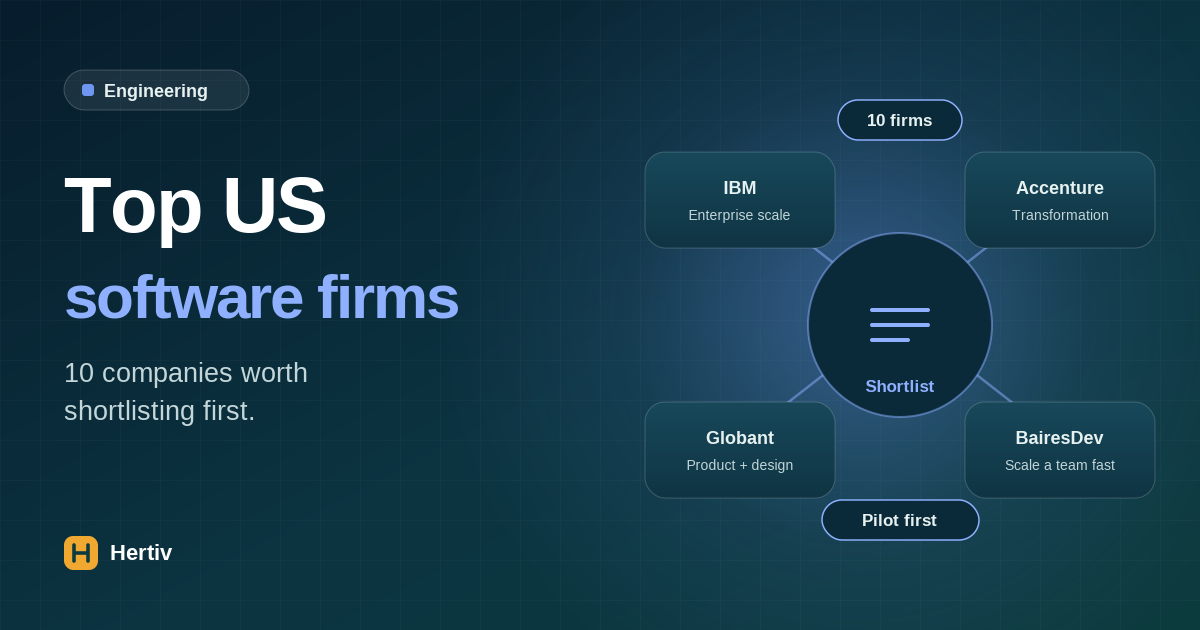
These 10 software development companies in the USA cover enterprise modernisation, product engineering and dedicated teams. IBM and Accenture lead on large enterprise programmes, Globant and Thoughtworks on product engineering, and BairesDev and ScienceSoft on scaling teams fast. Shortlist two or three, then judge them on a small paid pilot.
Which US software development companies should you shortlist?
The companies below are large, established firms with US offices and long delivery records. Use the table to shortlist by what you need: enterprise programmes, product engineering or team scaling.
All of them work with enterprise clients and offer custom development. Prices are not listed here because rates vary by team, location and scope, so ask for a quote. See vendor site for current rates.
| Company | Best for | Known for |
|---|---|---|
| IBM | Large enterprise programmes | Consulting plus engineering at scale |
| Accenture | Digital transformation | Global delivery and industry depth |
| Cognizant | Enterprise modernisation | Legacy modernisation and cloud |
| Globant | Digital products and design | Product studios and design |
| Thoughtworks | Engineering practices | Agile and modern engineering |
| EPAM Systems | Large engineering teams | Product engineering at scale |
| BairesDev | Scaling a team fast | Nearshore engineers in the Americas |
| ScienceSoft | Long-running enterprise builds | Custom software and support |
| Intellectsoft | Mobile and enterprise apps | Mobile-first product builds |
| WillowTree | Consumer digital products | Mobile and web product design |
Shortlist by fit, not by size. A firm that is right for a bank's core system may be wrong for a startup's first product. If you are comparing vendors, software development companies explains how to judge a shortlist.
1. IBM: best for large enterprise programmes
1. IBM: best for large enterprise programmes
IBM is one of the largest technology companies in the world, with consulting and engineering teams across the US. It builds and modernises enterprise systems, often as part of a wider programme that includes cloud migration, data and AI work.
IBM suits organisations that need a single partner for a multi-year programme, with the scale to staff large teams and the processes to run regulated projects. It is less suited to a small team that needs a fast, focused product build.
Pros. Huge scale and US presence; deep experience in regulated industries; can cover cloud, data and AI in one programme.
Cons. Large teams and processes; slower to start than a smaller firm; pricing is enterprise-level.
2. Accenture: best for digital transformation
Accenture is a global consulting and technology firm with large US delivery teams. It combines strategy, design and engineering, and it works across industries from banking to retail to healthcare.
Accenture suits companies that want a transformation partner, not just a development team. It is a good choice when the work spans business process, design and technology, and when the programme needs many specialists at once.
Pros. Global scale; industry depth; can staff a full programme quickly.
Cons. Premium pricing; large teams need strong client-side management.
3. Cognizant: best for enterprise modernisation
3. Cognizant: best for enterprise modernisation
Cognizant is a large IT services firm with US headquarters and delivery teams worldwide. It is known for modernising legacy systems, moving them to the cloud and rebuilding them as modern applications.
Cognizant suits companies with old systems that need careful migration, where the risk is in the data and the integrations rather than in the new interface. It is less suited to a greenfield consumer product.
Pros. Strong modernisation experience; large delivery capacity; US-based account teams.
Cons. Better for large programmes than small builds; timelines can be long.
4. Globant: best for digital products and design
Globant is a digital product company with studios in the US and Latin America. It builds consumer and enterprise products with a strong design focus, and it is known for its studio model, where small teams own a product end to end.
Globant suits companies that want a product built well, not just delivered. Its design-led approach fits consumer apps, digital banking and retail products where the experience matters as much as the code.
Pros. Strong design and product thinking; studio teams own the product; good for consumer-facing work.
Cons. Less suited to heavy back-end modernisation; pricing reflects the design focus.
5. Thoughtworks: best for engineering practices
5. Thoughtworks: best for engineering practices
Thoughtworks is a technology consultancy known for modern engineering: test-driven development, continuous delivery and clean architecture. It has US offices and works with companies that want to raise their own engineering standards while shipping a product.
Thoughtworks suits teams that care about how the software is built, not just what it does. Clients often hire it to build a product and to leave their own engineers working better afterwards.
Pros. High engineering standards; strong agile practices; good knowledge transfer to client teams.
Cons. Premium rates; best for clients who value engineering quality over speed alone.
6. EPAM Systems: best for large engineering teams
EPAM Systems is a product engineering company with large delivery teams and US offices. It builds software products for enterprise clients, often staffing teams of dozens of engineers for a single product.
EPAM suits companies that need a large, skilled engineering team quickly, with the process maturity to run a multi-year product programme. It is a good choice when the product needs many engineers and the scope is well understood.
Pros. Large engineering capacity; mature delivery processes; strong product engineering record.
Cons. Large teams need clear requirements; smaller than the big consultancies in strategy work.
7. BairesDev: best for scaling a team fast
7. BairesDev: best for scaling a team fast
BairesDev is a nearshore software company with engineers across Latin America and US offices. It staffs dedicated teams for US clients, usually within weeks, and it is known for fast team scaling.
BairesDev suits companies that need engineers quickly and want them in a similar time zone. It works well for staff augmentation, where the client keeps product ownership and the vendor supplies the engineers.
Pros. Fast staffing; similar time zones to the US; flexible team sizes.
Cons. Client must manage the product; quality varies by the engineers assigned.
8. ScienceSoft: best for long-running enterprise builds
ScienceSoft is a software development company with US offices and a long record of enterprise builds, including healthcare, banking and manufacturing systems. It is known for long engagements and steady delivery.
ScienceSoft suits companies that want a stable partner for a system that will be built and supported over years. It is a good choice for regulated industries where the vendor must understand the compliance rules.
Pros. Long delivery record; experience in regulated industries; stable teams.
Cons. Smaller than the global firms; less design-led than product studios.
9. Intellectsoft: best for mobile and enterprise apps
9. Intellectsoft: best for mobile and enterprise apps
Intellectsoft is a software development company with US offices, known for mobile apps and enterprise software. It builds iOS and Android apps, web platforms and the back-end systems behind them.
Intellectsoft suits companies that need a mobile product with a solid back end, such as a banking app, a logistics platform or a field-service tool. It is a practical choice when the app must work well on phones and connect to existing enterprise systems.
Pros. Strong mobile experience; full-stack delivery; practical, delivery-focused teams.
Cons. Less known for large transformation programmes; smaller than the top consultancies.
10. WillowTree: best for consumer digital products
WillowTree is a US digital product company that designs and builds consumer apps and websites for well-known brands. It is known for polished mobile products and for working closely with client product teams.
WillowTree suits companies that want a consumer-facing app built to a high design standard, with a team that cares about the details of the experience. It is less suited to heavy back-end or legacy modernisation work.
Pros. Excellent product design; strong mobile record; close client collaboration.
Cons. Premium pricing; not the right choice for back-end heavy programmes.
How to choose the right company
Choose by fit with your project, not by brand size. The best company for your project is the one that has built something like it before, can staff it in your time zone and will work the way your team works.
- Write down the problem, the users and the deadline before you talk to any vendor.
- Shortlist two or three companies that have built similar products, not just similar technologies.
- Ask for a reference call with a client in your industry, and ask what went wrong.
- Run a small paid pilot of two to four weeks before signing a large contract.
- Check who will actually work on your project, not just who sells it.
Judge the pilot on communication and delivery, not on promises. A vendor that answers quickly, ships on time and raises problems early is worth more than one with a longer client list. See custom software development companies for a shorter, custom-focused shortlist.
Common mistakes when choosing a vendor
The most common vendor mistakes are choosing on price alone, skipping the pilot and signing a large contract before the team is proven.
- Choosing the cheapest quote without checking who will do the work
- Skipping reference calls with clients in your industry
- Signing a large fixed contract before a pilot has proven the team
- Accepting a sales team as the delivery team
- Ignoring time zone overlap, then losing days to slow replies
- No exit plan, so switching vendors later costs more than the project
- Judging vendors on slides instead of on a working pilot
For a US-focused comparison in one area, top AI development companies in the USA covers the AI specialists.
Key takeaways
- IBM, Accenture and Cognizant lead on large enterprise programmes.
- Globant, Thoughtworks and WillowTree lead on product engineering and design.
- BairesDev and ScienceSoft are strong for scaling teams and long builds.
- Shortlist two or three companies, then judge them on a small paid pilot.
- Check who will actually work on your project, not just who sells it.
Frequently asked questions
How much does it cost to hire a US software development company?
Rates vary widely by team, location and scope, so there is no single number. Large consultancies charge more than smaller product firms, and nearshore teams cost less than onshore ones. Ask each shortlisted vendor for a quote based on your scope, and see vendor site for current rates.
Should I hire a large consultancy or a smaller firm?
A large consultancy suits multi-year enterprise programmes with many workstreams. A smaller product firm suits a focused product build where design and speed matter. Match the vendor to the size and shape of your project, not to the size of the vendor.
What is the difference between staff augmentation and a dedicated team?
Staff augmentation adds engineers to your team, and you manage the work. A dedicated team is a full team from the vendor, including a project manager, that owns delivery. Augmentation suits companies with strong product management; a dedicated team suits companies that want delivery handled for them.
How do I check a vendor's quality before signing?
Ask for a reference call with a client in your industry, look at products they have shipped, and run a small paid pilot of two to four weeks. The pilot shows you the real team, the communication and the code quality, which a proposal cannot.
Do US companies outsource development overseas?
Many do, using nearshore teams in Latin America or offshore teams in Eastern Europe and Asia. The trade-off is cost against time zone overlap and communication. Nearshore teams share US working hours, while offshore teams are cheaper but harder to meet with during the day.
What should a software development contract include?
It should cover scope, timelines, payment terms, intellectual property ownership, confidentiality, support after launch and an exit clause. Get a lawyer to review it before signing, especially for large or long-running engagements.


