Smart Contract Development Trends Worth Watching
Smart contract work is shifting toward safer code, cheaper execution, and contracts that can be fixed after launch. These six trends change how teams build.
On this page
Short answer
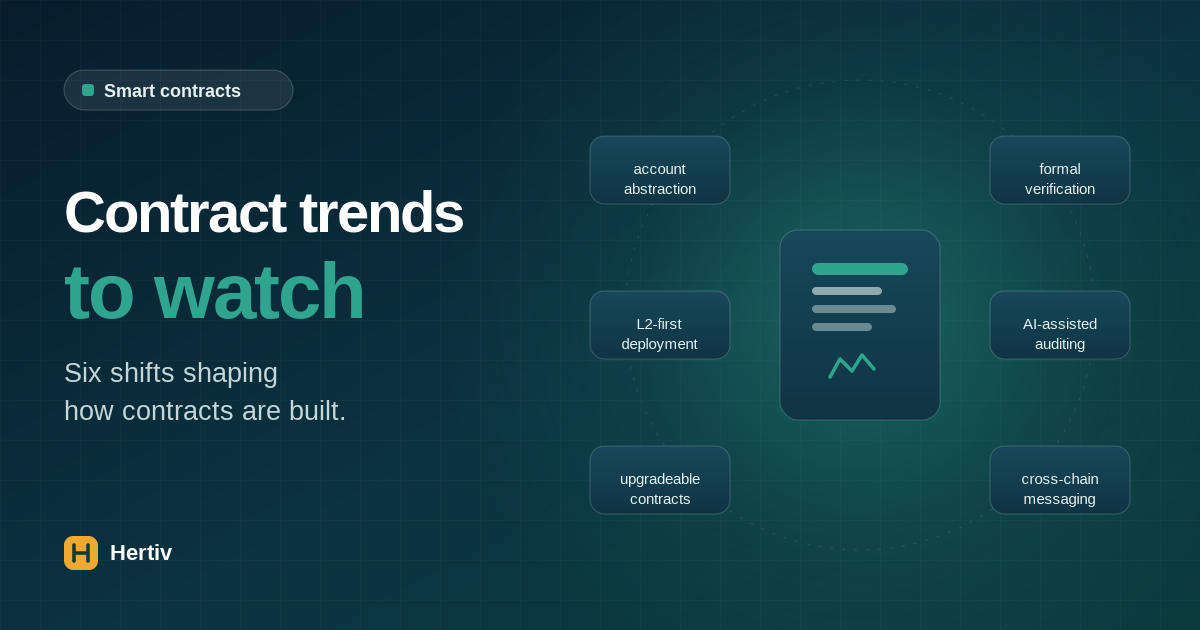
Smart contract development is shifting toward safer code, cheaper execution, and contracts that can be fixed after deployment. The six trends that matter most are account abstraction, formal verification, L2-first deployment, AI-assisted auditing, upgradeable contracts, and cross-chain messaging.
What is changing in smart contract development?
Smart contract development is moving from hand-written contracts deployed once to a set of practices around safer code, cheaper execution, and contracts that can be fixed after deployment. The change is driven by high-profile exploits, cheaper layer-2 networks, and better tooling.
| Trend | What it changes | Who it helps most |
|---|---|---|
| Account abstraction | Wallets behave like apps | Teams building for non-crypto users |
| Formal verification | Proofs replace some tests | Teams holding large value |
| L2-first deployment | Lower fees, faster finality | Apps with many small transactions |
| AI-assisted auditing | Faster first-pass review | Small teams before a full audit |
| Upgradeable contracts | Bugs can be fixed | Long-lived protocols |
| Cross-chain messaging | Contracts talk across chains | Apps spanning several networks |
The six trends below are the ones that change how teams actually build, not just how they talk about building. Each one has real trade-offs, and none of them removes the need for careful review before a contract holds other people's funds.
Account abstraction
1. Account abstraction: best for teams building wallets for everyday users
Account abstraction lets a wallet act like a smart contract account, so users can sign in with familiar methods, recover access without a seed phrase, and pay fees in tokens other than the network's native coin. The wallet becomes programmable instead of a single fixed key.
For builders, this removes the hardest part of onboarding: explaining seed phrases and gas to a first-time user. A team can sponsor a new user's first transactions, set spending limits, and batch several actions into one confirmation. The trade-off is added complexity in the wallet code and new failure modes to test.
Pros
- Removes seed-phrase onboarding for new users
- Lets teams sponsor fees and batch actions
- Spending limits and recovery built into the account
Cons
- More code to audit in the account itself
- Standards are still settling across wallets
- Recovery design must be planned before launch
Formal verification tooling
2. Formal verification tooling: best for protocols that hold large amounts of value
Formal verification checks a contract against a written specification using mathematical reasoning, rather than only running test cases. If the specification says funds can only leave through approved paths, the tool tries to prove that claim for every possible input.
This catches classes of bugs that tests miss, because tests only cover the cases someone thought to write. The cost is real: writing a good specification takes time, and the tools need engineers who understand both the contract and the property being checked. Most teams use it for the highest-risk parts, not the whole codebase.
Pros
- Finds bugs that test cases never reach
- Gives a stronger claim about critical invariants
- Fits well with high-value vaults and bridges
Cons
- Writing specifications is slow and skilled work
- Tools cover only the properties you state
- Not a replacement for an independent audit
L2-first deployment
3. L2-first deployment: best for apps with many small transactions
Deploying first on a layer-2 network has become the default for many consumer apps, because fees are low enough that small actions, such as a game move or a vote, make sense on chain. The main chain is still used for settlement and for assets that need its security.
The practical effect is a different design: contracts are written to be cheap to call, and teams plan from the start for users who will never touch the main chain directly. The trade-off is fragmentation. Liquidity, users, and tooling are spread across networks, so teams must choose where to launch and how to bridge.
Pros
- Fees low enough for everyday actions
- Faster confirmation for users
- Mature tooling on the main L2 networks
Cons
- Users and liquidity split across networks
- Bridging adds risk and complexity
- Network choice is hard to reverse later
AI-assisted auditing
4. AI-assisted auditing: best for small teams preparing for a full audit
AI tools now read contract code and flag patterns that look like known bugs, such as re-entrancy, unchecked external calls, and faulty access control. They work as a fast first pass, often inside the editor, before a human reviewer or an audit firm looks at the code.
The value is speed: a team gets a list of suspicious spots within minutes, and can fix the obvious ones before paying for review time. The limit is that these tools guess from patterns. They miss logic errors that only make sense in the context of the business rules, and they can flag safe code, so every finding still needs a human to judge it.
Pros
- Fast first pass before human review
- Catches common bug patterns early
- Cheap to run on every change
Cons
- Misses logic errors tied to business rules
- False alarms need human triage
- Never a substitute for a full audit
Upgradeable and modular contracts
5. Upgradeable and modular contracts: best for long-lived protocols that must change
Upgradeable contracts separate the logic from the stored data, so the team can replace buggy or outdated logic while keeping user balances and history in place. Modular designs go further, splitting a protocol into small contracts that can be replaced one at a time.
This is a practical answer to a hard fact: no contract is bug-free forever, and protocols need new features. The risk is governance. Whoever holds the upgrade key can change the rules, so teams now publish upgrade procedures, time locks, and multi-signature controls to make that power visible and limited.
Pros
- Bugs can be fixed without migrating users
- New features ship without a fresh launch
- Modules can be replaced one at a time
Cons
- Upgrade keys are a central point of trust
- Proxy patterns add audit complexity
- Bad upgrades can break stored data
Cross-chain messaging
6. Cross-chain messaging: best for apps that span several networks
Cross-chain messaging lets a contract on one network send a verified message to a contract on another, so an app can hold assets on one chain and serve users on another. The message is checked by the receiving contract before it acts, which is what makes the pattern usable rather than just a bridge for tokens.
For builders, this opens designs that were awkward before: one source of truth for state, with user-facing contracts on cheaper networks. The cost is security review. Every message path is a trust assumption, and a flaw in the messaging layer can affect every connected contract, so teams audit the messaging setup as carefully as the app itself.
Pros
- One state source can serve many networks
- Users stay on the cheapest network for them
- Enables apps that no single chain could host
Cons
- Every message path is a trust assumption
- More moving parts to audit and monitor
- A messaging failure can affect all chains
How to choose which trends to follow
Choose by the risk your app actually carries, not by what is most discussed. A consumer app with small transactions gains most from account abstraction and L2 deployment. A protocol holding large value gains most from formal verification and a careful upgrade plan.
- List your top three risks. Lost funds, bad onboarding, high fees, or frozen upgrades are common ones.
- Match one trend to each risk. If a trend fixes none of your risks, ignore it for now.
- Check maturity. Prefer tools with public audits and real production use over new releases.
- Budget for review. New patterns need audit time. Add it to the plan before you commit.
- Ship one change at a time. Combine at most one new pattern per release, so a failure has a clear cause.
Trends that do not match a current risk are worth watching, not adopting. A team that adopts every new pattern at once spends its review budget on novelty instead of on the risks that could actually hurt users.
What are the common mistakes?
The most common mistakes are adopting a trend for its own sake, underestimating the audit cost, and trusting a new pattern before it has been tested in production.
- Upgrading without a time lock. If an upgrade takes effect instantly, a compromised key can change the rules before anyone reacts.
- Skipping the audit for an L2 deploy. Cheaper fees do not make the code safer; the same review is needed.
- Trusting AI audit output blindly. A clean AI report is not an audit, and a flagged line is not always a bug.
- Designing for every chain at once. Cross-chain support multiplies the review surface. Start on one network and expand deliberately.
- Writing a specification nobody reads. Formal verification only helps if the specification matches what the protocol should actually do.
Key takeaways
- Account abstraction and L2 deployment help consumer apps most
- Formal verification suits high-value protocols, not every contract
- AI auditing is a fast first pass, never a full audit
- Upgradeable contracts need time locks and visible governance
- Adopt one new pattern per release and budget for review
Frequently asked questions
Do smart contracts still need an audit if AI tools check them?
Yes. AI tools flag patterns that look like known bugs, but they miss logic errors tied to your business rules and they can flag safe code. An independent audit by experienced reviewers remains the standard before a contract holds other people's funds.
What is account abstraction in simple terms?
It lets a wallet act like a programmable account instead of a single key. Users can recover access without a seed phrase, pay fees in different tokens, and batch actions. It makes crypto apps feel closer to normal apps for first-time users.
Why deploy on a layer-2 network first?
Fees are low enough for small, everyday actions, and confirmations are faster for users. The trade-off is fragmentation: users and liquidity are spread across networks, so choosing where to launch matters and bridging adds risk.
Are upgradeable contracts safe?
They are useful but they concentrate trust in whoever holds the upgrade key. Safe teams publish the upgrade procedure, use a time lock so changes cannot take effect instantly, and require several signatures before an upgrade is approved.
What is formal verification?
It is a method of checking contract code against a written specification using mathematical reasoning, aiming to prove a property holds for every possible input. It catches bugs tests miss, but it takes skilled work and only covers the properties you state.
How do I pick which trend to adopt?
Start from your top three risks, such as lost funds, poor onboarding, or high fees, and match one trend to each. Ignore trends that fix none of your risks, and ship one new pattern at a time so a failure has a clear cause.


