Top On-Ramp Providers for Crypto Apps Compared
Fiat on-ramps let users buy crypto with a card or bank transfer inside your app. These eight providers cover cards, bank payments and local methods.
On this page
Short answer
The leading fiat on-ramp providers are MoonPay, Ramp Network, Transak, Banxa, Mercuryo, Simplex, Onramper and Coinbase Pay. MoonPay and Transak suit teams that want broad card and bank coverage, Ramp Network suits teams that want a clean widget and local payment methods, and Onramper suits teams that want several providers behind one integration. Check each vendor's coverage and pricing on its own site before you commit.
Which on-ramp providers should you compare first?
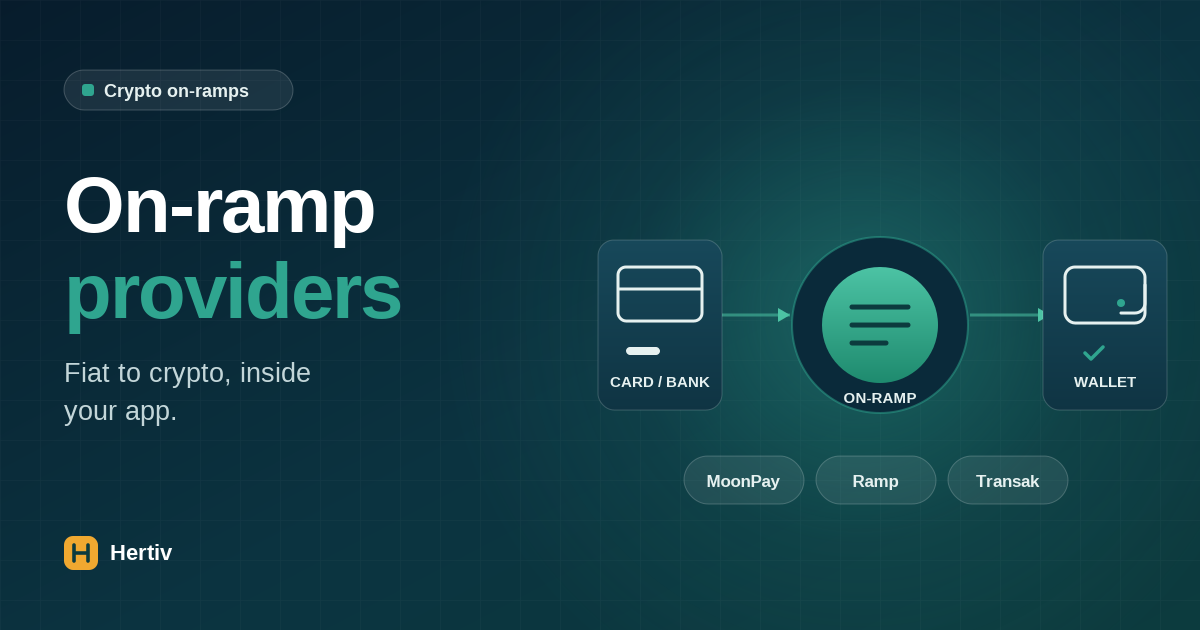
An on-ramp provider is the service that turns a user's card or bank payment into crypto inside your app. The user never leaves your product: they enter an amount, pay, and the crypto arrives in their wallet. Which provider fits depends on your users' countries, their payment methods, and how much of the compliance work you want to hand over.
Use this comparison to shortlist two or three providers, then test the full flow with real users in your main markets before you commit.
| Provider | Payment methods | Best for | Integration |
|---|---|---|---|
| MoonPay | Card, bank transfer | Broad coverage | Widget, API |
| Ramp Network | Card, bank, local methods | Clean checkout | Widget, API |
| Transak | Card, bank transfer | Many markets | Widget, API |
| Banxa | Card, bank, local methods | Local payments | Widget, API |
| Mercuryo | Card, bank transfer | Fast checkout | Widget, API |
| Simplex | Card, bank transfer | Fraud controls | Widget, API |
| Onramper | Depends on provider | Several providers | Aggregator API |
| Coinbase Pay | Card, Coinbase balance | Coinbase users | SDK, API |
Fees and supported countries change often, and they vary by payment method and user location, so check the vendor's own site before you budget. If you are also planning the token side, see how to create a cryptocurrency. The rest of this article compares what each provider is good at, not what it charges.
Card-first providers: MoonPay and Transak
1. MoonPay: best for broad coverage
MoonPay is one of the most widely used on-ramp providers, with a widget and API that let users buy crypto with a card or bank transfer without leaving your app. It handles identity checks and payment processing, so your team does not have to build either.
Its strength is reach: it supports many countries and many assets, and its checkout is familiar to users who have bought crypto before. Its weakness is that fees and limits vary by market, so a flow that looks cheap in one country can be expensive in another.
- Pros: wide country and asset coverage, familiar checkout, widget and API options
- Cons: fees and limits vary by market, you rely on its compliance process
2. Transak: best for many markets
Transak is an on-ramp provider that focuses on broad market coverage, with card and bank transfer payments and a widget that drops into web and mobile apps. It is a common choice for wallets and games that need to onboard users in many countries from one integration.
Its strength is the breadth of its payment coverage and its developer tooling. Its weakness is that support for a given local method or asset can differ by country, so you need to check your main markets rather than assuming global coverage.
- Pros: broad market coverage, good developer tooling, widget and API options
- Cons: local method support varies by country, fees differ by market
Widget and local-payment providers: Ramp Network and Banxa
3. Ramp Network: best for a clean checkout
Ramp Network is an on-ramp provider known for a simple, fast checkout and support for local payment methods alongside cards and bank transfers. Its widget is designed to sit inside wallets and apps with minimal setup, and it handles identity checks for you.
Its strength is the checkout experience: fewer steps, clear pricing shown up front, and local methods that matter in markets where cards are less common. Its weakness is coverage: it does not serve every market, so check your users' countries first.
- Pros: clean, fast checkout, local payment methods, clear pricing
- Cons: coverage is narrower than the largest providers, limits vary by market
4. Banxa: best for local payments
Banxa is an on-ramp provider with a strong focus on local payment methods, which makes it useful for apps whose users pay by bank transfer or local rails rather than by card. It offers a widget and API, and it handles compliance and fraud checks as part of the service.
Its strength is local coverage in markets where international card providers are weaker. Its weakness is that the checkout experience and supported assets vary by region, so test the flow in each market that matters to you.
- Pros: strong local payment coverage, handles compliance, widget and API options
- Cons: experience varies by region, narrower asset list in some markets
Broad-coverage providers: Mercuryo and Simplex
5. Mercuryo: best for fast checkout
Mercuryo is an on-ramp provider that focuses on a fast, simple purchase flow, with card and bank transfer payments and a widget that fits into wallets and apps. It is often chosen by teams that want users from payment to wallet in as few steps as possible.
Its strength is speed: the flow is short, and returning users can move faster once verified. Its weakness is that coverage and limits differ by market, so a flow that works well in one country may not be available in another.
- Pros: short checkout flow, returning users move faster, widget and API options
- Cons: coverage and limits vary by market, smaller provider than the leaders
6. Simplex: best for fraud controls
Simplex, now part of Nuvei, is an on-ramp provider that built its name on fraud prevention for card payments. It offers a widget and API for buying crypto with a card or bank transfer, with its own risk checks running behind the checkout.
Its strength is the fraud and risk tooling, which matters when you are onboarding new users at scale and cannot absorb chargebacks. Its weakness is that strict risk checks can slow down or block legitimate first-time buyers, so watch your approval rate.
- Pros: strong fraud and risk controls, card payment expertise, widget and API options
- Cons: strict checks can block legitimate buyers, fees vary by market
Aggregators and exchange options: Onramper and Coinbase Pay
7. Onramper: best for several providers behind one integration
Onramper is an aggregator that routes each purchase to the best on-ramp provider for that user, country and payment method. Instead of integrating one provider, you integrate Onramper and it picks between several providers behind the scenes.
Its strength is coverage and fallback: if one provider cannot serve a user, another one can, so fewer users hit a dead end. Its weakness is that you add a middleman, so debugging a failed payment can mean dealing with two vendors instead of one.
- Pros: multiple providers behind one integration, better coverage, automatic fallback
- Cons: an extra layer to debug, pricing depends on the underlying providers
8. Coinbase Pay: best for Coinbase users
Coinbase Pay lets users fund a wallet or app using their Coinbase account balance or a linked card, without going through a separate identity check if they are already verified with Coinbase. It is a natural fit for apps whose users already hold funds on Coinbase.
Its strength is the existing user base: millions of people already have a verified Coinbase account, so the checkout is short for them. Its weakness is scope: it is most useful for users who already use Coinbase, and less useful as a general on-ramp for everyone else.
- Pros: short checkout for Coinbase users, no repeat identity check, trusted brand
- Cons: best for existing Coinbase users, less useful as a general on-ramp
If your app also needs to move crypto between users or settle payments, crypto payment gateway services cover the payment side in more depth.
How to choose an on-ramp provider
Choose by testing the full purchase flow in your main markets, not by comparing feature lists. A provider that looks good on paper can fail on the payment methods your users actually have.
- List your users' countries. Rank your markets by user numbers and drop any provider that does not serve your top three well.
- Check payment methods. Cards, bank transfer and local methods differ by country. Match the provider to what your users actually pay with.
- Test the full flow. Buy a small amount through each shortlisted provider in each main market, and record how many steps it takes and where users drop off.
- Read the fee and limit details. Fees, minimums and maximums vary by market and method. See the vendor site for current pricing before you commit.
- Plan for failure. Decide what happens when a payment fails or a user is rejected: a clear error, an alternative provider, or a support path.
Keep the shortlist short. Two providers tested properly in your main markets beat five compared on paper. If you are building the wallet side as well, stablecoin use cases shows where on-ramps fit into a wider product.
What are the common mistakes?
The most common mistakes are assuming global coverage, ignoring local payment methods, and launching without testing the real flow.
- Assuming one provider covers everywhere. No on-ramp serves every country and every payment method. Check your top markets one by one.
- Ignoring local payment methods. In many markets, bank transfer or a local wallet matters more than cards. A card-only checkout will lose those users.
- Not testing with real users. A flow that works in your office may fail for a user on a different bank, device or network. Test in each main market.
- Hiding fees until the last step. Users abandon purchases when the final amount differs from what they expected. Show fees and the final amount early.
- No fallback when a payment fails. A rejected payment with no alternative provider and no support path is a lost user.
- Forgetting compliance. Identity checks and limits are part of the service, not an optional extra. Make sure your users understand what they will be asked for.
Key takeaways
- MoonPay and Transak suit teams that want broad card and bank coverage
- Ramp Network and Banxa suit teams that need local payment methods
- Onramper adds fallback by routing each purchase to the best provider
- Coinbase Pay is the shortest path for users who already use Coinbase
- Test the full purchase flow in your top markets before you commit
- Show fees early and plan a fallback for failed payments
Frequently asked questions
What is a fiat on-ramp provider?
A fiat on-ramp provider turns a card or bank payment into crypto inside your app. The user pays in local currency and the crypto arrives in their wallet. The provider handles payment processing, identity checks and compliance, so your team does not have to build them.
Do on-ramp providers handle identity checks?
Yes, most providers run their own identity checks as part of the purchase flow. Users are usually asked for an ID document and sometimes a selfie, depending on the amount and the country. The exact requirements vary by provider and market.
How much do on-ramp providers charge?
Fees vary by provider, payment method, country and amount, and they change often. Most providers show the fee and the final amount before the user confirms. Check the vendor site for current pricing in your main markets.
Can one on-ramp provider cover all countries?
No. Every provider has markets it serves well and markets it does not serve at all. Aggregators such as Onramper help by routing each purchase to a provider that serves that user, but even they cannot cover every country.
What is the difference between an on-ramp and an exchange?
An on-ramp only converts fiat to crypto inside another product, such as a wallet or game. An exchange is a full trading platform where users buy, sell and hold assets. Many apps use an on-ramp for the first purchase and an exchange for later trading.
Do I need a licence to add an on-ramp to my app?
Usually not, because the provider handles the regulated payment and compliance work. Your app integrates the provider's widget or API, and the provider is the party that processes the payment. Check the rules in your own markets, since requirements differ by country.


