Top 5 Metaverse Development Companies to Shortlist
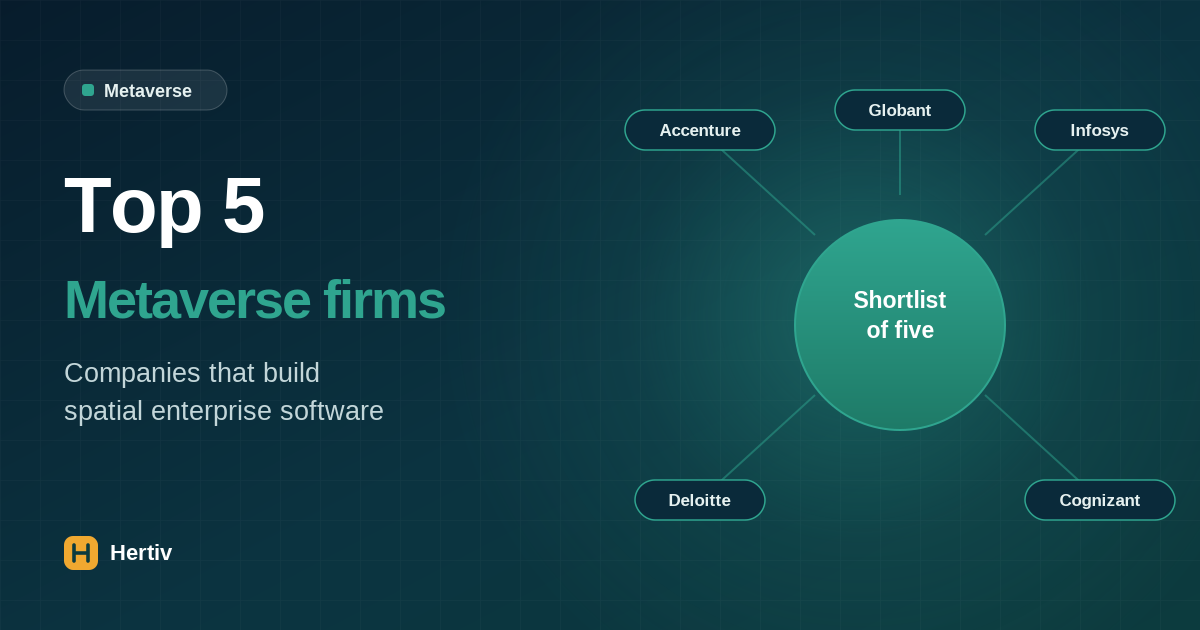
These five firms build enterprise metaverse software: digital twins, training, showrooms and spatial collaboration. Compare what each does best first.
On this page
Short answer
Metaverse development companies build shared 3D software for enterprises: digital twins, immersive training, virtual showrooms and spatial collaboration tools. The five firms below all run enterprise metaverse programmes, and each one leans on a different strength, from consulting scale to engineering depth.
Which metaverse development companies should you shortlist?
Shortlist a metaverse development company by what it has actually shipped for enterprises, not by how large its virtual worlds look in a demo. The five firms below all run enterprise metaverse programmes, and each one is strongest in a different place: consulting scale, systems integration, engineering depth, or a product-led approach.
Every firm here works with 3D engines, real-time networking and identity systems, and every one of them can build digital twins, training spaces and showrooms. The differences show up in how they staff a project, how they connect the 3D layer to your existing systems, and whether they stay for long-term support. The table below compares them at a glance.
| Company | Best for | Enterprise strength | Watch out for |
|---|---|---|---|
| Accenture | Large programmes | Global delivery, metaverse studio | Premium fees, long sales cycle |
| Deloitte | Regulated industries | Risk, compliance and strategy | Heavy process on small builds |
| Infosys | Cost-conscious builds | Large engineering teams, Metaverse Foundry | Needs clear specs from you |
| Cognizant | Data-led twins | IoT and analytics integration | Less known for pure 3D craft |
| Globant | Product-style builds | Design and engineering in one team | Smaller scale than the big four |
1. Accenture: best for large metaverse programmes
1. Accenture: best for large metaverse programmes
Accenture runs one of the largest metaverse practices among global consultancies, with a dedicated studio that builds training environments, digital twins and virtual showrooms for enterprise clients. Its strength is scale: it can staff a programme across countries, run change management alongside the build, and connect the 3D layer to the systems a large company already runs.
Accenture fits best when the project is a programme rather than a single build, for example rolling out training spaces to several plants or connecting twins to live operations data. It is the safe shortlist pick for a large buyer that needs delivery in many regions at once. Fees are at the premium end, so ask for a fixed scope before you sign.
- Pros: global delivery, deep enterprise experience, strong change management
- Cons: premium fees, long sales and onboarding process
2. Deloitte: best for regulated industries
2. Deloitte: best for regulated industries
Deloitte builds metaverse software with its consulting and risk practices in the same room, which matters in banking, healthcare and government work. A training space or a digital twin in a regulated setting needs identity controls, audit trails and data residency rules, and Deloitte plans for those from the first workshop rather than adding them later.
Deloitte fits best when compliance shapes the build: patient data in a training space, audit logs for a regulated process, or identity rules for a shared environment. Its projects tend to be heavier on process than a pure engineering shop, so a small pilot can feel slow. For a first proof of concept, agree a tight scope in writing.
- Pros: strong compliance and risk practice, trusted in regulated sectors
- Cons: heavy process, slower on small pilots
3. Infosys: best for cost-conscious enterprise builds
3. Infosys: best for cost-conscious enterprise builds
Infosys runs a metaverse practice built around its Metaverse Foundry, a set of reusable parts for digital twins, virtual commerce and training. The model is engineering-led: large teams, reusable assets and a focus on getting a working environment into production at a lower cost than the big consulting firms.
Infosys fits best when you know what you want to build and need it delivered at scale, for example a showroom for a product range or a training space for a standard procedure. It works less well when the brief is still vague, because its teams need clear specs to move fast. Bring a defined use case and a success metric to the first meeting.
- Pros: reusable platform parts, large engineering capacity, competitive fees
- Cons: needs clear specs, less suited to open-ended discovery
4. Cognizant: best for data-led digital twins
4. Cognizant: best for data-led digital twins
Cognizant builds metaverse software from the data side: IoT feeds, analytics and operations systems that a digital twin must read to be useful. Its twin work tends to sit inside wider modernisation programmes, where the 3D view is the front end for data a plant or a building already produces.
Cognizant fits best when the twin must be live, not a static model: a factory floor that shows real sensor readings, a building that reports energy use, or a network that shows faults as they happen. It is less known for pure 3D craft than a specialist studio, so check its design work if the experience itself is the product.
- Pros: strong IoT and data integration, twin work tied to real operations
- Cons: less known for 3D design craft, project scope can widen
5. Globant: best for product-style metaverse builds
5. Globant: best for product-style metaverse builds
Globant works as a product studio: designers and engineers in one team, building metaverse software the way it builds apps and platforms. Its metaverse work covers virtual showrooms, training spaces and customer experiences, with a focus on how the experience feels to the person using it.
Globant fits best when the experience is the product, for example a configurator buyers enjoy using or a training space staff actually finish. It is smaller than the consulting giants, so a very large multi-country rollout may need a second partner. For a focused build with a clear audience, its product approach usually moves faster.
- Pros: design and engineering in one team, fast on focused builds
- Cons: smaller scale, may need a partner for global rollouts
How to choose a metaverse development company
Choose a metaverse development company in five steps, and judge each one on the same criteria so the shortlist stays honest.
- Define the job. Write down the workflow the environment improves and the metric that proves it, such as training completion or fewer site visits.
- Ask for architecture, not screenshots. Request a diagram showing the 3D layer, real-time services, identity and data feeds.
- Check integration experience. Confirm work with your device targets, your identity provider and your systems of record.
- Run a small proof of concept. One environment, one integration, real users and a fixed review date before you fund more.
- Agree the handover. Source code, asset pipelines and documentation, so your team can run the environment afterwards.
Price every shortlist on the same scope, and ask each firm what it will not do. The gaps tell you more than the brochures. How metaverse companies reshape enterprise software explains what to expect from a first project.
What are the common mistakes?
The most common mistake is choosing a firm for its demo reel instead of its integration record. A beautiful world that cannot read live data from your systems is a demo, not enterprise software, and it will be abandoned after launch.
The second mistake is skipping the proof of concept and funding a full platform on the first signature. A small pilot with real users answers the only question that matters: does the spatial version beat the current way of working? If it does not, stop and reassess.
The third mistake is forgetting content costs. Asset production is often the largest hidden cost, and a showroom or training space goes stale without a pipeline for updates. Budget for content creation and maintenance, not only for code. Digital twins in the enterprise metaverse shows where twin projects usually run over budget.
Key takeaways
- The five firms differ in scale, not in the basics
- Accenture and Deloitte suit large and regulated programmes
- Infosys and Cognizant suit cost-conscious and data-led builds
- Globant suits product-style builds where the experience matters
- Judge every firm on integration, a proof of concept and handover
Frequently asked questions
What does a metaverse development company actually build?
It builds shared 3D software for enterprises: digital twins, immersive training, virtual showrooms, spatial collaboration tools and connected experiences that run in browsers, on phones and on headsets, with identity and data feeds behind them.
Do I need a headset to use enterprise metaverse software?
No. Most enterprise deployments prioritise browsers, desktop and mobile, with headsets as an optional channel. Designing browser-first reduces device dependency, reaches more users, and makes updates simpler for large user groups.
How much does a metaverse project cost?
It varies widely by scope, content volume and integrations. A focused proof of concept costs far less than a persistent platform. Ask each firm for a fixed-scope quote and a separate line for content production, or see vendor site for current rates.
Which company is best for a first pilot?
Pick the firm whose strength matches your pilot: Deloitte for regulated work, Infosys for a cost-conscious build, Globant for an experience-led build. Run one environment with real users before funding more.
Should the firm also handle blockchain?
Only if your use case needs verifiable ownership, payments or provenance across parties, such as tokenised assets or tickets. Otherwise keep the ledger out of scope and add it later if a business rule needs it.
What should I ask for before signing?
Ask for an architecture diagram, a proof of concept plan, a handover plan for code and assets, and a fixed scope with content costs shown separately. If a firm cannot show these, keep looking.


