Top DePIN Development Companies in the USA: 6 to Compare
These six US companies build the networks behind DePIN, from wireless hotspots to GPU compute. Compare what each one builds and who it suits best.
On this page
Short answer
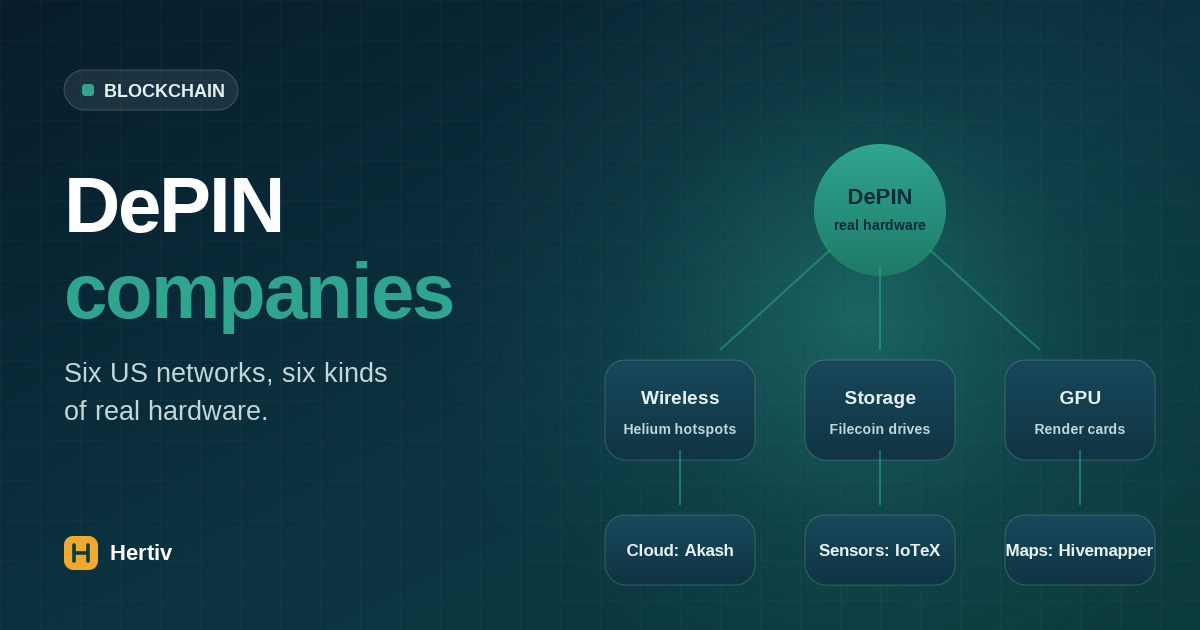
DePIN, short for decentralized physical infrastructure networks, lets people earn tokens for running real hardware such as wireless hotspots, storage drives and graphics cards. The six US companies below build the best-known DePIN networks, and they differ in what hardware they use, who runs it and what customers pay for.
Which DePIN development companies lead in the USA?
Six US companies lead DePIN development, each building a network around a different kind of hardware: wireless, storage, compute, mapping, sensing and machine data. The table below compares them at a glance, and the sections after it explain what each one builds and who it suits.
| Company | Network it builds | What the network provides | Best for |
|---|---|---|---|
| Nova Labs | Helium | Wireless coverage from hotspots | Connectivity and IoT projects |
| Protocol Labs | Filecoin | Decentralized file storage | Archiving and large data sets |
| OTOY | Render Network | GPU rendering and compute | 3D, AI and media workloads |
| Overclock Labs | Akash Network | Cloud compute from spare servers | Developers needing flexible hosting |
| IoTeX | IoTeX | Machine and sensor data | Device and sensor projects |
| Hivemapper | Hivemapper | Street-level map data | Mapping and location products |
All six are companies that build and maintain a network, not agencies that build one-off apps. That distinction matters: when a team hires a DePIN partner, it is usually buying into a live network with existing hardware operators, not starting from zero. The rest of this article compares what each network does and where each one fits.
<h3>1. Nova Labs: best for wireless coverage</h3>
Nova Labs is the US company behind the Helium network, where people run small wireless hotspots that provide coverage for phones and internet-of-things devices. Hotspot operators earn tokens for the coverage they provide, and the network is used for low-power device connections and, in some areas, mobile data.
The model suits teams that need coverage in places where building towers is too expensive, such as farms, warehouses and remote sites. A team can check whether hotspots already cover its area before committing, which makes the cost of a trial low.
Pros: coverage grows where users place hotspots, with no tower build-out; low-power device connectivity suits sensors and trackers.
Cons: coverage depends on where hotspot operators live, so rural gaps remain; token rewards change with network rules and demand.
<h3>2. Protocol Labs: best for decentralized storage</h3>
Protocol Labs is the US research and development company behind Filecoin, a network where storage providers rent out spare drive space and customers pay to store files. It also created IPFS, a protocol for addressing files by content rather than by location, which many decentralized apps use.
The model suits teams that store large data sets, backups or archives and want storage spread across many providers instead of one data centre. Files are split and stored in several places, so no single provider holds the only copy.
Pros: storage is spread across many independent providers; content addressing makes files verifiable by their content.
Cons: retrieval speed varies by provider, so it suits archives better than live, low-latency data; managing deals adds work for small teams.
<h3>3. OTOY: best for GPU rendering</h3>
OTOY is the US graphics company behind the Render Network, where owners of graphics cards rent out spare GPU power for rendering 3D scenes, video and AI workloads. Artists and studios submit jobs to the network instead of buying their own render farm.
The model suits media and AI teams with spiky workloads: a studio may need a hundred GPUs for one week and none the next. Renting from the network fits that pattern better than buying hardware that sits idle most of the time.
Pros: large GPU capacity without buying hardware; pay per job fits spiky rendering and training work.
Cons: job queues and pricing change with demand, so urgent jobs can cost more; large, sensitive data sets need care before upload.
<h3>4. Overclock Labs: best for flexible cloud compute</h3>
Overclock Labs is the US company behind the Akash Network, a marketplace where data centre and server owners rent out spare compute capacity. Developers deploy containers on the network and pay for the resources they use, similar to a cloud provider but across many independent hosts.
The model suits developers who want an alternative to the big cloud providers for workloads that can move between hosts. It is used for web services, background jobs and testing environments where price and flexibility matter more than a single vendor's managed services.
Pros: spare server capacity is often cheaper than on-demand cloud; workloads can move between providers.
Cons: fewer managed services than a large cloud provider; teams must handle more of the operations themselves.
<h3>5. IoTeX: best for machine and sensor data</h3>
IoTeX is a US company building a blockchain platform for machines and sensors, where devices record data that can be verified and, in some products, rewarded. Its network connects devices such as trackers, meters and cameras, and lets developers build apps that use the data those devices produce.
The model suits teams building products around real-world devices: a logistics firm tracking vehicles, an energy firm reading meters, or a city project collecting sensor data. The platform focuses on proving that data came from a real device, which matters when the data feeds a payment or a decision.
Pros: built for device data, with tools to verify where data came from; suits sensor and tracking products.
Cons: device projects need hardware, installation and maintenance, which adds cost beyond the software; the ecosystem is smaller than general-purpose chains.
<h3>6. Hivemapper: best for street-level maps</h3>
Hivemapper is a US company building a decentralized mapping network, where drivers run dashcams that record street-level imagery and earn tokens for fresh map data. The imagery is used to build maps for navigation, logistics and city planning.
The model suits teams that need up-to-date road imagery and map data without running their own fleet of survey vehicles. Because drivers cover roads every day, the map can be refreshed far more often than a survey car could manage.
Pros: map data is refreshed by everyday drivers, so coverage stays current; token rewards grow the fleet without buying vehicles.
Cons: coverage depends on where drivers go, so quiet roads may stay unmapped; imagery quality varies by camera and weather.
How to choose a DePIN development company in 5 steps
You choose a DePIN development company by matching your workload to the hardware the network runs on, then checking coverage, cost and support before you commit. The cheapest network is the wrong choice if it has no hardware where you need it.
- Name the workload. Write down what you need: wireless coverage, storage, GPU compute, cloud hosting, sensor data or map data.
- Check live coverage. Look at the network's map or explorer to see whether hardware already runs where your users are.
- Run a small trial. Move one real workload to the network and measure speed, reliability and cost for a month.
- Compare the full cost. Add token price changes, fees and your own operations time, not just the headline rate.
- Check the team and support. Confirm the company is active, ships updates and answers questions, because you will need help when something breaks.
Most teams also keep a fallback. A DePIN network can be one part of a setup that also uses a traditional provider, so a gap in coverage or a price spike does not stop the product. The fallback is worth planning before the launch, not after the first outage.
Common mistakes
The most common mistake is choosing a DePIN company by its token price instead of its network. A token that rises fast does not mean the network covers your area, runs fast enough or will still be there next year. The network's hardware and usage matter far more than its token chart.
- Ignoring coverage. Picking a network with no hotspots, storage or GPUs where the users actually are.
- Assuming decentralization means no support. Every network still has a team, and that team's responsiveness matters.
- No cost ceiling. Letting usage grow without a budget cap, so a busy month costs far more than planned.
- Skipping the trial. Moving a production workload to a network nobody on the team has used.
- Treating tokens as income. Counting token rewards as profit before checking what they are worth after fees and tax.
The teams that do well start with one workload, measure it for a month and compare the result with their current provider. If the DePIN network is faster or cheaper for that workload, they move more. If not, they have learned something useful for a small cost.
Key takeaways
- DePIN pays people to run real hardware, from hotspots to GPUs
- Each US company builds a network around a different kind of hardware
- Check live coverage before choosing; token price is not a guide
- Run one real workload as a trial before moving production
- Keep a fallback provider for gaps in coverage or price spikes
Frequently asked questions
What is DePIN in simple terms?
DePIN stands for decentralized physical infrastructure networks. People run real hardware, such as wireless hotspots, hard drives or graphics cards, and earn tokens for the service that hardware provides. Customers pay for coverage, storage or compute, and the network coordinates the hardware instead of one company owning it all.
Are DePIN companies the same as crypto exchanges?
No. DePIN companies build networks that provide a physical service, while exchanges are marketplaces for buying and selling tokens. A DePIN network may have a token that trades on exchanges, but the company's product is the network itself, such as wireless coverage or storage.
Do I need to buy tokens to use a DePIN network?
Usually you pay for the service, and the network handles the token side. Some networks let customers pay in ordinary money through a provider, while others need tokens. Check how payment works before you start, because the answer differs by network.
Can a business run its own DePIN hardware?
Yes, many businesses run hotspots, storage nodes or GPU rigs as part of their operations. The hardware earns tokens, but the business must cover power, internet and maintenance, and the token income varies. Run the numbers on a small setup before buying hardware at scale.
Is DePIN legal in the United States?
DePIN networks operate in the United States, but the legal treatment of their tokens varies, and some tokens are restricted in certain states. Businesses should check the legal position of the specific network they use, especially if they plan to earn or hold tokens.
How do I know if a DePIN network is reliable?
Check its public data: how much hardware is online, where it is located, how long it has run, and whether the team ships updates. A network with steady hardware growth and an active team is a better sign than a new network with big promises and little usage.


