Top DeFi Aggregators Worth Knowing
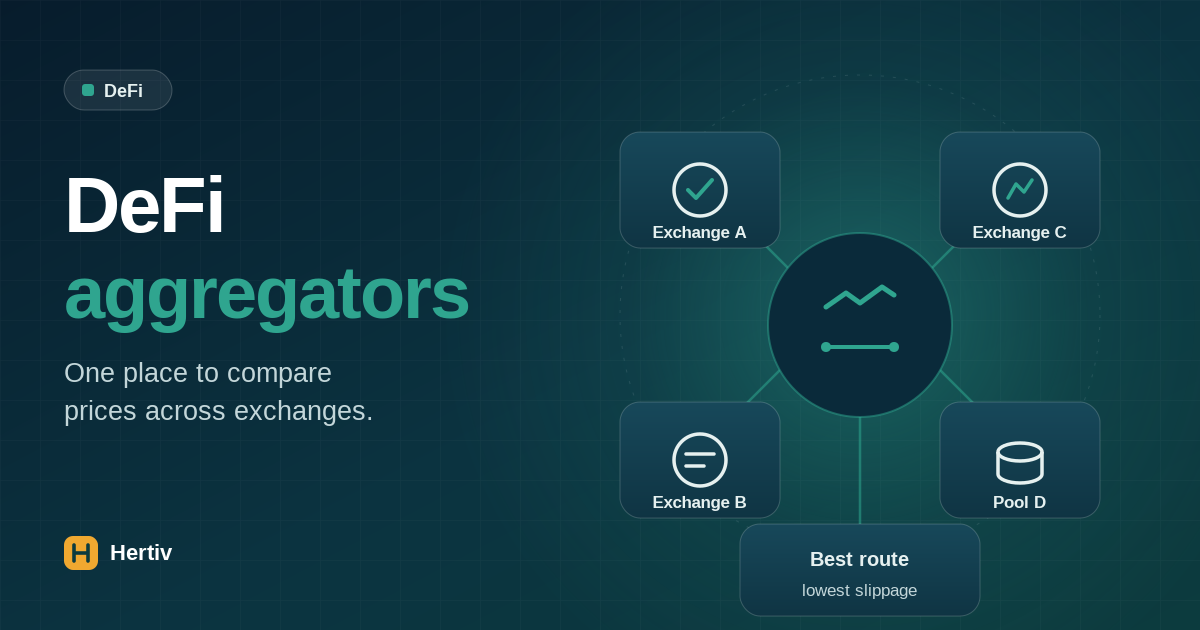
DeFi aggregators compare prices across exchanges to find the best route for a swap. These six are the options, with what each does best and where it falls short.
On this page
Short answer
The best-known DeFi aggregators are 1inch, ParaSwap, Matcha, CowSwap, OpenOcean and Jupiter. They split or route a swap across several decentralised exchanges to find the best price and lowest slippage, and they differ in which chains they cover, how they protect against front-running and whether they charge a fee.
Which DeFi aggregators are worth knowing?
The aggregators worth knowing are the ones with deep liquidity, broad chain coverage and a track record of working through volatile markets. Each one routes a swap across several decentralised exchanges instead of trading on one, which is what makes the price better than a single exchange can offer.
Use this comparison to shortlist. Fees change, so check the aggregator's own site before you trade.
| Aggregator | Main strength | Chains covered | Best for |
|---|---|---|---|
| 1inch | Deep routing across many sources | Ethereum and major L2s | Large swaps on Ethereum |
| ParaSwap | Gas-efficient routes | Ethereum and major L2s | Traders watching gas costs |
| Matcha | Simple interface, no fees on many pairs | Ethereum and major L2s | First-time aggregator users |
| CowSwap | Protection against front-running | Ethereum and Gnosis Chain | Trades that need fair pricing |
| OpenOcean | Wide chain coverage | Many EVM and non-EVM chains | Multi-chain trading |
| Jupiter | Solana routing | Solana | Swaps on Solana |
Start with the chain you trade on, not the brand name. An aggregator is only useful if it covers your chain and the tokens you actually hold.
1inch: best for large swaps on Ethereum
1. 1inch: best for large swaps on Ethereum
1inch is the longest-running aggregator and the one with the widest set of liquidity sources on Ethereum. Its routing engine splits a large swap across several exchanges and pools, which keeps slippage down when a single pool cannot absorb the trade.
It also offers limit orders and a fusion mode that can remove gas costs for the trader in some cases. That makes it a strong choice for larger trades where a small price improvement is worth real money.
Pros:
- Deep routing across many liquidity sources
- Limit orders and gas-free swaps in fusion mode
- Long track record through volatile markets
Cons:
- Interface can feel busy for a first-time user
- Best results need Ethereum or a major L2
ParaSwap: best for traders watching gas costs
2. ParaSwap: best for traders watching gas costs
ParaSwap focuses on finding routes that keep gas costs low as well as prices good. Its routing takes the cost of the transaction itself into account, which matters on Ethereum when gas is expensive.
It is widely integrated into wallets and other apps, so many traders use it without opening its own site. That integration is also its main strength: the route it finds is available wherever the wallet shows it.
Pros:
- Routes account for gas costs, not only price
- Integrated into many wallets and apps
- Works across Ethereum and major L2s
Cons:
- Less useful for chains outside its coverage
- Fewer advanced order types than some rivals
Matcha: best for first-time aggregator users
3. Matcha: best for first-time aggregator users
Matcha, built by 0x, is the simplest aggregator to use. It shows the price, the route and the fee in plain terms, and it charges no fee on many pairs, which keeps the total cost easy to understand.
It routes across the same 0x liquidity network that powers many other apps, so the prices are competitive even though the interface is simple. That combination makes it a good first aggregator for someone who has only used a single exchange before.
Pros:
- Clear interface with plain price and fee display
- No fee on many trading pairs
- Built on the established 0x network
Cons:
- Smaller feature set than 1inch or CowSwap
- Coverage is narrower than OpenOcean
CowSwap: best for trades that need fair pricing
4. CowSwap: best for trades that need fair pricing
CowSwap works differently from the others: it matches orders against each other before touching an exchange, and it settles trades in batches through solvers that compete for the best price. That design protects traders from front-running, where a bot sees a pending trade and trades ahead of it.
The protection matters most for larger trades, where front-running can move the price by a meaningful amount. For small trades the difference is minor, but for a trade of several thousand dollars it can be the deciding factor.
Pros:
- Strong protection against front-running
- Batch auctions can find better prices
- Solvers compete, which keeps pricing honest
Cons:
- Mainly Ethereum and Gnosis Chain
- Settlement can take longer than a direct swap
OpenOcean: best for multi-chain trading
5. OpenOcean: best for multi-chain trading
OpenOcean covers more chains than any other aggregator on this list, including EVM chains and several non-EVM chains. If you hold tokens on several networks, it is the one most likely to route a trade without moving funds between chains first.
Its routing compares both centralised and decentralised sources where available, which can help on pairs with thin liquidity. The breadth of coverage is the reason to pick it; the depth on any single chain is less than a specialist like Jupiter on Solana.
Pros:
- Widest chain coverage of the six
- Compares centralised and decentralised sources
- Useful for traders spread across networks
Cons:
- Less depth on any single chain than a specialist
- Interface is busier than Matcha
Jupiter: best for swaps on Solana
6. Jupiter: best for swaps on Solana
Jupiter is the main aggregator on Solana, and it routes across the network's decentralised exchanges and liquidity pools. Solana trades settle fast and cost little, so Jupiter's job is to find the best route among many small pools rather than to split a huge trade.
It also offers limit orders and dollar-cost averaging, which makes it useful for regular buying as well as one-off swaps. Anyone trading on Solana will meet Jupiter sooner or later, because most Solana wallets and apps route through it.
Pros:
- Deepest routing on Solana
- Limit orders and dollar-cost averaging built in
- Fast, low-cost settlement on Solana
Cons:
- Solana only, so no help for Ethereum trades
- Dependent on Solana network health
How to choose a DeFi aggregator
Choose by chain first, then by trade size, then by protection. An aggregator that does not cover your chain is useless, however good its routing is elsewhere.
- List the chains you trade on. Keep only aggregators that cover them all.
- Check the route, not only the price. Look at slippage, gas and any fee before you confirm.
- Match the tool to the trade size. Large trades need deep routing or front-running protection; small trades need low fees.
- Test with a small amount first. Run one small swap to see the real cost and settlement time.
- Keep a backup. Have a second aggregator ready for the day your first one is slow or down.
Before you build anything around an aggregator, read what a DEX is and how it works.
Also check how liquidity pools work, since the route an aggregator finds depends on both.
Common mistakes when using a DeFi aggregator
Most losses with aggregators come from rushing a trade or trusting the displayed price without checking the details.
- Ignoring slippage settings. A high slippage tolerance lets the trade execute at a worse price than shown.
- Trading a thin pair at size. If the pools are shallow, even the best route will move the price.
- Skipping the fee check. Some aggregators charge a fee on top of the exchange price; check the total before confirming.
- Approving unlimited token spending. Approve only the amount you need for that trade.
- Using a new aggregator with real money first. Test with a small amount and check the settlement.
If you are building a product that needs routing, a partner for DeFi development can integrate aggregation into the product rather than leaving it to the user.
Key takeaways
- Aggregators route one swap across several exchanges to find the best price and lowest slippage
- 1inch suits large Ethereum swaps; ParaSwap suits gas-sensitive trades; Matcha suits first-time users
- CowSwap protects larger trades from front-running through batch auctions
- OpenOcean covers the most chains; Jupiter is the main choice on Solana
- Choose by chain first, then trade size, then protection, and test with a small amount
Frequently asked questions
What is a DeFi aggregator?
A DeFi aggregator is a tool that compares prices across several decentralised exchanges and routes your swap through the best combination. It can split a trade across pools so a large order does not move the price on a single exchange.
Is a DeFi aggregator the same as a DEX?
No. A DEX is a single exchange where you trade against a liquidity pool. An aggregator sits above several DEXs and picks the best route across them. You still trade on a DEX; the aggregator only chooses which ones.
Do DeFi aggregators charge fees?
Some do and some do not, and the fee can depend on the pair and the mode you choose. Always check the total cost shown before confirming a trade, and check the aggregator's own site for current fee terms.
Are DeFi aggregators safe to use?
The established ones have been used for years, but every trade still needs a wallet approval, so approve only the amount you need. Check the token contract, the slippage setting and the route before you confirm, and test with a small amount first.
Which aggregator is best for Solana?
Jupiter is the main aggregator on Solana, with the deepest routing across its exchanges and pools. It also offers limit orders and dollar-cost averaging. It does not cover Ethereum, so you need a different aggregator there.
Can an aggregator guarantee the best price?
No. It can only compare the liquidity sources it connects to at that moment. Prices move between the quote and the settlement, so the final price can differ, especially for large trades or thin pairs.


