Top 10 Cryptocurrencies to Watch: What to Check First
Bitcoin, Ethereum, Solana and seven other well-known coins dominate most watchlists. Compare what each is used for and the checks to run before you follow any list.
On this page
Short answer
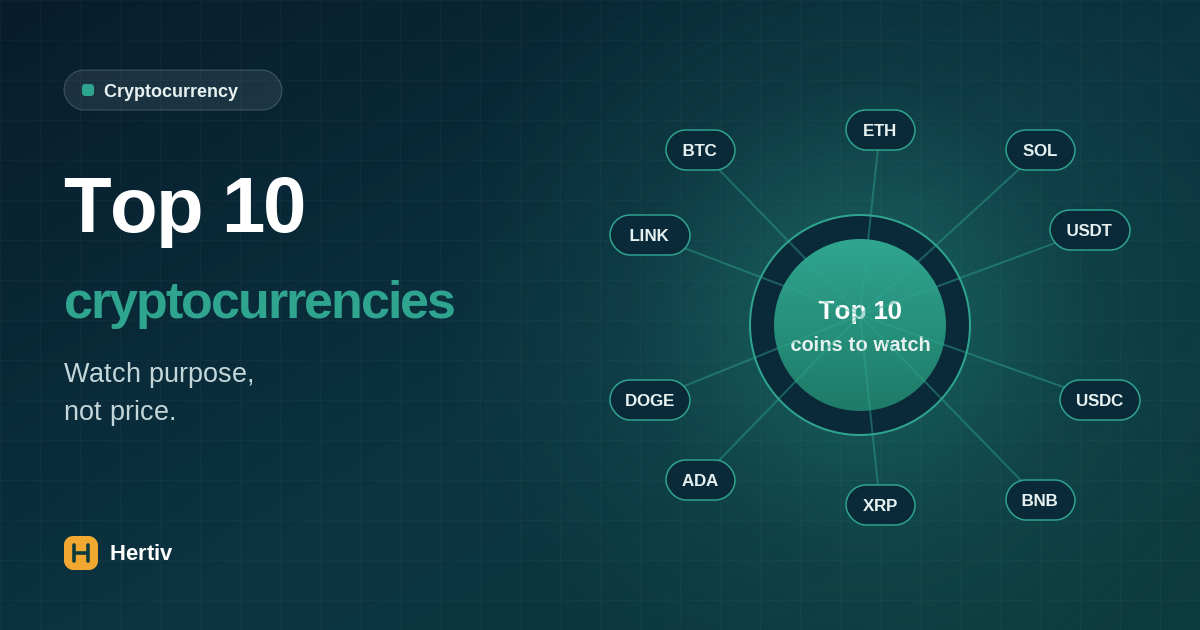
The cryptocurrencies most people watch are Bitcoin, Ethereum, Solana, the major stablecoins and a handful of large networks such as BNB, XRP, Cardano, Dogecoin and Chainlink. Each one serves a different purpose, from payments and smart contracts to price feeds for other apps. Before following any watchlist, check what the network is used for, who runs it and what could go wrong.
Which cryptocurrencies do people watch, and why?
The coins on most watchlists are the large, long-running networks that other products are built on. They are watched because developers use them, exchanges list them and news covers them, not because any list can predict prices.
| Coin | What it is | Main use | Network |
|---|---|---|---|
| Bitcoin (BTC) | First cryptocurrency | Payments and store of value | Bitcoin |
| Ethereum (ETH) | Smart contract platform | Apps, tokens and DeFi | Ethereum |
| Solana (SOL) | Fast smart contract chain | Apps, games and payments | Solana |
| Tether (USDT) | Dollar-pegged stablecoin | Trading and transfers | Several chains |
| USD Coin (USDC) | Dollar-pegged stablecoin | Payments and trading | Several chains |
| BNB (BNB) | Exchange chain token | Fees, apps and trading | BNB Chain |
| XRP (XRP) | Payments network token | Cross-border payments | XRP Ledger |
| Cardano (ADA) | Smart contract platform | Apps and staking | Cardano |
| Dogecoin (DOGE) | Community coin | Tipping and small payments | Dogecoin |
| Chainlink (LINK) | Oracle network token | Price feeds for contracts | Ethereum |
Use this table to compare purpose, not price. Two coins can look similar on a chart and do completely different jobs. The sections below explain each one in plain terms, with what stands out and what to watch. This article is not investment advice: it explains what these networks do so you can follow the news with context. For the basics, start with what a cryptocurrency is.
Bitcoin and Ethereum: the two largest networks
1. Bitcoin (BTC): best for understanding crypto itself
Bitcoin is the first cryptocurrency, launched in 2009, and the network most other coins are measured against. It runs on a public ledger with no central issuer, and its main uses are payments and holding value over time. Its supply is capped by design, which is the feature most often discussed.
Bitcoin is also the slowest of the large networks for everyday payments, and its fees rise when the network is busy. It does not run smart contracts the way Ethereum does, so most apps are built elsewhere. That simplicity is part of its appeal: it does one job and has done it for over a decade.
Pros
- Longest-running network with the most independent operators.
- Simple design that is easy to explain and audit.
Cons
- Slow and costly for small everyday payments when busy.
- No native smart contracts for building apps.
2. Ethereum (ETH): best for apps and tokens
Ethereum is the platform where most tokens, decentralised apps and DeFi products are built. It runs smart contracts, which are programs that execute on the network, and its token ETH pays for the work those programs do. If you use a crypto app, there is a good chance it runs on Ethereum or on a network connected to it.
Ethereum moved to proof of stake, which cut its energy use sharply, and its fees vary with demand. Layer 2 networks now handle much of the everyday traffic, which keeps costs lower for users. The trade-off is complexity: the ecosystem has many layers, and newcomers often struggle to follow it.
Pros
- Largest ecosystem of apps, tokens and developers.
- Well-tested smart contract platform with deep tooling.
Cons
- Fees rise sharply when the network is busy.
- The ecosystem is complex, with many layers to follow.
Solana and the stablecoins: speed and steady value
3. Solana (SOL): best for fast, low-cost apps
Solana is a smart contract chain built for speed, with very low fees and fast confirmation times. It is popular for games, NFT trading and payment apps that need many small transactions. Its token SOL pays for network fees and for staking, where holders help secure the network.
Solana has had network outages in the past, and its speed depends on powerful validator hardware, which raises questions about how easy it is to run a node. For users, the appeal is simple: transactions confirm in seconds and cost very little.
Pros
- Very fast confirmations with low fees.
- Strong following among games and payment apps.
Cons
- Past outages have stopped the network for hours.
- Running a validator needs powerful hardware.
4. Tether (USDT): best for moving value between exchanges
Tether is a stablecoin pegged to the US dollar, which means one USDT is meant to hold the value of one dollar. Traders use it to move value between exchanges without converting to fiat, and it is the most widely used stablecoin by trading volume.
The peg depends on the reserves behind the token, and Tether has faced repeated questions about how those reserves are held and audited. That is the main risk to watch: a stablecoin is only as steady as the assets and audits behind it.
Pros
- Accepted almost everywhere crypto is traded.
- Moves value quickly without fiat conversion.
Cons
- Reserve transparency has been questioned for years.
- Offers no yield or upside beyond holding value.
5. USD Coin (USDC): best for regulated payments
USD Coin is another dollar-pegged stablecoin, issued by a regulated US company with regular reserve reports. It is widely used for payments, trading and as the dollar leg of DeFi products. Businesses often prefer it because the issuer and the reserves are easier to check.
USDC can be frozen by its issuer at specific addresses, which is a feature for compliance and a concern for users who want censorship resistance. Like any stablecoin, its value depends on the reserves behind it and the company that runs it.
Pros
- Regular reserve reports from a regulated issuer.
- Widely supported by exchanges, wallets and apps.
Cons
- The issuer can freeze funds at specific addresses.
- Value depends on the issuer and its reserves.
BNB and XRP: exchange chains and payments
6. BNB (BNB): best for the Binance ecosystem
BNB is the token of BNB Chain and the Binance exchange ecosystem. It pays trading fees at a discount, covers gas fees on BNB Chain and is used across the exchange's products. BNB Chain hosts many apps and tokens, and its low fees attract developers who want a cheap place to build.
BNB's value is closely tied to one company, Binance, which is both a strength and a risk. If the exchange faces regulatory trouble, the token usually follows. That link is the main thing to watch with BNB.
Pros
- Low fees and fast transactions on BNB Chain.
- Deep links to the largest exchange by volume.
Cons
- Value is closely tied to one company.
- Regulatory pressure on that company affects the token.
7. XRP (XRP): best for cross-border payments
XRP is the token of the XRP Ledger, a network built for fast, low-cost cross-border payments. Banks and payment firms use the ledger to move value between currencies, and XRP itself is used as a bridge asset in some of those flows. Transactions settle in seconds.
XRP spent years in a legal dispute with the US regulator over whether it is a security, and that case shaped its price and its coverage for a long time. The network is also more centralised than Bitcoin or Ethereum, which is a common criticism.
Pros
- Very fast, low-cost cross-border settlement.
- Established links to banks and payment firms.
Cons
- Regulatory history has been long and uncertain.
- More centralised than the largest networks.
Cardano and Dogecoin: research-led and community-led
8. Cardano (ADA): best for research-led development
Cardano is a smart contract platform built through peer-reviewed research, with a slow, formal approach to upgrades. Its token ADA pays for fees and staking, and the network supports apps, tokens and governance votes by holders.
Cardano's careful pace is both its selling point and its weakness: the ecosystem of apps is smaller than Ethereum's or Solana's, and developers sometimes find fewer tools. Supporters argue the slow pace buys reliability; critics argue it costs momentum.
Pros
- Formal, research-led approach to upgrades.
- Staking is built in and easy to use.
Cons
- Smaller app ecosystem than the leading chains.
- Development moves slowly by design.
9. Dogecoin (DOGE): best for community and tipping
Dogecoin started as a joke in 2013 and became the best-known community coin, used for tipping creators and small payments. Its brand is a dog meme, its community is large and vocal, and it has survived far longer than most coins launched as jokes.
Dogecoin has no supply cap and no smart contract platform, so its use cases are narrow. Its price moves sharply on social media attention, which makes it one of the most volatile coins on this list.
Pros
- Large, active community and strong brand recognition.
- Simple to use for tipping and small payments.
Cons
- No supply cap and no smart contract platform.
- Price moves sharply on social media attention.
Chainlink: the data feed behind smart contracts
10. Chainlink (LINK): best for data that contracts need
Chainlink is not a payments coin or a smart contract platform. It is an oracle network: it brings outside data, such as prices, weather and sports results, onto blockchains so smart contracts can use it. Most DeFi apps depend on oracles, and Chainlink is the largest oracle provider.
Its token LINK pays node operators who supply the data. The main risk is dependence: if oracle data is wrong or delayed, every contract using it can fail at once. That is why oracle design, and not just the token, matters when you follow Chainlink.
Pros
- Largest oracle network, used by most major DeFi apps.
- Solves a real problem contracts cannot solve alone.
Cons
- Token value depends on demand for oracle services.
- Bad oracle data can break every contract using it.
Oracle networks are easy to overlook because they sit behind the apps, but they carry real risk. How to create a cryptocurrency explains the other side: what it takes to launch a token of your own, and why most new tokens fail.
How to choose what to follow
Choose what to follow by purpose, not by price charts. A watchlist should teach you how the market works, not tell you what to buy. This article is not investment advice, and no list can predict prices.
- Pick one purpose first: payments, apps, stable value or data feeds.
- Read what the network is used for, not just its price history.
- Check who runs it: how many validators, who builds on it, who audits it.
- Look for real use: are apps and users active, or is it only traded?
- Follow the risks, such as regulation, outages and reserve questions.
Revisit your list every few months. Networks change, new chains appear and old ones fade. A list that never changes is a list that is not being read. For building rather than following, a crypto exchange development partner can explain how these networks are actually used in products.
Common mistakes
Most people misuse watchlists by treating them as buy lists. A watchlist is a study tool: it tells you what to learn about, not what to own.
- Treating a watchlist as investment advice or a buy list.
- Following coins only because their price moved this week.
- Ignoring what the network is actually used for.
- Skipping the risks: regulation, outages and reserve questions.
- Putting money into a coin before understanding how it works.
- Assuming a large market cap means a safe or useful network.
Key takeaways
- Watch purpose, not price: each coin does a different job.
- Bitcoin and Ethereum are the largest; the rest serve niches.
- Stablecoins hold value; they do not grow it.
- Oracles like Chainlink sit behind the apps you use.
- No watchlist is investment advice.
Frequently asked questions
What is the safest cryptocurrency to watch?
There is no safe cryptocurrency. Even the largest networks can fall sharply, face regulation or suffer outages. Bitcoin and Ethereum are the most established, but both have lost large parts of their value in past downturns. Treat every coin as a product to understand, not as a safe place to put money.
Why are stablecoins on a watchlist?
Stablecoins are on watchlists because they are the plumbing of crypto trading and payments. Traders move value in USDT and USDC, and many apps use them as their dollar. Watching them means watching reserves, audits and regulation, which is where their real risk sits.
What is the difference between a coin and a token?
A coin runs on its own blockchain, such as Bitcoin on the Bitcoin network or ETH on Ethereum. A token runs on someone else's blockchain, such as a token built on Ethereum. Coins usually pay for network fees; tokens usually represent an asset, a right or a share in an app.
How often should a watchlist change?
Review it every few months, or when a network has a major upgrade, outage or regulatory decision. Networks change fast: new chains appear, old ones fade and use cases shift. A list that never changes is a list that is not being read.
Can I buy these coins from any exchange?
Most large exchanges list the coins in this article, but availability varies by country and by exchange. Some coins are not listed in some regions for regulatory reasons. Check your local rules and the exchange's own list before assuming a coin is available to you.
Where can I learn how these networks work?
Start with the basics of how blockchains and smart contracts work, then read each network's own documentation. Exchange and wallet guides are useful for practical steps, but the network's own docs explain the design. Avoid sources that promise returns or sell tips.


