Chatbot Development Companies Worth Shortlisting
These six chatbot development companies build bots that answer customers, book appointments and take orders. Compare what each does best first.
On this page
Short answer
A chatbot development company builds the software that lets a business talk to its customers automatically, through chat on a website, in a messaging app, or by voice. The right firm depends on the channels you need, the systems the bot must connect to, and whether you want a ready-made platform or a bot built for your own workflows.
Which chatbot development companies should you shortlist?
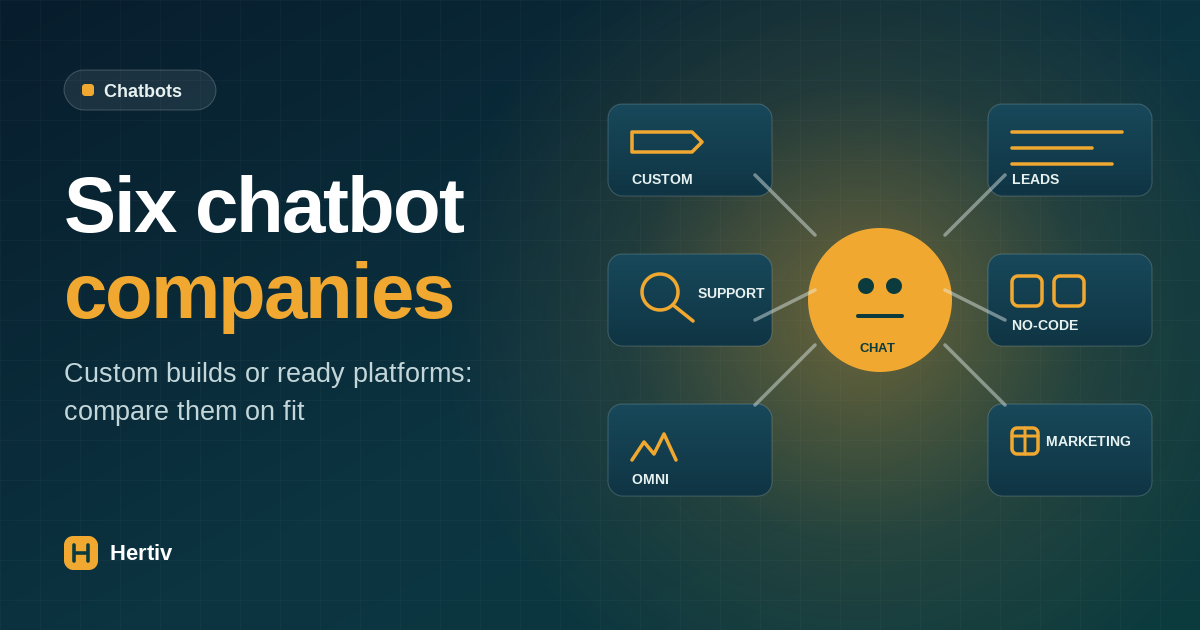
The companies below build chatbots for businesses, from simple website chat to bots that connect to ordering, booking and support systems. The table gives a quick comparison; the sections after it explain what each firm does best.
| Company | Best for | Main channels | Typical work |
|---|---|---|---|
| Master of Code Global | Custom AI chatbots | Web, WhatsApp, voice | Chatbots built around a business |
| Tars | Lead generation chatbots | Web, WhatsApp | Conversation flows that collect leads |
| BotsCrew | Support and sales bots | Web, Messenger, Slack | Bots for support, sales and HR |
| Chatfuel | No-code Messenger bots | Messenger, Instagram | Self-serve bot building |
| Engati | Omnichannel bots | Web, WhatsApp, Messenger | Bots across many channels at once |
| MobileMonkey | Marketing chatbots | Web, Messenger, SMS | Chat marketing and lead capture |
Prices are not listed here because chatbot work is priced per project. Ask each firm for a quote based on your channels, integrations and the number of conversations the bot must handle, or check the vendor site. For the use cases a bot can cover, AI chatbot use cases shows where teams start.
<h3>1. Master of Code Global: best for custom AI chatbots</h3>
Master of Code Global is a development company that builds custom chatbots and AI assistants for businesses, rather than selling a single platform. Its teams design the conversation, connect the bot to the company's systems, and keep improving it after launch.
It suits a business that wants a bot shaped around its own workflows, such as checking an order, booking a service, or answering product questions from a catalogue. The work usually starts with a discovery phase, then a pilot on one channel before the bot is rolled out more widely.
Pros:
- Bot built around the business, not a fixed template
- Experience with voice as well as text chat
- Support after launch, not just delivery
Cons:
- Custom work takes longer than a ready-made platform
- Costs more than self-serve tools for a simple bot
<h3>2. Tars: best for lead generation chatbots</h3>
Tars is a chatbot platform built around lead generation. Its bots replace web forms with a conversation that asks visitors questions one at a time, then passes the answers to the sales team.
It suits marketing teams that want more completed forms from the same traffic. The platform includes templates for common lead flows, such as booking a demo, requesting a quote, or signing up for a trial, and it connects to common CRM tools.
Pros:
- Templates for lead capture that work out of the box
- Easy to test different questions and flows
- Connects to CRM tools for follow-up
Cons:
- Focused on lead capture, not complex support
- Limited scope for deep system integrations
<h3>3. BotsCrew: best for support and sales bots</h3>
BotsCrew is a development company that builds chatbots for customer support, sales and internal teams. Its bots work on websites, Messenger and Slack, and they can hand a conversation to a human when the bot cannot help.
It suits a business that wants a bot to take the repetitive questions off the support team, such as order status, returns, or account help, while keeping a human in the loop for the rest. The company also builds bots for HR tasks such as onboarding and leave requests.
Pros:
- Covers support, sales and internal use in one team
- Human handover built into the bot
- Works across web, Messenger and Slack
Cons:
- Custom projects need a clear brief to start
- Smaller firms may find project pricing high
<h3>4. Chatfuel: best for no-code Messenger bots</h3>
Chatfuel is a no-code platform for building bots on Messenger and Instagram. A team can build a bot by dragging blocks into a flow, without writing code, and publish it the same day.
It suits small businesses and marketing teams that want a bot for answering common questions, running a promotion, or taking simple orders on social channels. The platform includes templates and a visual builder, and it connects to common tools for sending follow-up messages.
Pros:
- No code needed to build and launch a bot
- Fast to start, with ready-made templates
- Built for Messenger and Instagram audiences
Cons:
- Limited to social channels, not web or voice
- Harder to build deep integrations with internal systems
<h3>5. Engati: best for omnichannel bots</h3>
Engati is a chatbot platform that runs the same bot across many channels at once, including web chat, WhatsApp, Messenger and voice. A business writes the conversation once and deploys it everywhere its customers are.
It suits a business whose customers contact it on several channels and expect the same answers on each. The platform includes a visual builder, live chat handover, and analytics that show which questions the bot handles and which it misses.
Pros:
- One bot across web, WhatsApp, Messenger and voice
- Live chat handover for hard questions
- Analytics show where the bot fails
Cons:
- More setup than a single-channel tool
- Advanced features need a paid plan; see vendor site
<h3>6. MobileMonkey: best for marketing chatbots</h3>
MobileMonkey is a chat marketing platform for building bots that capture leads and run campaigns on web chat, Messenger and SMS. Its tools focus on turning a conversation into a contact, a booking or a sale.
It suits marketing teams that run campaigns and want the bot to follow up automatically, such as sending a discount, reminding a visitor about an abandoned cart, or booking a call. The platform includes audience tools and drip campaigns built around chat.
Pros:
- Built for marketing campaigns and lead capture
- Works across web, Messenger and SMS
- Follow-up campaigns built into the platform
Cons:
- Less suited to deep support workflows
- Marketing focus means fewer tools for internal use
How to choose a chatbot development company
Choosing a chatbot development company starts with the job the bot must do, not with the list of features. A bot that answers support questions needs different skills from one that captures leads.
- Write down the top ten questions the bot must answer. If the firm cannot show how it would handle them, it is the wrong fit.
- Pick the channels first. Web, WhatsApp, Messenger and voice need different tools, and a firm strong on one may be weak on another.
- Ask what the bot connects to. Order systems, CRMs and booking tools decide whether the bot can do real work or only answer FAQs.
- Check the handover. A good bot knows when to pass a conversation to a human, and the handover should keep the full chat history.
- Ask for a pilot, not a promise. A small pilot on real questions shows whether the bot works before you commit to a full build. For the pilot stage, how to build an AI proof of concept covers the same discipline.
Ask each shortlisted firm for the same brief and compare their answers side by side. The comparison should cover the channels, the integrations, the handover, the pilot plan and the price, so the choice is made on the same facts.
What are the common mistakes?
The most common mistakes when choosing a chatbot company are buying on features, skipping the handover, and launching without measuring whether the bot helps.
- Choosing on a feature list. A long feature list does not mean the bot answers your customers' questions well. Test it on your own questions.
- No human handover. A bot that cannot pass a hard question to a person will frustrate customers and lose sales.
- Launching on every channel at once. Start on the channel with the most traffic, fix the failures, then add the next channel.
- No success measure. If nobody tracks how many conversations the bot finishes, nobody knows whether it is working.
- Forgetting the data. A bot needs your FAQs, product details and policies to answer well. Gather them before the build starts.
For examples of bots that work in production, AI agents use cases shows the tasks teams automate first.
Key takeaways
- A chatbot company should be judged on the job the bot must do, not on a feature list
- Custom firms suit bots shaped around your workflows; platforms suit fast launches on one channel
- Pick the channels first, then check what the bot connects to and how it hands over to a human
- Ask every shortlisted firm for a pilot on your real customer questions
- Track how many conversations the bot finishes, not how many it starts
Frequently asked questions
What does a chatbot development company do?
It designs, builds and maintains the software that talks to customers automatically, through chat on a website, in a messaging app, or by voice. The work includes the conversation design, the system connections, and the ongoing fixes.
How much does a chatbot cost to build?
It depends on the channels, the integrations and the number of conversations the bot must handle. A no-code platform can cost little to start, while a custom bot built around your systems is a project with a quoted price. Ask each firm for a quote on the same brief, or check the vendor site.
Should I choose a platform or a custom chatbot company?
Choose a platform when the bot answers common questions on one channel and you want it live fast. Choose a custom company when the bot must connect to your systems, follow your rules, or work across several channels.
How long does it take to build a chatbot?
A simple bot on one channel can be live in a few weeks. A custom bot with system integrations and a pilot usually takes longer, because the conversation design and the data work take time.
Do chatbots replace support staff?
No. A chatbot takes the repetitive questions so support staff can handle the hard ones. Every good bot hands a conversation to a person when it cannot help, and the handover keeps the full chat history.
What should I ask a chatbot company before hiring?
Ask which channels it covers, what systems the bot connects to, how the human handover works, what the pilot looks like, and how it measures success. Ask for a demo on your own customer questions, not on a prepared script.


