Top Blockchain Ecosystem Protocols: 6 Worth Comparing
The best blockchain protocol depends on what you are building: payments, apps or cross-chain tools. Compare six leading ecosystems on speed, cost and trade-offs.
On this page
Short answer
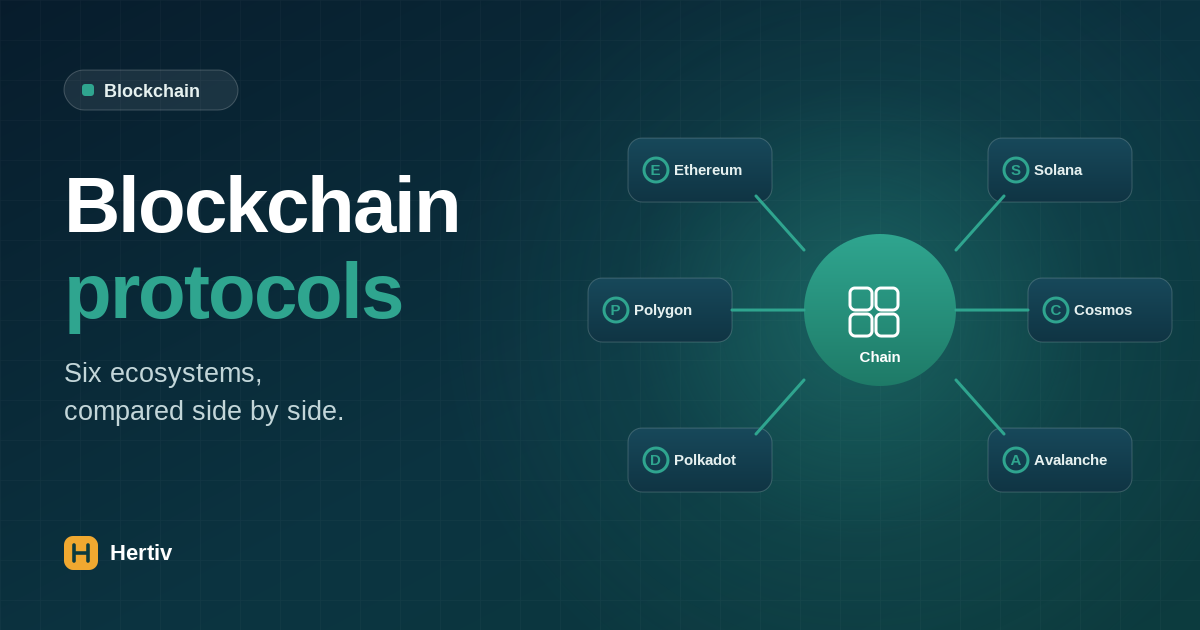
The leading blockchain ecosystem protocols for most teams are Ethereum, Solana, Polygon, Cosmos, Polkadot and Avalanche. Ethereum has the largest developer base and tooling, Solana and Avalanche suit fast, low-cost apps, Polygon adds scale to Ethereum, and Cosmos and Polkadot connect independent chains. The right pick depends on your users, budget and how much decentralisation your product needs.
Which blockchain ecosystem protocols are worth comparing?
A blockchain ecosystem protocol is the base layer that apps, wallets and tools are built on. The six below are the ones most teams actually choose between when they pick a chain for a product. Each has a different mix of speed, cost, developer tools and trade-offs.
| Protocol | Best for | Key strength | Main trade-off |
|---|---|---|---|
| Ethereum | Apps that need the largest ecosystem | Tooling and liquidity | Higher fees on the base layer |
| Solana | Fast, low-cost consumer apps | High throughput | Past network outages |
| Polygon | Ethereum-compatible apps at lower cost | Compatibility with Ethereum tools | Extra layer to understand |
| Cosmos | Custom chains that talk to each other | Chains built for one app | Smaller user base per chain |
| Polkadot | Chains that share security | Shared security model | Longer build and launch path |
| Avalanche | Fast apps and custom subnets | Quick finality, subnets | Smaller ecosystem than Ethereum |
Use this list as a comparison, not a ranking. The right protocol depends on your users, your budget and how much decentralisation your product needs. If you are new to the space, start with our explainer on what a blockchain is before choosing.
Ethereum
1. Ethereum: best for the largest ecosystem
Ethereum is the oldest smart contract platform still in wide use, and it has the largest set of developers, tools, wallets and liquidity. If you build on Ethereum, your users can reach the most exchanges, lending markets and NFT marketplaces without leaving the ecosystem.
That reach is its main advantage. A team can hire from a large pool of Solidity developers, reuse audited libraries, and plug into infrastructure that has been tested by years of real use. For a product that needs trust and composability, Ethereum is still the default choice.
Pros
- Largest developer base and tooling
- Most liquidity and the widest app ecosystem
- Mature security practices and audited libraries
Cons
- Base-layer fees rise when the network is busy
- Slower than newer chains for simple transfers
Solana
2. Solana: best for fast, low-cost consumer apps
Solana is built for speed. It processes many transactions per second with low fees, which suits consumer apps, games and payments where users expect instant confirmation and will not pay much per action.
Its programming model differs from Ethereum, so a team needs developers who know Rust and Solana's account model. The ecosystem is smaller than Ethereum's, but it is strong in consumer apps, and its tooling has improved a lot in the last few years.
Pros
- Very fast confirmations and low fees
- Strong in consumer apps, games and payments
- Growing developer tooling
Cons
- The network has had outages in the past
- Fewer developers than Ethereum, and a different programming model
Polygon
3. Polygon: best for Ethereum-compatible apps at lower cost
Polygon is a scaling network that runs alongside Ethereum and supports the same tools and smart contract language. Teams use it when they want Ethereum compatibility without Ethereum base-layer fees.
Because it speaks the same language as Ethereum, a team can move an existing app to Polygon with little rewriting. That makes it a common choice for apps that started on Ethereum and outgrew its fees, and for consumer products where low cost per transaction matters.
Pros
- Works with existing Ethereum tools and code
- Low fees and fast confirmations
- Wide wallet and exchange support
Cons
- Adds another layer to understand and maintain
- Security depends on its own validator set, not Ethereum alone
Cosmos
4. Cosmos: best for custom chains that talk to each other
Cosmos is a toolkit for building application-specific blockchains that connect through a shared messaging protocol. Instead of sharing one chain with everyone, each app can run its own chain with its own rules and still exchange assets and data with others.
That design suits teams that need control over their chain: custom fees, custom governance, or performance tuned to one app. The trade-off is that each chain starts with a small user base, so the team must bring its own users rather than borrowing an existing crowd.
Pros
- Full control over chain rules and fees
- Chains can exchange assets and data
- Good fit for apps with unusual needs
Cons
- Each chain starts with few users
- Running your own chain adds operational work
Polkadot
5. Polkadot: best for chains that share security
Polkadot lets independent chains, called parachains, share the security of one relay chain. A team builds its own chain but does not need to recruit its own validators, because the relay chain secures them all.
The model suits teams that want a custom chain with strong security from day one. The cost is a longer path to launch: slots are limited, the build process is involved, and the developer community is smaller than Ethereum's.
Pros
- Shared security for new chains
- Chains can pass messages to each other
- Designed for long-term, large-scale apps
Cons
- Longer and more involved launch path
- Smaller developer community than Ethereum
Avalanche
6. Avalanche: best for fast apps and custom subnets
Avalanche is a fast platform that confirms transactions quickly and lets teams launch subnets: their own chains with custom rules, running on shared infrastructure. It suits apps that need speed and a degree of customisation without building a chain from scratch.
Its subnet model is the middle ground between building on a shared chain and running your own. Teams get fast confirmations and low fees, plus the option to tune a subnet for one app, while still tapping into the wider Avalanche ecosystem.
Pros
- Fast confirmations and low fees
- Subnets give custom rules without full chain work
- Good tooling for developers
Cons
- Smaller ecosystem than Ethereum
- Subnets add design choices a team must get right
How to choose
Choosing a protocol is a product decision, not a technology contest. Work through the steps below with your actual users and budget in mind.
- Start with the user. Where are they, what wallets do they already use, and what fees will they accept per action?
- Check the tools your team knows. A chain your developers already understand ships faster than a faster chain they must learn.
- Count the real cost. Add up fees per transaction at your expected volume, not at today's quiet rates.
- Test with a small app first. Build one feature on your shortlist and measure fees, speed and developer friction.
- Plan the exit. Know how hard it is to move if the chain changes direction or your needs change.
Most teams narrow the list to two chains after step two, then let the small test in step four decide. If you need help with that test, a blockchain consulting review can compare the options against your product plan.
Common mistakes
The most common mistakes are choosing a chain for its headlines, ignoring fees at real volume, and locking in before a test. Each one is easy to avoid with a small trial.
- Picking the fastest chain on paper. Speed numbers assume ideal conditions; your users care about fees, wallets and uptime.
- Ignoring fees at volume. A fee that looks small per transaction adds up fast at thousands of transactions a day.
- Choosing for the token, not the product. A chain's token price says nothing about whether your app will work on it.
- Skipping the test build. A week-long prototype on two chains teaches more than a month of reading comparisons.
- Forgetting the users. If your users' wallets do not support the chain, they will not come.
Key takeaways
- Ethereum has the largest ecosystem; Solana and Avalanche are faster and cheaper per transaction
- Polygon adds low-cost scale to Ethereum-compatible apps
- Cosmos and Polkadot suit teams that want their own chain with shared connections
- Choose on users, fees at real volume and team skill, not on headline speed
- Build one feature on two chains before you commit
Frequently asked questions
What is a blockchain ecosystem protocol?
It is the base layer that apps, wallets and tools are built on, such as Ethereum or Solana. The protocol sets the rules for transactions, fees and smart contracts, and the ecosystem is the set of apps, developers and users around it.
Which blockchain protocol is best for beginners?
Ethereum is the easiest starting point for most teams, because it has the most tutorials, tools and developers. Polygon is a good second choice when low fees matter, since it uses the same tools and language as Ethereum.
Is Solana better than Ethereum?
It depends on the product. Solana is faster and cheaper per transaction, which suits consumer apps and games. Ethereum has a larger ecosystem, more liquidity and more mature tooling. Neither is better for every use.
What is the difference between Cosmos and Polkadot?
Both connect independent chains. Cosmos lets each chain run its own security and connect through a shared messaging protocol, while Polkadot chains share the security of one relay chain. Cosmos gives more freedom; Polkadot gives shared security.
Do I need to pick only one protocol?
No. Many products start on one chain and add others later, or use a scaling network alongside a base layer. Starting with one keeps the work simple, and you can add a second chain once the first version works.
How much do transaction fees matter when choosing?
A lot, once volume grows. A fee of a few cents is fine for rare actions but adds up at thousands of transactions a day. Estimate fees at your expected volume, not at today's quiet rates, before you commit.


