Top Blockchain Development Use Cases That Hold Up in Production
The blockchain use cases that survive real production: payments, tokenized assets, supply chain, identity, audits and cross-border settlement, plus what each one costs in effort.
On this page
Short answer
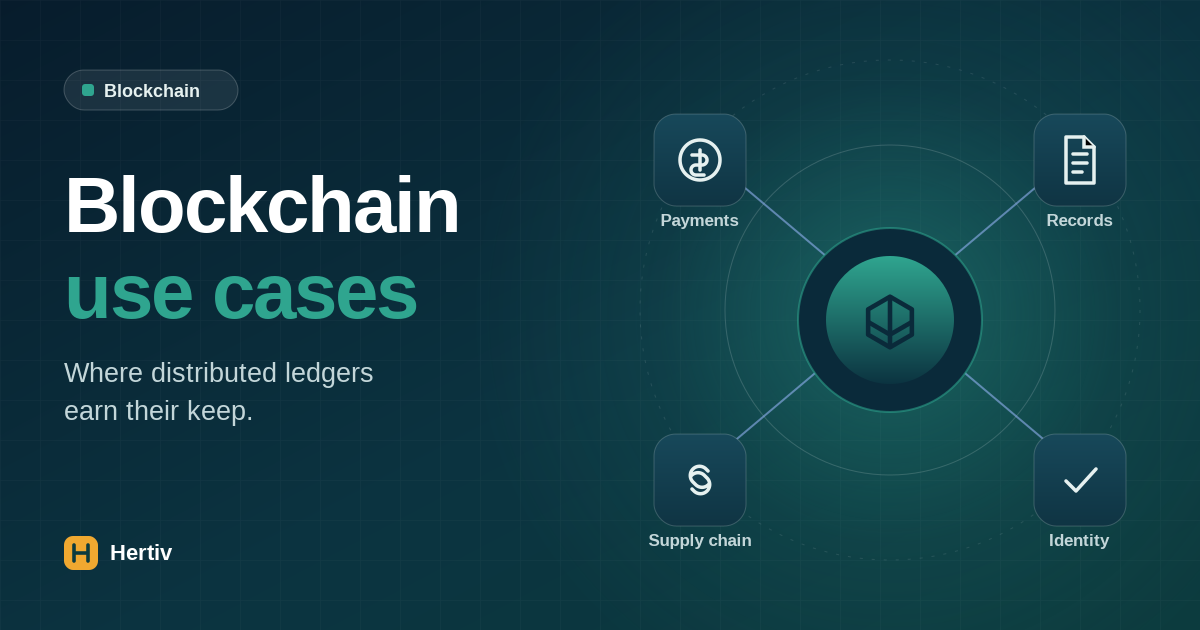
The blockchain use cases that hold up in production are cross-border and stablecoin payments, tokenized real-world assets, supply chain traceability, verifiable identity, tamper-evident audit logs and post-trade settlement. Each wins only where several parties need a shared, trustworthy record without a central owner.
Which blockchain use cases actually work in production?
The use cases that work share one trait: several organizations need to agree on the same record, and no single one of them should be the trusted owner of that record. Where one company already owns the data and everyone trusts it, a normal database is cheaper and faster.
Below is a comparison of the main patterns, what each one does, and the kind of data and effort involved.
| Use case | What it does | Typical data needed | Effort |
|---|---|---|---|
| Cross-border payments | Moves value between parties without correspondent banks | Payment instructions, KYC, FX rules | Medium to high |
| Stablecoin settlement | Settles B2B or merchant payments on-chain | Wallet setup, treasury rules, compliance | Medium |
| Tokenized real-world assets | Represents fund units, gold, property or carbon credits | Legal agreements, custody, valuation feed | High |
| Supply chain traceability | Records custody and origin events across parties | Event data from each participant | Medium |
| Verifiable identity | Lets users prove claims without sharing raw documents | Issuer credentials, revocation lists | Medium |
| Audit and provenance logs | Creates tamper-evident records of changes | System events, hashes, timestamps | Low to medium |
| Post-trade settlement | Reduces reconciliation between institutions | Trade data, counterparty identifiers | High |
Effort depends heavily on legal and integration work rather than the chain itself. A payments pilot can be scoped in weeks. A tokenized asset program usually takes quarters because custody and regulatory questions dominate.
Payments and stablecoin settlement
Payments are the most proven blockchain use case because the pain is real: cross-border transfers move through several intermediaries, take days and cost more than the transaction justifies for smaller amounts. A shared ledger can shorten the chain of intermediaries and make settlement near-instant.
The two common shapes are cross-border remittance and business-to-business settlement in stablecoins. In both, the hard work is compliance and treasury, not the smart contracts. You need to know who your counterparties are, how you convert in and out of local currency, and how you account for balances. A merchant accepting crypto payments needs a conversion and reconciliation layer behind the wallet.
If you are scoping this, our work on crypto payment gateways covers the wallet, conversion and reconciliation side in more detail.
Tokenized real-world assets
Tokenization puts a legal claim on an asset, such as fund units, gold, property or carbon credits, into a transferable digital form. The chain is the easy part. The value comes from faster transfer, smaller minimum ticket sizes and clearer ownership records.
Projects usually fall into three groups: fund and security tokenization, commodity tokenization such as gold, and environmental assets such as carbon credits. Each needs a legal wrapper that states what the token actually represents, a custody arrangement for the underlying asset, and a way to keep the on-chain record in step with reality. Valuation feeds and redemption rules are where most designs get complicated.
Example (hypothetical): a fund with 200 investors wants to allow transfers between them. If each transfer needs a manual register update and a legal review taking two days, the token only helps if the register update becomes automatic and the legal wrapper permits on-chain transfer. Without that, the token adds cost instead of removing it.
Explore real-world asset tokenization if this is the direction you are considering.
Supply chain traceability and provenance
Traceability works when several parties along a supply chain need to record custody, origin or compliance events they do not fully trust each other to hold. A shared ledger gives every participant the same history without appointing one company as the owner of the record.
Food, pharmaceuticals and luxury goods are common starting points because regulators and buyers already ask for provenance evidence. The design question is who is allowed to write events and how you stop bad data entering the chain. A ledger records what it is told; it does not verify that a crate left the warehouse when the form says it did.
Sensors, scanning at handover points and penalties for false entries do more for data quality than the chain itself. Keep the on-chain payload small, usually a hash and a timestamp, and store documents off-chain.
Identity, credentials and audit records
Verifiable identity lets a person or company prove a claim, such as a licence, a qualification or a KYC status, without handing over the underlying documents each time. The issuer signs a credential, the holder stores it, and the verifier checks the signature.
Audit and provenance logs are the lowest-risk entry point. You hash system events and anchor them on-chain so any later change to the records is detectable. This suits regulated teams that need tamper-evident history but do not want to rebuild their systems. It also pairs well with enterprise data work, which is why many teams start there before touching payments.
Both patterns share a practical constraint: revocation. A credential or a record can become invalid, and your design must handle that cleanly without leaking private data. Keep personal data off-chain and store only proofs and references.
Our enterprise blockchain work covers permissioned setups for exactly this kind of internal and partner-facing record keeping.
How to prioritise blockchain use cases
Start from a workflow that already costs money in reconciliation, disputes or delay, then check whether blockchain is the right fix. The steps below keep that decision honest.
- Map the shared record. List every party that reads or writes the data, and confirm that no single one should own it. If one party can own it, use a database.
- Quantify the current pain. Count manual reconciliation hours, dispute resolution time or settlement delay. If you cannot name the cost, the business case is not ready.
- Check the regulatory path. Confirm licensing, reporting and data protection requirements before choosing a chain or a token design.
- Pick the smallest live slice. One workflow, a small set of counterparties, a clear success measure. Audit logs and traceability are easier first projects than tokenized assets.
- Decide build versus buy per layer. Wallets, custody and compliance tooling are usually bought. The integration and the workflow logic are where custom work pays off.
A short blockchain consulting engagement is a cheap way to pressure-test steps one and two before committing budget.
Common mistakes
Most blockchain projects that disappoint were mis-scoped rather than badly coded. The recurring mistakes are predictable and avoidable.
- Using a chain where a database fits. If one company owns the data and everyone trusts it, blockchain adds cost and latency for no gain.
- Ignoring the off-chain world. Tokens and records only matter if they stay in step with physical assets, bank balances and legal registers.
- Skipping compliance until launch. Licensing, KYC and reporting shape the architecture, not the other way round.
- Designing for anonymous users when you need accountability. Permissioned networks with known participants solve many enterprise problems more simply.
- Treating the chain as a data store. Keep personal and bulky data off-chain; store hashes and references.
- No exit plan. Decide up front how records are exported and how the system behaves if a partner leaves.
Key takeaways
- Blockchain pays off when multiple parties need one shared record and no single party should control it
- Payments and tokenized assets are the most mature use cases, with the clearest regulatory paths
- Supply chain and identity projects live or die on who enters the data and how
- Audit logs and provenance are low-risk starting points with visible compliance value
- Most failed projects were database problems dressed up as blockchain problems
- Start with one workflow, one set of counterparties and a measurable manual cost
Frequently asked questions
When is blockchain actually better than a normal database?
When several organizations need to share one record and none of them should be able to change it unilaterally. If a single trusted party owns the data, a standard database is simpler, faster and cheaper.
Which blockchain use case is easiest to start with?
Tamper-evident audit logs and provenance records are usually the lowest-risk start. They add a hash and timestamp layer to existing systems without changing core workflows, and they give compliance teams something concrete.
Do enterprise blockchain projects need a public chain?
Not always. Permissioned networks suit many enterprise cases because participants are known, privacy is easier and throughput is predictable. Public chains make sense when you need open access, broad liquidity or public verifiability.
How long does a blockchain pilot take?
A focused pilot on one workflow typically runs a few weeks to a few months, depending on integrations and compliance review. Tokenized asset programs take longer because legal and custody work dominates the timeline.
What skills does a blockchain development team need?
Smart contract engineering, backend integration, security review and compliance analysis, plus standard product and DevOps skills. The compliance and integration skills usually decide whether the project succeeds.
How do you measure success for a blockchain project?
Pick a measure tied to the original pain: reconciliation hours removed, settlement time reduced, disputes closed faster or audit preparation time cut. If the measure does not move, the project has not delivered.


