Top 8 AI Copilot Development Agencies to Shortlist
An AI copilot development agency builds an assistant that works inside your tools and drafts or completes tasks. These eight firms are a good place to start.
On this page
Short answer
An AI copilot works inside the tools your team uses, such as email, documents or code editors, and drafts or completes work while a person stays in charge. An AI copilot agency builds that assistant for you: it designs the workflows, connects your data, adds safety checks and ships a version. This guide compares eight firms so you can shortlist two or three and ask each for a pilot plan.
Which AI copilot development agencies should you shortlist?
An AI copilot development agency is a firm that designs and builds AI assistants for other companies. The best ones have done this work before: they can show a copilot in production, explain how they connected it to real data, and describe how they handle mistakes and privacy.
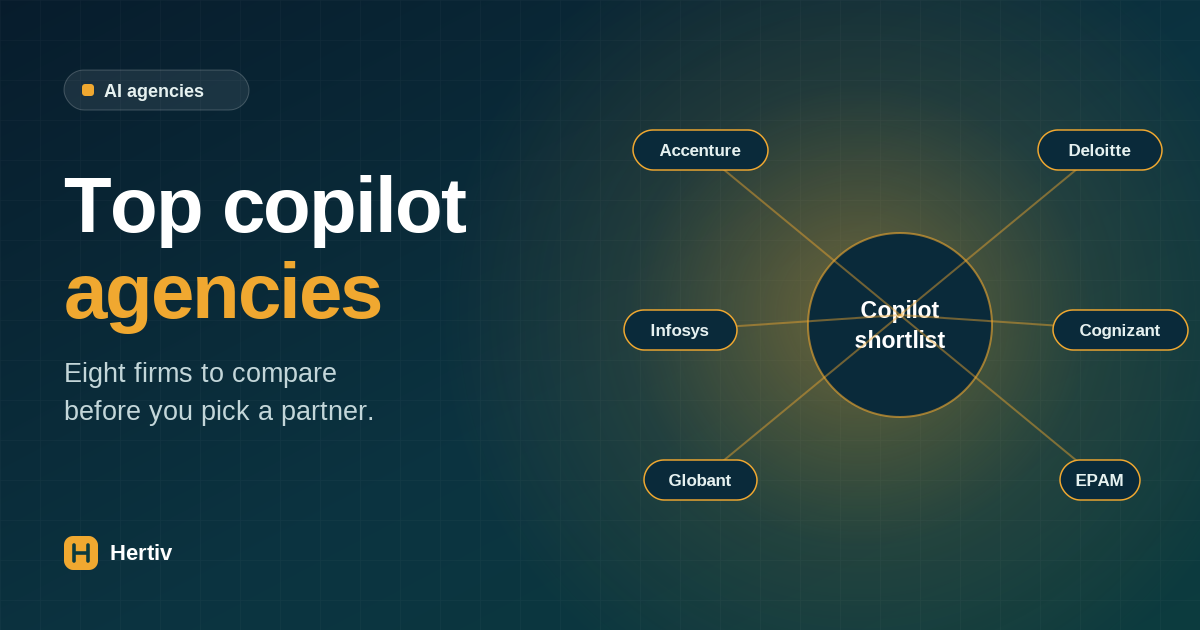
The table below compares eight firms that build copilots and other AI assistants. Use it to pick two or three to talk to, then judge them on a small pilot rather than on a slide deck.
| Agency | Copilot focus | Best for | Typical team |
|---|---|---|---|
| Accenture | Enterprise copilots, support and sales | Large companies | Large delivery team |
| Deloitte | Regulated work, finance and public sector | Governed rollouts | Large delivery team |
| Infosys | Code, support and operations copilots | Scale and cost control | Large offshore team |
| Cognizant | Service desk, HR and field work | Service operations | Large delivery team |
| Globant | Product and engineering copilots | Software teams | Mid-size pods |
| Thoughtworks | Custom copilots and data platforms | Complex builds | Small senior team |
| EPAM Systems | Engineering and document copilots | Product companies | Mid-size pods |
| LeewayHertz | Small business copilots and chatbots | Fast pilots | Small team |
Ask each agency for one copilot they built that is still running today. A live example tells you more than any brochure. If you want background on what copilots do in practice, read six copilot use cases that save teams real time.
Accenture and Deloitte: best for large, governed rollouts
1. Accenture: best for large enterprise copilots
Accenture builds copilots for large companies, often inside support, sales and operations. Its teams usually start with one department, connect the copilot to the company's own documents and systems, and measure how much time the pilot saves before rolling it out further.
The firm's size is its main strength: it can staff a large project and support it in many countries. That also makes it a better fit for companies with a large budget and a long rollout plan than for a small team that wants a quick pilot.
- Pros: deep enterprise experience, global delivery, strong change management.
- Cons: high cost, long sales process, less suited to small pilots.
2. Deloitte: best for regulated and governed work
Deloitte builds copilots for finance, insurance and the public sector, where rules about data and approvals matter as much as the technology. Its teams put controls in place early: who can see which documents, what the copilot may not do, and how every answer is logged.
This makes Deloitte a good choice when your legal or compliance team needs to sign off before launch. The trade-off is pace: a governed build takes longer than a simple pilot, so plan for that in your timeline.
- Pros: strong governance and risk practice, trusted in regulated sectors.
- Cons: slower start, premium pricing.
Infosys and Cognizant: best for scale and service operations
3. Infosys: best for scale and cost control
Infosys builds copilots for code, support and operations at large scale. Its teams often use a shared delivery model, with part of the work done offshore, which keeps the cost down for big projects. It suits companies that need a copilot rolled out to hundreds or thousands of staff.
Ask how the team will be staffed and who owns quality. Large programmes work well when one named team owns the pilot from start to finish, rather than handing it between groups.
- Pros: large talent pool, competitive pricing, mature delivery process.
- Cons: less personal for small projects, slower to change direction.
4. Cognizant: best for service operations
Cognizant builds copilots for service desks, HR teams and field workers. Its work usually starts with the tickets and calls a team already handles, then adds a copilot that drafts replies and pulls the right documents for the agent.
This focus on operations makes it a good fit when your goal is shorter handling times and steadier answers. If your copilot is mainly about writing code or creating content, another firm on this list may fit better.
- Pros: strong in support and operations, practical pilot approach.
- Cons: less known for product or engineering copilots.
Globant and Thoughtworks: best for product and complex builds
5. Globant: best for software and product teams
Globant builds copilots for product and engineering teams, often inside the tools developers and designers use every day. Its teams work in small pods that include design, engineering and data skills, which suits companies that want the copilot to feel like part of their product.
Globant is a good choice when the copilot is customer-facing or tied to your own software. For a purely internal support copilot, a firm focused on operations may be cheaper.
- Pros: strong product and design skills, fast small teams.
- Cons: mid-range pricing, less scale than the largest firms.
6. Thoughtworks: best for complex custom builds
Thoughtworks builds custom copilots where the data, the rules and the workflow are all unusual. Its teams are senior and small, and they usually start by testing the hardest part of the problem before building the rest.
This approach fits companies with a tricky use case, such as a copilot that must read several internal systems and follow strict rules. For a standard support copilot, a simpler and cheaper build may do the same job.
- Pros: senior engineers, strong on data and testing, honest about limits.
- Cons: premium rates, small team size.
EPAM Systems and LeewayHertz: best for product companies and fast pilots
7. EPAM Systems: best for product companies
EPAM Systems builds engineering and document copilots for product companies. Its teams often work alongside the client's own engineers, which helps the copilot fit the way the product is already built and tested.
EPAM suits companies that want a partner to build with them over months, not a one-off project. Ask for a named technical lead and a plan for handing the copilot over to your own team.
- Pros: strong engineering depth, good for long builds.
- Cons: less suited to very small pilots.
8. LeewayHertz: best for fast pilots
LeewayHertz is a smaller firm that builds copilots and chatbots for small and mid-size businesses. Its projects are usually short: a pilot that covers one workflow, such as answering support questions from your help centre, in a few weeks.
A small firm like this is a good choice when you want to test the idea quickly before spending more. The trade-off is scale: if the pilot grows into a company-wide rollout, you may need a larger partner later.
- Pros: fast start, lower cost, direct access to the builders.
- Cons: smaller team, less depth for very large rollouts.
How to choose an AI copilot development agency
Choosing an agency is mostly about fit: the right partner has built something like your copilot before, works at your pace, and will show you real results. Follow these steps before you sign anything.
- Write down the one workflow the copilot must handle, and how you will measure success.
- Shortlist two or three agencies from this list and ask each for a live example.
- Ask who will actually build it, and how much of the work is done in-house.
- Agree on a small paid pilot with a clear scope, timeline and success measure.
- Check how the copilot handles wrong answers, private data and handover to your team.
Judge the pilot on the measure you set in step one, such as time saved per task or tickets resolved without a person. A good agency will agree to that test. For a sense of what a pilot should cover, read how an AI copilot works in sales.
Common mistakes
The most common mistake is choosing on brand name alone. A large firm is not automatically the best fit for a small pilot, and a small firm may not cope with a company-wide rollout. Match the agency to the size of your project.
Another mistake is skipping the pilot. A copilot that looks good in a demo can fail on your real documents, your real questions and your real edge cases. A small paid pilot on live work shows you the truth before you commit.
A third mistake is ignoring the handover. Ask who owns the copilot after launch, who fixes it when it gives a wrong answer, and what it costs to keep it running. If the agency cannot answer those questions, keep looking. Teams that plan a first build often read how to compare AI service providers before they choose.
Key takeaways
- A good copilot agency has a live copilot to show, not just a slide deck.
- Match the agency to your project size: large firms for rollouts, small firms for fast pilots.
- Ask for a small paid pilot on your real work before you sign a big contract.
- Check how the copilot handles wrong answers, private data and handover.
- Judge the pilot on one clear measure, such as time saved per task.
Frequently asked questions
What does an AI copilot development agency do?
It designs and builds an AI assistant that works inside your tools, connects to your documents and systems, adds safety checks and ships a first version your team can use. Most agencies start with one workflow and a small pilot.
How much does it cost to build an AI copilot?
There is no fixed price, because the cost depends on the workflow, the data and the number of users. Ask each agency for a fixed price for a small pilot, then a separate estimate for the full rollout, so you can compare like with like.
How long does a copilot pilot take?
A small pilot usually takes a few weeks: one or two weeks to connect the data and set up the copilot, then two to four weeks of live use with a small team. A company-wide rollout takes months, because it adds governance, training and support.
Should I pick a large agency or a small one?
Pick a large agency for a company-wide rollout with strict rules, and a small agency for a fast pilot or a simple workflow. The right size is the one that has built something like your copilot before and can staff your project properly.
What should I ask an agency before hiring them?
Ask for a live copilot they built, the name of the team that will build yours, how they test for wrong answers, how they protect private data, and what support costs after launch. Clear answers on all five are a good sign.
Do I need my own data ready before I talk to an agency?
No, but it helps to know where your documents and records live and who can approve access to them. The agency will usually help you prepare the data, but a pilot cannot start until it can read the documents the copilot must use.


