Top Agentic AI Development Companies in USA
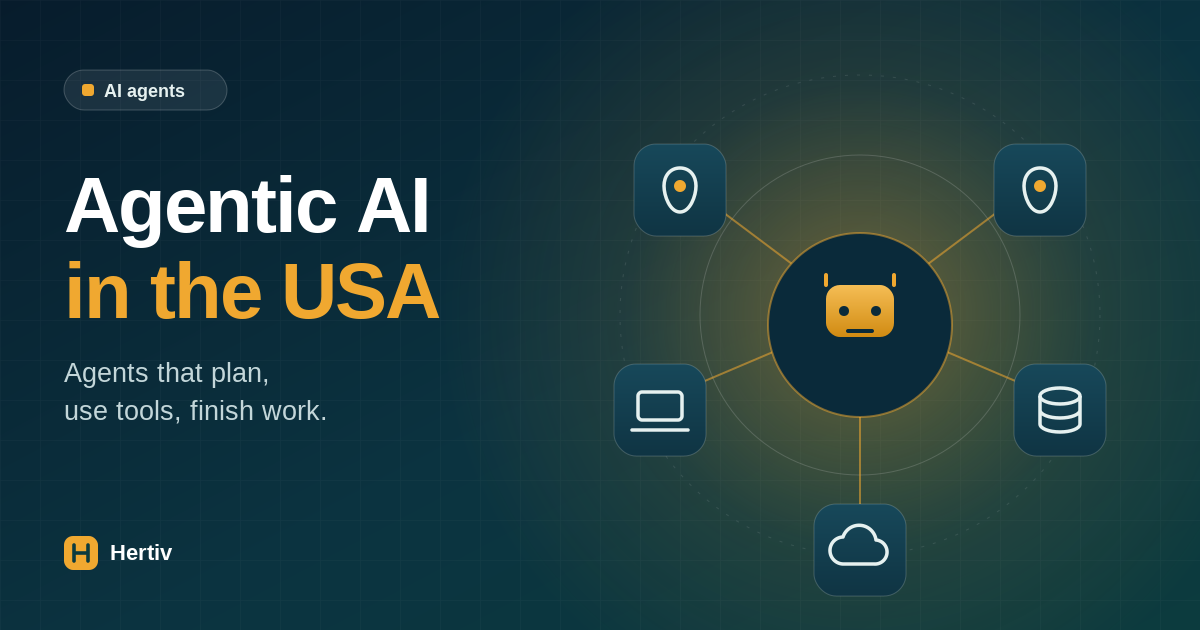
These eight US agentic AI development companies build agents that plan, use tools and finish multi-step work. Compare their focus before you shortlist.
On this page
Short answer
The strongest agentic AI development companies in the USA are LeewayHertz, Markovate, Master of Code, Azumo, InData Labs, Suffescom, SoluLab and Appinventiv. They differ in focus: some build custom agent platforms, others build agents for customer service, operations or specific industries. Pick the firm whose past agent work matches your use case, not the one with the broadest service list.
Which agentic AI development companies in the USA should you compare?
Agentic AI companies build systems that do more than answer questions: their agents plan steps, call tools, check results and finish multi-step work. The US market has both large consultancies and specialist builders, and the right choice depends on whether you need a platform, a single use case, or a full programme.
| Company | Based in | Best for | Typical work |
|---|---|---|---|
| LeewayHertz | San Francisco | Custom agent builds | Agents, copilots, RAG |
| Markovate | San Francisco | Startup agent products | Agents, LLM apps |
| Master of Code | USA | Conversational agents | Chat, voice, support agents |
| Azumo | San Francisco | Nearshore agent teams | Agents, data products |
| InData Labs | USA | Data-heavy agents | Agents, analytics, AI apps |
| Suffescom | USA | Full product builds | Agents, Web3, mobile |
| SoluLab | USA | Enterprise agent systems | Agents, tokenization |
| Appinventiv | USA | Large agent programmes | Agents, apps, platforms |
Use the table to narrow the list to two or three firms, then judge them on past agent work in your sector. For the global agency shortlist, top agentic AI development agencies covers the large firms most buyers compare first.
<h3>1. LeewayHertz: best for custom agent builds from a US team</h3> <h3>2. Markovate: best for startup agent products</h3>
LeewayHertz is a San Francisco-based AI development company that builds custom agentic systems, including agents, copilots and retrieval-based applications, for startups and enterprises. It also appears on the global agency shortlist, which reflects the depth of its agent work.
The trade-off is that a custom build takes longer than buying a ready-made agent. If your use case is standard, a product may be faster. If it is specific to your business, a custom build is the right route.
Pros:
- Strong custom agent experience
- US-based team
- Enterprise and startup work
Cons:
- Custom builds take time
- Higher cost than a product
- Needs a clear use case
Markovate is a San Francisco-based AI company that builds agent products and LLM applications for startups and growing firms. It suits teams that want a working agent product quickly, with a team that has shipped similar products before.
The trade-off is size. Markovate is smaller than the large consultancies, so a very large enterprise programme may need extra staffing. For a focused product, that is rarely a problem.
Pros:
- Fast agent product delivery
- Startup-friendly approach
- LLM application experience
Cons:
- Smaller team than consultancies
- Less suited to huge programmes
- Ask about capacity upfront
<h3>3. Master of Code: best for conversational and support agents</h3> <h3>4. Azumo: best for nearshore agent development teams</h3>
Master of Code is a US-based AI company that builds conversational agents, including chat and voice agents for customer support and sales. Its work is centred on agents that talk to customers, which makes it a good fit when the agent is the front door of your business.
The trade-off is focus. Master of Code suits customer-facing agents, and it is not the first pick for a back-office agent that works with internal systems and data. Match the firm to where your agent will work.
Pros:
- Deep conversational agent experience
- Customer-facing focus
- Voice and chat coverage
Cons:
- Less back-office agent work
- Check industry experience
- Smaller than the big firms
Azumo is a San Francisco-based software company that builds AI agents and data products with nearshore engineering teams. It suits US teams that want a senior engineering partner at a lower cost than a fully onshore team, without the time-zone pain of a far-offshore vendor.
The trade-off is that part of the team works nearshore, so you need clear communication habits. Daily standups and written specs matter more than they would with a fully local team.
Pros:
- Nearshore cost advantage
- Overlapping US time zones
- Senior engineering talent
Cons:
- Part of the team is remote
- Needs disciplined communication
- Check who staffs your project
<h3>5. InData Labs: best for data-heavy agent systems</h3> <h3>6. Suffescom: best for full agent product builds</h3>
InData Labs is a US-based AI company that builds agent systems on top of data platforms, analytics and custom AI applications. It suits teams whose agents need to work with large or messy data, because the data engineering is part of the build, not an afterthought.
The trade-off is that InData Labs is a data and AI firm first, so a purely conversational agent may be better served elsewhere. For agents that reason over your data, its background is the point.
Pros:
- Strong data engineering base
- Agents built on real data
- Analytics and AI in one team
Cons:
- Less conversational focus
- Check agent-specific past work
- Data-first scope needs scoping
Suffescom is a US-based development company that builds full agent products alongside Web3 and mobile work. It suits teams that want one vendor for the whole product, including the app, the agent and the integrations around it.
The trade-off is breadth. Suffescom covers many technologies, so you should check that the team assigned to your agent has agent experience, not just general app experience.
Pros:
- Full product coverage
- Agent plus app in one team
- US presence
Cons:
- Broad focus needs scoping
- Verify the assigned team's agent work
- Less specialised than pure agent firms
<h3>7. SoluLab: best for enterprise agent systems</h3> <h3>8. Appinventiv: best for large agent programmes</h3>
SoluLab is a US-based AI and blockchain development firm that builds enterprise agent systems, including multi-agent workflows and tokenized platforms. It suits enterprises that need agents inside a larger system, with the governance and integration work that comes with it.
The trade-off is that SoluLab's work spans AI and blockchain, so a small, single-agent project may be more than it is built for. For enterprise agent systems, that breadth is an advantage.
Pros:
- Enterprise agent experience
- Multi-agent workflow work
- Strong engineering bench
Cons:
- Less suited to tiny pilots
- Broad practice needs scoping
- Ask for the agent team by name
Appinventiv is a US-based digital product company that builds AI agents and large-scale apps and platforms for enterprises and funded startups. It suits teams that need a big, structured programme with design, engineering and product management in one place.
The trade-off is cost and process. A large programme brings overhead that a small pilot does not need, so Appinventiv fits best when the agent is part of a bigger product or a multi-team effort.
Pros:
- Large delivery capacity
- Design and engineering in one place
- Enterprise programme experience
Cons:
- Higher cost than specialists
- More process than a small build needs
- Less suited to a single pilot
How to choose an agentic AI development company in the USA
Choosing a US agentic AI partner starts with the use case. An agent that talks to customers needs different skills from one that works on internal data.
- Write the use case in one sentence. Say what the agent does, who it serves, and what a good result looks like. If you cannot write that sentence, the project is not ready.
- Shortlist by agent experience. Keep only firms with past agent work in your area, and drop general AI firms with no shipped agents.
- Ask for a live demo. A working agent demo tells you more than a slide deck. Ask the firm to show an agent doing a task like yours.
- Check governance and evaluation. Agents need guardrails, logging and a way to measure quality. Ask how the firm tests an agent before it goes live.
- Agree the support terms. Agents drift as models and data change. Agree who monitors, retrains and fixes the agent after launch.
For the enterprise angle, agentic AI development companies for enterprises compares eight firms that suit large organisations.
For the buyer side, AI agent development companies in the USA covers the wider US agent market.
What are the common mistakes?
The most common mistakes when hiring an agentic AI development company are starting without a clear use case, skipping evaluation, and giving the agent too much freedom too soon.
- No clear use case. An agent built for a vague goal drifts. Define the task, the user and the success measure first.
- Skipping evaluation. Agents need a test set and a quality bar before launch. Without one, you cannot tell whether a change helped or hurt.
- Too much freedom too soon. Let the agent handle low-risk tasks first, with a human reviewing the rest. Expand its scope only after it proves itself.
- Ignoring data access. Agents are only as good as the systems they can reach. Sort out access, permissions and data quality before the build.
- No monitoring plan. Agents change behaviour as models update. A product without monitoring will surprise you in production.
Key takeaways
- LeewayHertz and Markovate suit custom builds and startup products; Master of Code suits customer-facing agents.
- Only one of the eight overlaps with the global agency shortlist, so this is a genuinely different USA list.
- Define the use case in one sentence before you talk to any firm.
- Ask for a live demo and a plan for testing the agent before launch.
- Give the agent low-risk tasks first and expand its scope only after it proves itself.
Frequently asked questions
What is the difference between an agentic AI company and an AI agent company?
The terms overlap, but agentic AI usually means agents that plan multi-step work, use tools and check their own results. An AI agent company may build simpler agents that follow a fixed flow. Ask any firm to show you an agent doing a task like yours, and the difference becomes clear.
How much does it cost to build an agentic AI system in the USA?
It depends on the number of agents, the systems they connect to, and the governance work around them. Firms usually quote per project after a scoping phase, so ask for a fixed-scope quote and see the vendor site for current rates.
Should I hire a US company or an offshore team?
A US team helps with time zones, contracts and face-to-face working, and it matters more for regulated industries. Offshore or nearshore teams can cost less, but they need stronger specs and communication habits. Many teams mix the two.
How do you test an agentic AI system before launch?
With a test set of realistic tasks, a quality bar for each one, and a human review of the failures. The firm should also log every agent action so you can trace what happened when something goes wrong.
Can an agent work with our existing software?
Usually yes, if the software has an API or a way to export data. The integration work is often the largest part of the build, so ask the firm to map your systems during scoping, before any agent is built.
What happens after the agent goes live?
It needs monitoring, because model updates and data changes can shift its behaviour. Agree who watches the logs, who retrains or retunes it, and how often it is reviewed, before you sign the contract.