Tokenizing Unconventional Assets: How It Works
Tokenizing unconventional assets turns art, wine, music rights and collectibles into tradable tokens. Here is how it works, what changes, and the risks to check.
On this page
Short answer
Tokenizing unconventional assets means creating digital tokens on a blockchain that represent ownership of, or rights to, assets such as art, wine, music royalties or collectibles. The process needs a valuation, a legal wrapper that ties the token to the asset, secure custody, and a way for holders to trade or redeem. It works best for assets with clear ownership records and a real buyer pool.
What does tokenizing an unconventional asset mean?
Tokenizing an unconventional asset means recording ownership of, or rights to, an unusual asset as digital tokens on a blockchain. The token does not replace the asset; it is a record that points to a legal claim on it, held by a company or trust that owns the asset.
Unconventional here means assets that are not real estate, company shares or standard funds: paintings, rare wine, whiskey casks, music royalties, sports memorabilia, classic cars, intellectual property and carbon credits. They are hard to divide, slow to sell and often locked to a small group of buyers.
Tokenization aims to fix three problems: splitting an expensive asset into smaller pieces, letting those pieces change hands without a long sale process, and keeping a clear record of who owns what. Whether it works depends less on the technology than on valuation, custody and the law. For the general process, see RWA tokenization and how tokens are issued.
What counts as an unconventional asset?
An unconventional asset is one that does not trade on a public market, has no standard price feed, and needs expert judgement to value. That covers a wide range, and not all of it tokenizes well.
| Asset type | Why it is hard to trade | Tokenization fit |
|---|---|---|
| Fine art | High price, slow sale, fakes | Good, if provenance is documented |
| Wine and whiskey | Storage and ageing matter | Good, with bonded storage |
| Music royalties | Income is uneven and complex | Good, with clear royalty data |
| Collectibles | Value depends on condition | Mixed, needs grading |
| Intellectual property | Rights are hard to split | Mixed, needs legal drafting |
| Carbon credits | Registries vary by scheme | Good, if registry-linked |
The pattern is simple: assets with a paper trail, a professional valuation and a storage or registry system tokenize far better than assets whose value rests on one person's opinion.
How does tokenization work, step by step?
Tokenization follows the same broad steps whatever the asset is, but the details change with the asset type. The work is mostly legal and operational, not technical.
- Pick the asset and check the title. Confirm who owns it, that it is free of liens, and that ownership can be proven with documents.
- Get an independent valuation. Use a recognised valuer for art, wine or collectibles, or audited royalty statements for music rights.
- Set up the legal wrapper. A company or trust holds the asset and issues tokens that represent shares or rights in it.
- Arrange custody. Store the physical asset in a bonded warehouse, vault or insured facility, with audits.
- Issue the tokens. Create the tokens on a chosen blockchain, with rules on who can hold and transfer them.
- Open a trading path. List the tokens on a licensed platform or run private transfers between verified holders.
- Handle income and redemption. Pay out royalties or sale proceeds, and define how a holder redeems or exits.
Steps one to four decide whether the project is credible. A token with a weak valuation or unclear custody is a liability, not an investment product.
What is different from tokenizing real estate or funds?
Real estate and funds have standard paperwork, regular valuations and established legal forms. Unconventional assets have none of that, so each deal needs more custom work.
Valuation is the biggest difference. A building has comparable sales and rental income; a painting has auction results and an expert's view. Two valuers can disagree by a wide margin, and that gap shows up in the token price.
Custody is the second difference. A fund holds securities in a custodian bank; a wine collection needs a bonded warehouse with temperature control and insurance. If storage fails, the asset itself is damaged, and the tokens lose their backing.
Income is the third difference. Real estate pays rent on a schedule. Music royalties arrive unevenly and depend on streaming and licensing deals. Token holders need clear reporting on what income exists and when it is paid. These differences are why real estate tokenization is the usual starting point, and unusual assets come later.
Example: tokenizing a wine collection
Example (hypothetical): a collector owns 1,200 bottles of fine wine, valued by an independent valuer at $600,000. The collection is stored in a bonded warehouse with insurance and yearly audits.
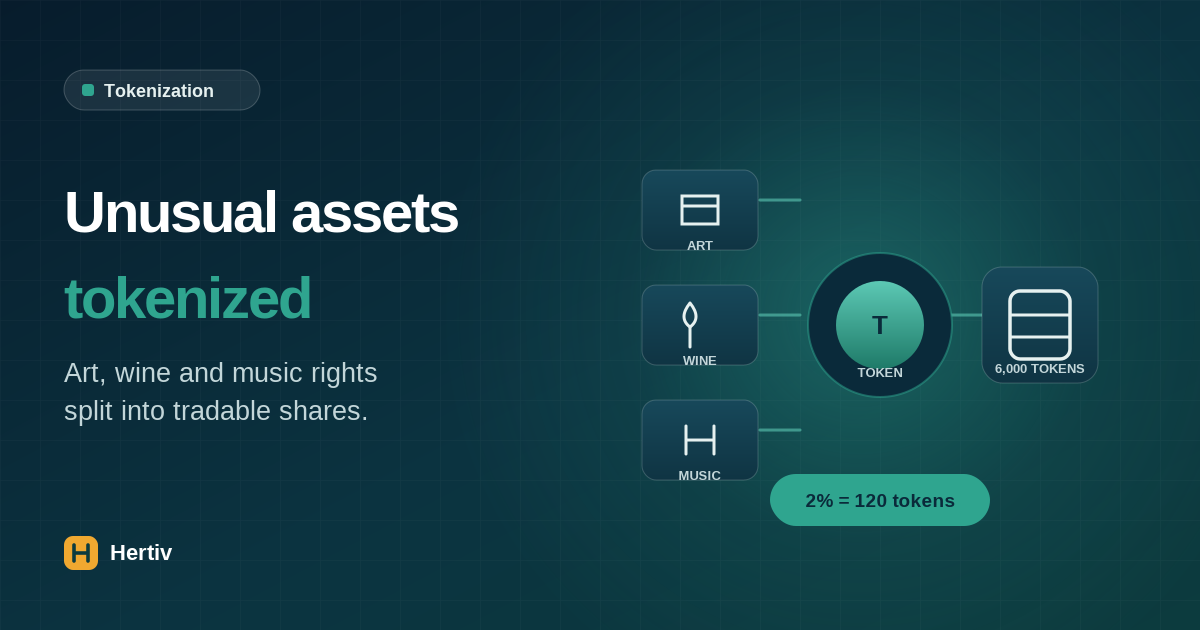
The collector sets up a company that owns the wine and issues 6,000 tokens at $100 each, so the full collection is represented by $600,000 of tokens. A buyer who holds 120 tokens owns 2% of the collection, since 120 divided by 6,000 is 0.02.
Storage and insurance cost $300 a month, or $3,600 a year, which is 0.6% of the collection value. If the collection is sold after three years for $660,000, a holder of 120 tokens receives 2% of the sale, which is $13,200, minus their share of costs. The arithmetic is simple; the hard parts are the valuation, the warehouse and the legal wrapper that ties each token to the wine.
What are the legal and custody risks?
The legal risks are larger than the technical ones. Tokens that represent a share of an asset can count as securities in many places, which brings licensing, disclosure and investor rules. The rules differ by country, and a token sold in one place may be restricted in another.
Custody risk is just as real. If the warehouse closes, the art is damaged or the vault operator fails, token holders have a claim on a company, not direct access to the asset. Insurance and independent audits reduce this risk but do not remove it.
Other risks include thin trading, so holders may not find a buyer quickly, and valuation disputes, where a new valuation changes the token price. Teams should publish the legal opinion, the valuation report and the audit schedule before selling any tokens.
Common mistakes when tokenizing unusual assets
The most common mistakes are skipping the valuation, choosing an asset with no buyer pool, and treating the token as the asset itself. Each one turns a useful tool into a costly experiment.
- No independent valuation. A price set by the seller, without a valuer, is a guess.
- Weak custody. Uninsured storage or no audit schedule leaves holders exposed.
- No legal wrapper. Tokens without a company or trust behind them may give holders no enforceable claim.
- No buyer pool. Tokenizing an asset nobody wants to buy does not create demand.
- Ignoring securities rules. Selling tokens without checking local rules can stop a project after launch.
- Hidden costs. Storage, insurance, audits and platform fees eat into returns if they are not disclosed.
Start with one asset, one valuation and one custody arrangement, and prove the full loop before tokenizing a second asset. If you are planning a tokenization project, blockchain development support should start with the legal and custody design, not the token contract.
Key takeaways
- Tokenization splits ownership; it does not create demand on its own
- Valuation, custody and the legal wrapper matter more than the token
- Assets with a paper trail and a buyer pool tokenize best
- Publish the valuation, custody and audit details before selling
- Check securities rules in every market where tokens are offered
Frequently asked questions
What assets can be tokenized?
Almost any asset with clear ownership and a valuation can be tokenized, from art and wine to music royalties and carbon credits. The practical test is whether the asset has a paper trail, professional storage or a registry, and a real group of buyers. Assets without those three rarely work.
Is tokenizing an unconventional asset legal?
It depends on the country and on how the token is structured. Tokens that represent a share of an asset can count as securities, which brings licensing and disclosure rules. Get a written legal opinion for each market where tokens are offered before launch.
How do token holders get paid?
Income such as royalties or sale proceeds is collected by the company or trust that holds the asset, then paid out to token holders in proportion to their tokens. The payout schedule and the fees should be written into the token terms before any sale.
Can I redeem a token for the physical asset?
Usually not for a single token. Most projects let holders sell their tokens on a platform, and only a holder of all tokens, or a large share, can claim the asset itself. Check the redemption terms in the token documentation before buying.
What does tokenization cost?
Costs include valuation, legal setup, custody, insurance, audits and the platform. They vary widely by asset type and country. Ask the issuer for a full fee schedule, including yearly storage and audit costs, before judging whether the returns make sense.
How is this different from an NFT of the same asset?
An NFT usually represents a unique item or a right to a digital file. Tokenizing an asset normally means issuing many fungible tokens that each represent a share of the same asset. The two approaches can be combined, but they solve different problems.


