What Is Tokenized Luxury, and How Does It Work?
Tokenized luxury turns a watch, painting or handbag into digital tokens, so ownership can be split and traded. Here is how it works, what it changes, and the risks.
On this page
Short answer
Tokenized luxury is a luxury item such as a watch, a piece of art or a handbag that is represented by digital tokens on a blockchain. The item is checked and stored safely, and the tokens act as proof of who owns which share, so ownership can be split and traded without moving the item.
What is tokenized luxury?
Tokenized luxury is a luxury item, such as a watch, a piece of art or a handbag, that is represented by a digital token on a blockchain, so ownership of the item can be split, recorded and traded without moving the item itself. The physical item is stored and checked, and the token acts as the proof of who owns which share of it.
One token can stand for the whole item, or many tokens can each stand for a share. A watch worth a large sum can be split into hundreds of tokens, so a buyer can own a small part of it instead of needing to buy the whole watch. The blockchain record shows who holds each token, and a sale is a transfer of tokens rather than a new paper contract.
| Feature | Traditional luxury ownership | Tokenized luxury ownership |
|---|---|---|
| Proof of ownership | Paper receipt and certificate | Token record on a blockchain |
| Buying a share | Usually not possible | Possible through small token amounts |
| Resale | Dealer, auction or private sale | Token transfer on a marketplace |
| Authenticity check | Expert inspection each sale | Checked once, then linked to the token |
Tokenized luxury sits inside the wider field of real-world asset tokenization, where a physical asset is linked to a digital token. Real-world asset tokenization covers how the legal wrapper and the token fit together for larger assets such as property.
What luxury goods get tokenized?
Luxury goods get tokenized when they are high in value, hard to split, and easy to check for authenticity. Watches, fine art, rare handbags, vintage wine, classic cars and high jewellery are the most common examples, because each one holds value over time and has a clear record of provenance.
Watches are a natural fit: a single watch can be worth more than a car, it is small enough to store safely, and its serial number and service history can be checked once and linked to the token.
Fine art works in a similar way, with the painting stored in a secure facility while tokens trade. Wine is tokenized by the case, with the bottles held in a bonded warehouse until a token holder asks for delivery.
Not every luxury item suits tokenization. Items that wear out quickly, lose value fast, or are hard to check are poor candidates. A fashion item with a short season, or a piece with unclear provenance, gains little from a token, because the token cannot fix a weak underlying asset.
How does tokenizing a luxury item work?
Tokenizing a luxury item works by checking the item, storing it safely, writing the legal terms, and then issuing tokens that represent ownership of it. Each step needs a named party to take responsibility, because the token is only as sound as the item and the paperwork behind it.
- Check and value the item. An expert confirms it is genuine, records its condition and serial number, and agrees a value.
- Store it safely. The item goes into insured storage, such as a vault or bonded warehouse, and stays there while tokens trade.
- Set the legal terms. A legal wrapper states what a token holder owns, what happens if the item is sold, and how holders vote on a sale.
- Issue the tokens. A smart contract mints the tokens and records each holder on the blockchain.
- Open trading. Holders can sell their tokens on a marketplace, and the token record updates with each trade.
- Handle exit and delivery. If the item is sold, the proceeds are shared by token; if a holder owns all tokens, they can claim the item.
The storage and legal steps matter most. A token that points to an item nobody can find, or to terms nobody can enforce, is worth little, so buyers should read the wrapper before they buy. Gold tokenization follows the same pattern for a metal that is easier to value and store.
What changes for buyers and sellers?
Tokenizing luxury changes who can buy, how fast a sale happens, and how the item's history is shown. For buyers, the main change is access: a person can buy a small share of a watch or painting that would otherwise be out of reach, and can sell that share without finding a buyer for the whole item.
For sellers, the main change is a wider pool of buyers. Instead of waiting for one person with the full amount, a seller can offer shares to many buyers at once. The sale also leaves a clear record: each token transfer is written to the blockchain, so the item's ownership history is easier to follow than a chain of paper receipts.
For brands and dealers, tokenization adds a way to prove authenticity and to stay in touch with owners. A brand can link a token to a service record, so the watch's service history travels with the token. A dealer can run a marketplace where shares trade, earning fees on trades rather than only on full sales.
What are the risks and limits?
The risks of tokenized luxury are that the item's value can fall, the token can be hard to sell, and the legal terms can be weaker than a buyer expects. A token does not make a risky asset safe, and it does not guarantee a buyer when you want to sell.
- Value can fall. Luxury prices move with fashion and the wider market, so a share can lose value just like the item itself.
- Thin trading. A token for one specific watch may have few buyers, so selling quickly can mean accepting a lower price.
- Storage and insurance costs. Vault storage, insurance and checks are charged every year, and they eat into returns.
- Legal gaps. What a token holder can actually enforce depends on the wrapper and the country it sits in, so the terms need reading.
- Fraud at the start. If the first authenticity check is wrong, every token built on it is wrong too.
Regulation is the other limit. Some countries treat these tokens as securities, which brings rules on who can buy and what must be disclosed. A buyer should check the rules in their own country before buying, and a seller should take legal advice before issuing tokens. Real-world asset tokenization use cases shows how the same pattern is used for property and funds.
Example (hypothetical): tokenizing a watch
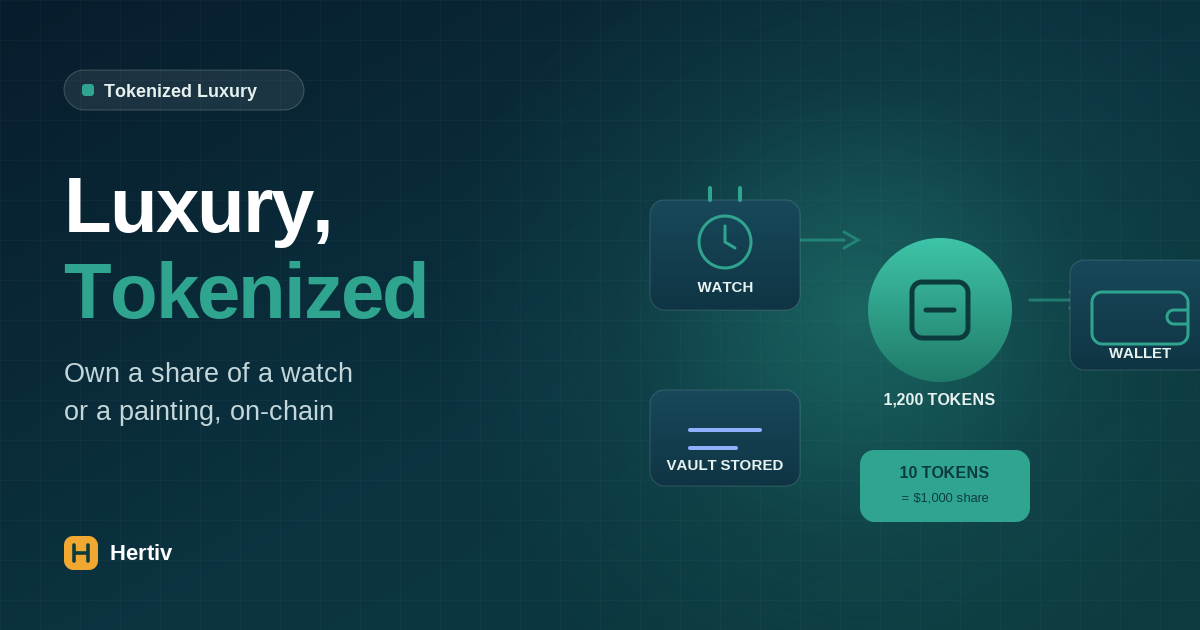
Example (hypothetical): a dealer tokenizes a rare watch valued at $120,000. An expert checks the watch, records its serial number, and the watch goes into insured vault storage. The dealer issues 1,200 tokens at $100 each, so 1,200 times $100 equals $120,000, the full value of the watch.
A buyer who wants a $1,000 share buys 10 tokens. If the watch later sells for $132,000, the gain is $12,000, and each token is worth $110, so the buyer's 10 tokens are worth $1,100. If the marketplace charges a 2% fee on a sale, selling those 10 tokens for $1,100 costs $22 in fees, leaving $1,078.
The yearly costs also matter. If storage and insurance cost $1,200 a year, that is $1 per token per year, so a holder of 10 tokens pays $10 a year in running costs. Small holders should check that these yearly costs do not eat up the gain they hope for.
What are the common mistakes?
The most common mistakes are buying the token without reading the legal terms, trusting the token instead of the authenticity check, and assuming a share will be easy to sell. Each of these comes from treating the token as the asset, when the asset is the item in the vault.
- Skipping the legal wrapper. If the terms do not say what a holder owns, a dispute is hard to resolve.
- Trusting a token with no check. A token linked to a fake or unchecked item is worthless, whatever the listing says.
- Assuming quick resale. A token for one specific item may sit unsold for months if few buyers want it.
- Forgetting yearly costs. Storage, insurance and platform fees run every year and reduce the return.
- Buying more than you can afford to lose. Luxury values fall as well as rise, and a share is still a risky asset.
Tokenized luxury works best for buyers who understand the item, the storage and the terms, and who treat the token as a share of a real thing rather than a shortcut to quick gains. Real estate tokenization uses the same idea for property, where the sums and the paperwork are larger.
Key takeaways
- A token stands for a share of a real luxury item held in safe storage
- Watches, art, handbags, wine and cars are the most common tokenized items
- Tokenizing needs an authenticity check, storage, legal terms and a smart contract
- Buyers gain access to high-value items in small shares; sellers reach more buyers
- The main risks are falling value, thin trading, yearly costs and weak legal terms
Frequently asked questions
Is tokenized luxury the same as an NFT?
Not quite. An NFT usually stands for one unique digital item or one whole physical item, while tokenized luxury often splits one item into many identical tokens, each standing for a share. Both use a blockchain record, but the legal terms and the way shares trade are different.
Who holds the physical item?
A named custodian, such as a vault operator or bonded warehouse, holds the item and insures it. The token holder does not hold the item itself. The legal wrapper should name the custodian and state what happens if the custodian fails.
Can I take the item home if I buy all the tokens?
Usually yes, if the terms allow it. When one person holds every token, they can normally redeem the item from storage. The wrapper should state the redemption process and any fees, so check it before buying.
Do tokenized luxury items pay an income?
Usually no. A watch or painting does not pay rent or interest, so the return comes only from a rise in value when it is sold. Running costs such as storage and insurance are charged each year, which reduces the return.
Is tokenized luxury regulated?
It depends on the country and the token's terms. Some countries treat these tokens as securities, which brings rules on who can buy and what must be disclosed. Buyers should check the rules where they live, and sellers should take legal advice.
How do I check a tokenized luxury item is genuine?
Ask who did the authenticity check, what they checked, and whether the report is linked to the token. A sound listing names the expert, the serial number and the storage location. If those details are missing, treat the listing with care.


