Tokenization in Travel: Where It Actually Pays Off
Tokenization in travel turns tickets, loyalty points and settlement into programmable digital assets. Here is where it pays off, where it does not, and how to scope a pilot.
On this page
Short answer
Tokenization in travel means representing tickets, loyalty points, deposits or settlement balances as programmable digital tokens on a shared ledger. It pays off where ownership must move between parties, be verified instantly, or settle across airlines, agencies and hotels without manual reconciliation.
What is tokenization in travel?
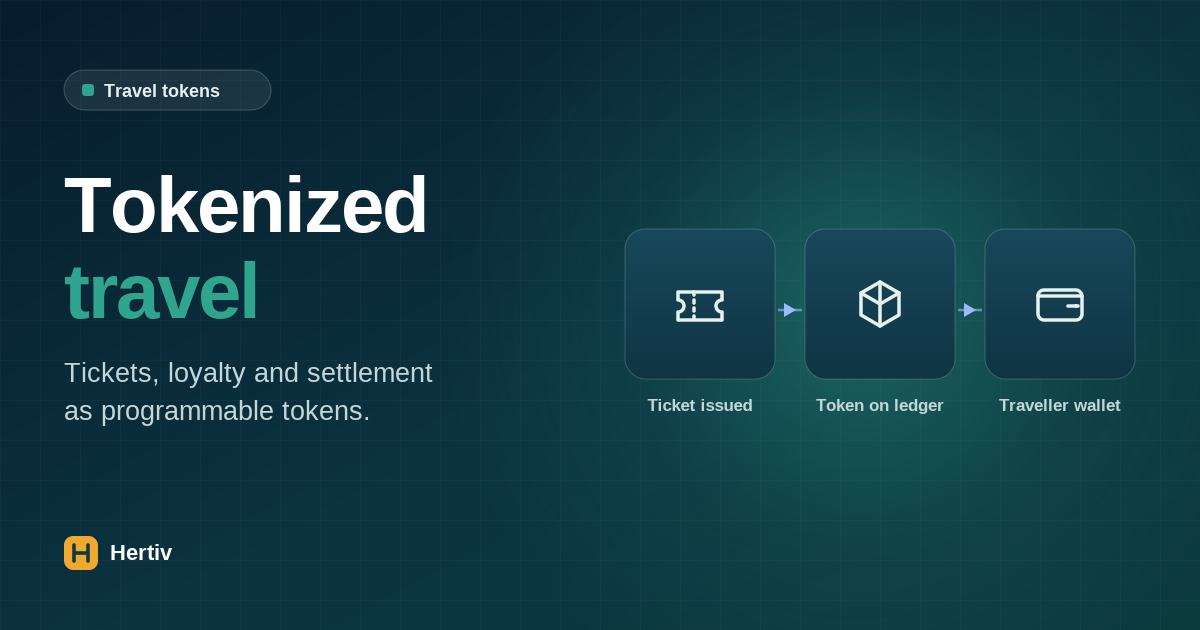
Tokenization in travel is the process of representing a travel asset, such as a seat, a hotel night, a loyalty point balance or a settlement obligation, as a digital token whose ownership and rules are enforced by software. The token is not the flight; it is a record of rights and conditions attached to that flight.
The asset can stay where it is. A ticket still lives in the airline's passenger service system, and a hotel booking still lives in the property management system. The token acts as a shared, verifiable reference that partners can act on without calling each other. That distinction matters because replacing core travel systems is rarely justified, while wrapping them is often practical.
There are four common token types in this sector:
- Inventory tokens: a specific seat, room night or experience with rules for transfer and expiry.
- Loyalty tokens: a points balance that can move between programs or be redeemed with partners.
- Settlement tokens: a stablecoin or deposit-backed balance used to settle interline or agency payables.
- Deposit and bond tokens: refundable amounts held for car rentals, group bookings or supplier guarantees.
Each has a different regulatory profile, which is why a single "travel token" project usually stalls. For a broader view of the asset class, see the RWA tokenization guide.
Where does tokenization actually pay off in travel?
It pays off where a travel asset changes hands between organisations and the current process depends on manual reconciliation, phone calls or batch files. That is the test to apply before scoping anything.
The table below compares the main use cases on the dimensions that decide a pilot.
| Use case | What it does | Typical data needed | Effort |
|---|---|---|---|
| Loyalty point exchange | Moves points between partner programs with rules on chain | Member IDs, balances, expiry rules | Medium |
| Interline settlement | Settles payables between carriers or agencies faster | Invoices, fare rules, FX rates | High |
| Refundable deposits | Holds and releases car or group deposits automatically | Booking IDs, deposit terms, release conditions | Medium |
| Ticket resale with rules | Enforces transfer and resale limits set by the issuer | Ticket records, fare conditions, identity checks | High |
| Group booking escrow | Holds funds until supplier confirmation milestones | Contracts, milestone dates, payout rules | Medium |
| Loyalty tier credentials | Verifies status across partners without exposing data | Membership level, partner scopes | Low |
| Supplier financing | Uses confirmed bookings as collateral for short-term finance | Booking confirmations, credit terms | High |
The low-effort items are usually credentials and loyalty mechanics, because they do not touch money movement or fare rules. Settlement and resale are where the value is largest and where legal review takes longest.
Why is loyalty the usual starting point?
Loyalty points are already digital, already transferable in principle and already suffer from fraud and reconciliation problems, which makes them the lowest-friction entry point. No airline needs to change how it flies to test a points exchange.
A typical design lets a member move a balance into a partner program under rules the issuer sets: caps per period, expiry, and a record of every movement. The ledger does not need to hold personal data. It can hold a pseudonymous member reference, with the identity mapping kept in the loyalty platform.
Example (hypothetical): A hotel group runs a pilot with two airline partners. Members can convert up to 20,000 points per year into partner points at a fixed ratio. Before the pilot, the finance team reconciles conversions monthly using spreadsheets, taking roughly three working days per cycle. After the pilot, conversions settle automatically and the team reviews exceptions only. The saving is not the three days; it is the disputes that no longer happen because both sides see the same record.
How does tokenized settlement work between travel partners?
Tokenized settlement replaces batch invoicing between partners with a shared ledger of obligations that can be netted and paid in near real time. The ledger records what each party owes, and a payment rail, often a stablecoin or a tokenized deposit, clears the net amount.
In practice the flow is:
- A booking is confirmed and an obligation is written to the ledger with its terms.
- Both parties see the same obligation, which removes the dispute about whether an invoice was issued.
- Obligations are netted across a period, so only the difference moves.
- The net amount settles through an approved rail, with a record of the payment linked to the obligations it closes.
- Exceptions, such as cancellations or no-shows, adjust the ledger before netting.
The hard parts are not technical. They are agreeing which obligations are in scope, how disputes are resolved, and which regulated entity holds the funds. Settlement between airlines and agencies touches payments licensing in most markets. If your case sits inside finance operations, the finance and banking work covers the compliance angle in more depth.
What does the architecture look like?
A workable travel tokenization architecture wraps existing systems rather than replacing them, with a ledger layer, an integration layer and a policy layer. Most teams build it in that order.
- Core systems unchanged: the PSS, GDS, property management and loyalty platforms stay as the source of truth for inventory and customer records.
- Integration layer: APIs and event streams that emit bookings, cancellations and balance changes to the ledger.
- Ledger layer: a permissioned chain or a public chain with restricted access, holding tokens, ownership records and settlement obligations.
- Policy layer: smart contracts or off-chain rule engines that encode transfer limits, expiry and eligibility.
- Identity layer: wallet or key management tied to partner organisations, not to end travellers, for most B2B cases.
The choice between a permissioned and a public chain is usually driven by who the counterparties are. A closed partner group fits a permissioned network; a market with many small agencies may benefit from public infrastructure and audited contracts. For the build side, see enterprise blockchain development.
What are the regulatory and operational risks?
The main risks are payments licensing, consumer protection, data protection and the operational risk of a ledger that no single party controls. None of these are unusual, but they arrive early in travel because so many tokens touch money or consumer rights.
Key points to check:
- Stored value and e-money: prepaid balances and some points schemes can fall under e-money rules in the EU and UK. Get a legal opinion on your specific design.
- Consumer rights: a tokenized ticket must still honour the passenger rights attached to the original ticket. Transferability cannot override fare conditions set by regulators.
- Data minimisation: keep personal data off the ledger. Store references, not identities.
- Key management: lost keys to a partner wallet are an operational incident. Plan recovery and rotation before launch.
- Dispute resolution: agree in writing who arbitrates when two ledgers disagree, before any money moves.
How do you scope a tokenization pilot in travel?
Scope the pilot around one measurable reconciliation problem, one partner group and a fixed time box. Broad "travel ecosystem" programs fail because they try to solve settlement, loyalty and inventory at once.
A practical sequence:
- Pick the pain: choose the process with the most manual hours or the most disputes. Loyalty conversion and deposit release are common starting points.
- Pick the partners: two or three organisations that already trust each other. A pilot with strangers tests legal drafting, not the technology.
- Define the measure: reconciliation time per cycle, dispute count, or release time for deposits. Record the baseline before building.
- Keep the ledger narrow: only the fields needed for the chosen use case. Resist the urge to model the whole booking.
- Run a parallel period: operate the ledger alongside the existing process until both agree for a full cycle.
- Decide the scale path: route expansion, partner expansion or new token types, with a cost review before each.
Budget expectations vary widely with scope and legal review. A focused pilot is usually a fraction of a full platform; see the tokenization platform cost breakdown for the cost drivers.
How to choose between building and buying
Build when your differentiation is in the partner rules, the integration with your own systems, or the data you hold. Buy when you need a standard settlement or loyalty ledger and the rules are conventional.
Use these questions in order:
- Is the rule set yours? If transfer limits, expiry and settlement terms are unique to your business, a configurable vendor product may fight you.
- How many core systems must connect? Every PSS, GDS or PMS integration adds cost. Count them before comparing options.
- Who holds the keys? If partners must hold their own keys, check that the vendor supports organisational wallets, not just consumer ones.
- What is the exit path? Ask how data and token records leave the platform. A ledger you cannot export is a lock-in.
- What does compliance require? If the design touches e-money, confirm the vendor has been through that review with another customer.
If your team lacks blockchain experience, a short consulting engagement to pressure-test the design is usually cheaper than a rebuild. Start with blockchain consulting and treat the output as a decision document, not a sales pitch.
Key takeaways
- The strongest near-term cases are settlement, loyalty point exchange and refundable deposits, not consumer-facing NFT collectibles.
- Most travel inventory already lives in GDS and PSS systems; tokenization works as a wrapper around them, not a replacement.
- Loyalty points are the easiest starting point because they are already digital, already transferable and already have a fraud problem.
- Regulatory treatment differs by market: prepaid or stored-value tokens can trigger e-money rules in the EU and UK.
- A credible pilot covers one route or one partner group, with measurable reconciliation time before and after.
Frequently asked questions
Is tokenization in travel the same as NFT tickets?
No. NFT tickets are one narrow form, usually consumer-facing collectibles or transferable passes. Most travel tokenization work is B2B: settlement, loyalty balances, deposits and supplier guarantees. Those cases rarely need public marketplaces or consumer wallets.
Do airlines need to replace their passenger service systems?
Generally no. The token layer references records held in the existing system and adds shared visibility for partners. Replacing a passenger service system is a multi-year programme with its own risk, and tokenization does not require it.
Which travel use case should a mid-market company start with?
Start with loyalty point exchange or refundable deposit handling. Both are digital already, involve a small number of partners, and have measurable reconciliation effort. Settlement and ticket resale carry heavier legal and fare-rule constraints.
Does tokenization reduce fraud in travel bookings?
It can reduce specific fraud types, such as duplicated loyalty redemptions and forged deposit releases, because every movement is recorded once on a shared ledger. It does not remove card fraud or account takeover, which need separate controls.
What does a travel tokenization pilot cost?
Cost varies with the number of partner integrations, legal review and whether a payment rail is involved. A narrow loyalty or deposit pilot is typically a fraction of a full settlement platform. Get a scoped estimate rather than a range before committing.
Can loyalty points be tokenized without touching customer wallets?
Yes. The common design keeps the member's identity in the loyalty platform and puts only pseudonymous references and balances on the ledger. Members interact through the existing app, and no wallet is required on their side.


