Tokenization in Retail: What It Does and Where It Pays Off
Tokenization in retail turns products, loyalty points and payments into tokens. Here is how retailers use it, what it costs, and where it pays off.
On this page
Short answer
Tokenization in retail means representing a retail asset or right as a digital token on a blockchain: a loyalty point, a product passport, a gift card, a share of a limited item, or a payment. The token can be transferred, verified and redeemed without a central database, which lets retailers run loyalty, authenticity and resale programmes that work across channels.
What is tokenization in retail?
Tokenization in retail is the practice of issuing a digital token that stands for something a retailer owns or owes: a loyalty point, a warranty, a limited-edition item, a gift card balance, or a proof of authenticity. The token lives on a blockchain, so anyone can check that it exists and who holds it.
The point is not the token itself. It is what the token lets a retailer do: move value between channels, prove that a product is genuine, let customers resell items safely, and reward repeat buyers without running a closed points database that only works in one store.
Most retail token projects start small. A loyalty token or a product passport for one product line is a sensible pilot. A full token economy across every store and channel is a multi-year programme, and teams that start there usually stall.
Retailers do not need to build a chain. Tokens usually run on an existing public or permissioned chain, and the retailer builds the app, the wallet experience and the business rules around them.
Where retailers use tokens today
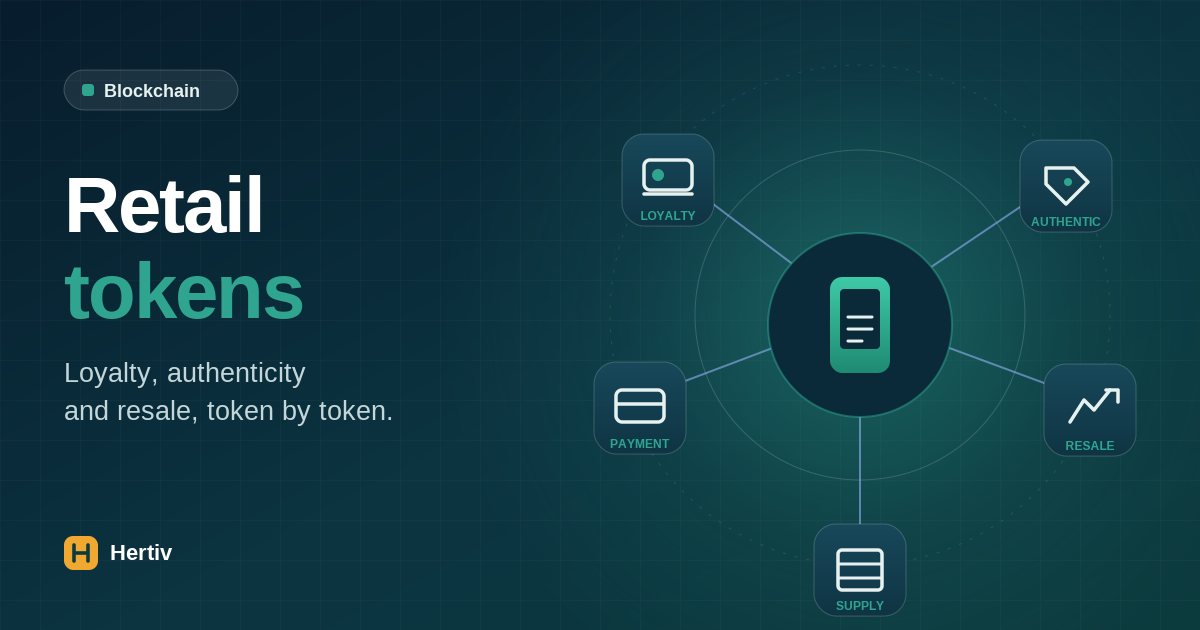
Retailers use tokens in four places today: loyalty, product authenticity, payments and resale. Loyalty is the most common starting point, because the value is easy to measure and the risk is low.
| Use case | What the token does | Who benefits |
|---|---|---|
| Loyalty points | Points become transferable tokens | Customers and the retailer |
| Product passport | Proves origin and authenticity | Buyers of luxury and electronics |
| Gift cards | Balance held as a token, not a code | Customers and gift buyers |
| Resale | Limited items resold with royalties | Brands and collectors |
| Payments | Stablecoin checkout at the till | Customers and the retailer |
| Supply chain | Each batch tracked as a token | Operations and compliance teams |
Stablecoin payments are the use case most likely to reach the till first, because the customer experience is close to card payment. The retail angle is covered in stablecoin use cases in retail, which looks at checkout, refunds and settlement.
Loyalty points as tokens
Loyalty points as tokens change one thing that matters: points stop being trapped in one retailer's database. A customer can earn points in a store, spend them online, gift them to a friend, or trade them with another customer, all without the retailer running a clearing house.
That freedom is also the risk. If points can be traded, they acquire a market price, and the retailer has to decide whether that is fine. Most pilots therefore limit transfer: points move between a customer's own devices and to friends, but not onto an open exchange.
The design questions are practical. How many points does a dollar of spend earn? Do points expire? Can they be used with a discount, or only for full-price items? Can they be redeemed for cash? Each answer changes the liability on the balance sheet, so the finance team needs a seat at the design table.
Start with one store format and one earning rule. A pilot with 5,000 customers and a simple rule teaches more than a launch across every channel with five earning rules and three redemption tiers.
Supply chain and product authenticity
Tokenization helps with authenticity because a product passport token can carry the item's history: where it was made, which batch it belongs to, and who has owned it. A buyer scans a code and checks the token, instead of trusting a printed label.
This matters most for luxury goods, electronics and pharmaceuticals, where fakes are common and expensive. A token does not stop a fake from being made, but it makes the fake easy to spot: the token either exists on the chain with a matching history, or it does not.
The hard part is the link between the physical item and the token. A code on a box can be copied, so high-value items need tamper-evident tags or chips. The token is only as trustworthy as the step that binds it to the item at the factory.
Supply chain tokens also help with recalls. If a batch is faulty, the retailer can find every holder of that batch's tokens in minutes instead of searching paper records. That speed is often the real return on the project.
What it costs and what to watch
Tokenization in retail costs less than most teams expect to build and more than most expect to run. The token contract and the app are a few months of work for a small team. The running costs are the wallet experience, customer support, and the gas or transaction fees of issuing tokens.
Three things deserve attention before the budget is signed. First, the wallet: customers will not install a separate crypto wallet for loyalty points, so the wallet must live inside the retailer's own app. Second, the legal view: in some countries a transferable loyalty token can count as a financial instrument. Third, the exit: if the pilot fails, customers must still be able to redeem their points.
Costs vary with the chain and the volume. Issuing tokens on a low-fee chain for a pilot of a few thousand customers is cheap. Issuing one token per item across millions of units needs a cost model per token, not per project.
For the platform side, the cost pattern is close to a tokenization platform build, and how much does tokenization cost breaks down the build, audit and running lines that apply here too.
Example (hypothetical): a loyalty token pilot
Example (hypothetical): a fashion retailer with 20 stores pilots a loyalty token for 5,000 customers. One dollar of spend earns one token, and 100 tokens buy a $10 reward. Tokens can be gifted to friends but not sold on an exchange.
In the first three months, customers earn 400,000 tokens on $400,000 of spend. Of those, 120,000 tokens are redeemed for $12,000 of rewards, 30,000 are gifted, and 250,000 sit unredeemed. The retailer sets aside $25,000 to cover the unredeemed balance, at 10 cents per token.
The pilot costs $45,000 to build and $2,000 a month to run. Repeat purchase rate among pilot members rises from 22% to 27%, and average basket size rises from $48 to $52. On $400,000 of spend, the extra 5% repeat rate is worth roughly $20,000 in the quarter, which covers the running cost but not the build.
The decision is therefore about the second year, not the first quarter. If the pilot scales to 50,000 members at the same rates, the repeat-purchase gain covers the build cost within a year. If it stays at 5,000, the retailer keeps the programme small or stops it.
What are the common mistakes?
The most common mistakes in retail tokenization are asking customers to manage a crypto wallet, launching with a token that has no clear use, and treating the token as the product instead of the programme behind it.
- A separate wallet. If earning a point needs a crypto wallet install, most customers will not bother.
- A token with no use. A token that can only be collected, not spent, is a gimmick, not a loyalty programme.
- Unlimited transfer. Letting points trade freely creates a market price the finance team did not plan for.
- No redemption promise. If the pilot ends and points vanish, trust is gone with them.
- Weak physical binding. A product passport token means little if the tag on the item can be copied.
- Starting too big. A token economy across every channel is a programme, not a pilot.
Key takeaways
- Tokenization in retail covers loyalty, authenticity, payments and resale, not just one of them
- Loyalty tokens work when points can be spent easily inside the retailer's own app
- A product passport is only as trustworthy as the tag that binds it to the item
- Build costs are modest; running costs and customer support are the long bill
- Pilot with one earning rule and a clear redemption promise before scaling
Frequently asked questions
What is tokenization in retail?
It is the practice of representing a retail asset or right, such as a loyalty point, a product passport or a gift card balance, as a digital token on a blockchain. The token can be transferred, verified and redeemed without a central database, which lets programmes work across stores and channels.
How do loyalty tokens differ from normal points?
Normal points live in one retailer's database and can only be spent there. Tokens can move between a customer's devices, be gifted to friends, and in some designs be traded. Most pilots limit transfer so the points do not acquire an unplanned market price.
Does tokenization stop counterfeit products?
It makes fakes easier to spot rather than impossible to make. A genuine item carries a token with a matching history on the chain, while a fake has no valid token. The link between the item and the token, such as a tamper-evident tag, is the part that needs the most care.
What does retail tokenization cost?
A pilot with a token contract and an in-app wallet is a few months of work for a small team, plus monthly running costs for support and transaction fees. Cost per token matters at scale, so a low-fee chain and a clear volume model belong in the budget.
Can customers resell tokenized products?
Yes, and that is one of the stronger use cases for limited items. The token records ownership, and the brand can take a royalty on each resale. The retailer needs to decide the royalty rate and the resale rules before launch, not after.
Do shoppers need a crypto wallet to use retail tokens?
They should not. The wallet needs to live inside the retailer's own app, with the crypto hidden behind a normal login. Asking shoppers to install a separate wallet is the fastest way to lose them.


