What Are System 1 Models in AI?
System 1 models in AI are the fast, pattern-matching side of thinking: they answer at once from learned patterns, while slower reasoning checks the hard cases.
On this page
Short answer
A System 1 model is an AI model that answers fast from learned patterns, the way a person answers a familiar question without stopping to think. It is quick and usually fluent, but it does not check its work. Teams use it for low-risk first drafts and sorting, and add a slower reasoning step when the answer matters.
What is a System 1 model in AI?
A System 1 model is an AI model built to answer fast, from learned patterns, without stopping to reason through the problem step by step. The name comes from the idea of two modes of thinking: a fast, automatic mode that recognises patterns at once, and a slow, deliberate mode that works through a problem in stages.
Most chat models behave as System 1 models on a first pass: they take a prompt and produce the most likely next words from patterns learned in training. That is why a first answer arrives in seconds and usually reads well. The model is not checking its work; it is completing a pattern.
The label is a design idea, not a product category. No vendor sells a box called a System 1 model. Teams use the term to describe the fast part of a system, so they can decide when a quick answer is enough and when the same system needs a slower check.
How is a System 1 model different from a System 2 model?
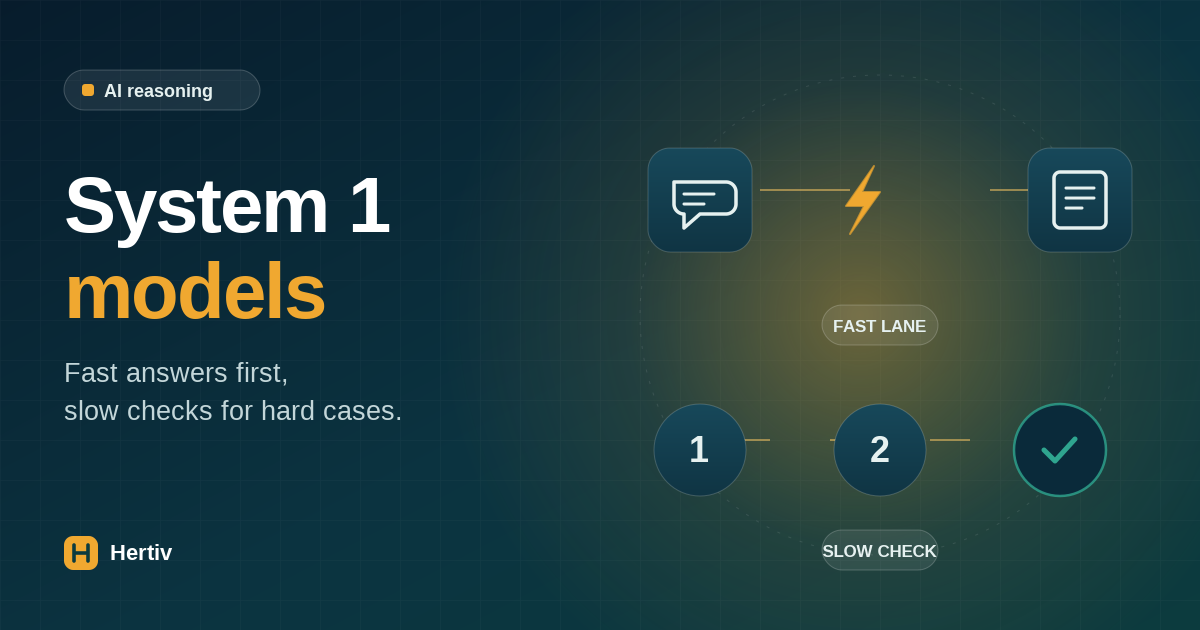
A System 2 step is the slow part of an AI system: it breaks a problem into steps, checks its own work, uses tools or a search, and only then answers. The table below shows how the two modes differ.
| Mode | How it answers | Best for | Main risk |
|---|---|---|---|
| System 1 (fast) | Answers at once from learned patterns | Drafts, sorting, simple questions | Confident but wrong answers |
| System 2 (slow) | Works step by step and checks the result | Maths, logic, high-stakes decisions | Slower and more expensive to run |
In practice the two are usually the same model used in two ways. A single language model can answer at once, or it can be asked to work step by step and check its answer before replying. The difference is the workflow around the model, not a different brain. For a grounding on how chat models produce answers, see what ChatGPT is and how it works.
Where do System 1 models work well?
System 1 models work well where speed matters, the task repeats often, and a wrong answer is cheap to catch. If a human or a simple rule checks the result, the fast answer is usually good enough.
- First drafts. Emails, summaries and product copy that a person edits before sending.
- Sorting and tagging. Classifying tickets, messages and documents into known buckets.
- Short summaries. Condensing a short text where the facts are all in the source.
- Simple questions. Answering from a help centre or manual where the answer is written down.
- Autocomplete and suggestions. Completing code, forms and sentences inside a tool the user already trusts.
The common thread is a short feedback loop. The user sees the output, fixes it if needed, and moves on. Support teams use this pattern heavily: AI agents for customer support shows how the handoff to a human is designed.
Where do System 1 models go wrong?
System 1 models go wrong where the task needs careful reasoning, fresh facts or exact numbers, because a fast pattern match cannot do those jobs. The failure is hard to spot because the answer still reads smoothly.
- Invented facts. The model fills gaps with plausible-sounding details that were never in the source.
- Multi-step logic. Each step looks right, but a small error early on changes the final answer.
- Exact arithmetic. A fast answer can state a wrong total with the same confidence as a right one.
- Rare cases. Patterns learned from common examples break on unusual inputs the model has rarely seen.
- Stale knowledge. The model answers from training data, not from what changed yesterday.
None of these are fixed by asking the same fast question twice. They need a different step: a check, a calculation, a search or a human review. That is why teams test before launch; how to evaluate an LLM application covers the evaluation set this needs.
How do teams combine fast and slow models?
Teams combine fast and slow models by routing work by risk: the fast model handles the easy cases at once, and the slow path only takes the cases that matter. The split keeps speed where it is safe and adds care where it is not.
- Sort by risk. Decide which answers are low stakes and which need checking, before building anything.
- Let the fast model go first. Use it for drafts, sorting and simple answers, with the source shown beside the output.
- Send flagged cases to the slow path. Multi-step questions, numbers, dates and anything a customer will rely on get a step-by-step check.
- Verify with tools, not with the same model. Use rules, calculators and searches to check facts and totals.
- Log everything. Keep the prompt, the answer and the human decision, so failures can be traced and fixed.
The slow path can be the same model asked to reason step by step, or a different tool entirely. What matters is that the check is independent of the first answer. A readiness assessment is a useful way to find which of your workflows need this split.
Example (hypothetical): a support team sorts tickets
Example (hypothetical): a support team receives 400 tickets a day. A fast model reads each ticket and sorts it into a queue, which takes minutes for the whole batch. About 320 tickets are routine and routed at once, while 80 are flagged as unclear, angry or billing-related and sent for a slower review.
Reviewers spend 5 minutes on each flagged ticket, which is 80 times 5, or 400 minutes, about 6 hours and 40 minutes of review a day. Reading all 400 tickets by hand at 5 minutes each would take 2,000 minutes, about 33 hours and 20 minutes. The fast sort saves roughly 26 hours a day, and the risky tickets still get a careful look.
The gain depends on the flagging rule. If the rule misses angry customers, the team saves time and loses trust. If it flags everything, the slow path becomes the bottleneck. Teams tune the rule on real tickets before they trust the split.
What are the common mistakes?
The most common System 1 mistakes are treating a fast answer as a checked answer, and slow-checking everything until the speed is gone. Both come from skipping the routing decision.
- Publishing first drafts unchecked. A fast draft that goes out without review will eventually carry an invented fact.
- No routing rule. If every question takes the same path, either risky answers go unchecked or simple ones wait too long.
- Checking with the same model. Asking the fast model whether its own answer is right rarely catches the error.
- No logging. Without the prompt and the answer on file, a bad output cannot be traced or fixed.
- Assuming fast means cheap. A fast model called millions of times still costs time and money to run and review.
Key takeaways
- A System 1 model answers fast from learned patterns, without checking its work
- The same model can act as System 1 or System 2, depending on the workflow around it
- Fast answers fit drafts, sorting and simple questions where a human checks the result
- Invented facts, multi-step logic and exact numbers need a slow, verified step
- Route by risk: fast first, then a slow check only for the cases that matter
Frequently asked questions
What is a System 1 model in simple terms?
It is an AI model used in its fast mode: it answers at once from patterns learned in training, the way a person answers a familiar question without stopping to think. It is quick and fluent, but it does not verify what it says.
Is a System 1 model a different kind of AI?
No. The label describes how a model is used, not a separate product. One language model can answer fast or be asked to work step by step. The workflow, the checks and the tools around it decide which mode it is in.
When should a team use the slow System 2 path?
Use it when the answer affects money, safety, legal standing or customer trust, and for maths, multi-step logic and anything that depends on fresh facts. Low-risk drafts and sorting can stay on the fast path.
Can a fast model check its own answer?
Not reliably. Asking the same model whether its answer is right usually returns the same answer with the same confidence. A useful check comes from a different source: a rule, a calculator, a search or a human reviewer.
Do System 1 models cost less to run?
They usually take less time per answer than a slow, step-by-step run, but cost depends on volume, model size and how much review the output needs. A fast answer that needs heavy human checking can cost more than a slower one that is right first time.
How do you start using System 1 and System 2 together?
Pick one workflow, sort its questions by risk, and let the fast model handle the low-risk cases while flagged cases go to a step-by-step check with logging. Measure the error rate on real cases before expanding to more work.


