How Much Does Substrate Development Cost?
Substrate is free and open source, but building a chain on it is not. Here is what drives the cost, from team time to audits, and how to budget a first chain.
On this page
Short answer
Substrate itself is free, so the cost of a Substrate chain is the cost of the team that builds it, the audit that checks it and the infrastructure that runs it. A first chain usually takes a small team several months, and custom runtime logic is the largest cost driver, ahead of the audit and the monthly running bill.
What is Substrate, and what does it cost?
Substrate is an open-source framework from Parity for building blockchains, now part of the Polkadot SDK. It gives a team the building blocks of a chain, such as consensus, networking, storage and a runtime, so the team writes only the logic that makes its chain different.
The framework itself costs nothing to use. The cost of a Substrate chain is the cost of the people who build it, the audit that checks it, and the infrastructure that runs it. That is why two teams can build on the same free framework and spend very different amounts.
A useful way to think about it is to separate the build from the run. The build is a one-off project measured in months of team time. The run is a monthly bill for validators, nodes and monitoring. For teams planning a chain, Substrate development covers the build and launch steps in more depth.
What drives the cost of a Substrate chain?
Five factors drive the cost of a Substrate chain, and the first two, scope and team, decide most of the budget. A chain that reuses existing pallets costs far less than one with custom runtime logic.
| Cost driver | What it covers | Effect on budget |
|---|---|---|
| Custom runtime logic | New pallets and business rules | The largest cost; each custom pallet adds weeks |
| Team size and rates | Developers, testers, DevOps | More people, faster delivery, higher monthly burn |
| Audit | Independent review of the runtime | A fixed cost that grows with custom code |
| Infrastructure | Validators, archive nodes, monitoring | A monthly bill that scales with the network |
| Launch and listing | Testnet, token distribution, exchange work | Often underestimated in first budgets |
The cheapest way to cut cost is to cut scope. A chain that launches with three pallets and adds features later costs less than a chain that tries to ship everything in version one.
How much team time does a first Substrate chain take?
A first Substrate chain usually takes a small team several months, and the range depends on how much custom logic the chain needs. A chain built mostly from existing pallets can reach a testnet in a few months, while a chain with heavy custom runtime work takes longer.
| Chain type | Team | Planning range |
|---|---|---|
| Standard chain from existing pallets | 2-3 developers | 3-4 months to testnet |
| Chain with custom pallets | 3-5 developers | 5-8 months to testnet |
| Chain with custom consensus or cryptography | 4-6 developers plus specialists | 8-12 months or more |
These are planning ranges, not quotes. The range widens when the team is new to Rust or to Substrate, and it narrows when the team has shipped a chain before. Budget for learning time if the team has not built on Substrate yet. The guide to building a Substrate blockchain walks through the stages a first chain goes through.
What does a Substrate audit add to the cost?
A Substrate audit adds an independent review of the runtime code, and it is the cost teams most often leave out of the first budget. An audit checks the custom pallets for logic errors, access control mistakes and economic attacks that tests miss.
Audit cost grows with the amount of custom code, not with the size of the chain. A chain with two small custom pallets costs far less to audit than a chain with ten large ones. Teams usually budget the audit as a fixed fee agreed before the audit starts, and they leave time in the schedule to fix what the audit finds.
Skipping the audit saves money up front and risks far more later. A bug in a runtime pallet can freeze funds or break consensus, and fixing it after launch means a runtime upgrade under pressure. Most teams treat the audit as part of the build, not as an optional extra.
Example: a first-chain budget
Example (hypothetical): a team of four developers builds a Substrate chain with three custom pallets over 16 weeks, working 40 hours a week each. That is 4 times 16 times 40, or 2,560 hours of development time.
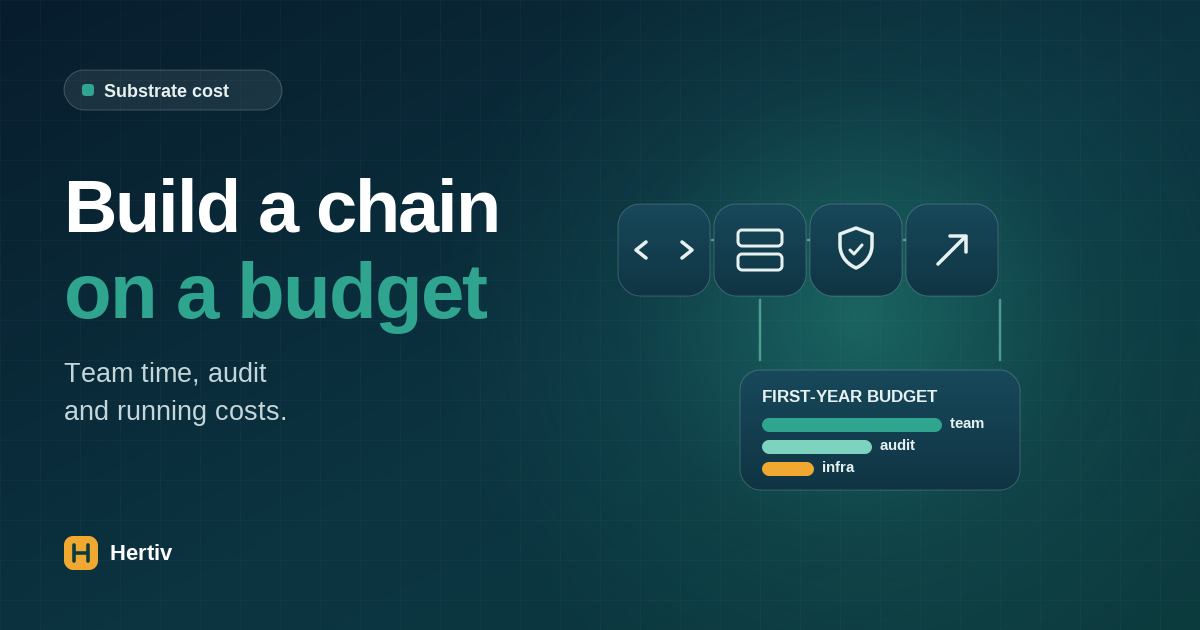
At a loaded rate of $100 an hour, the development cost is 2,560 times $100, or $256,000. The team adds a $40,000 audit and $1,000 a month for infrastructure over the first year, which is $12,000. The total first-year cost is $256,000 plus $40,000 plus $12,000, or $308,000.
The arithmetic shows where the money goes: development is about 83% of the total, the audit about 13% and infrastructure about 4%. A team that wants to cut the budget should cut custom pallets first, because that is where the hours sit.
How can you keep Substrate costs down?
You keep Substrate costs down by reusing what exists, launching small and testing on a testnet before spending on a mainnet. Each of these cuts the part of the budget that is largest: developer hours.
- Start from existing pallets and add custom logic only where the chain is genuinely different.
- Launch a testnet early and let real users find the rough edges before the audit.
- Fix the scope in writing before the build starts, and put new ideas in a later release.
- Hire or contract a developer who has shipped a Substrate chain before, even part-time.
- Automate the testnet deployment, so the team spends time on the chain instead of on operations.
The most expensive mistake is the opposite: building a large custom runtime, then discovering in testing that half of it is not needed. A small first release with a clear upgrade path costs less and ships sooner.
What are the common mistakes?
The most common mistakes are underestimating the audit, building custom pallets for features that already exist, and budgeting only for the build while forgetting the cost of running the chain.
- No audit budget. The audit is found late, and the launch slips while the team raises the money.
- Rebuilding existing pallets. A custom staking or governance pallet costs weeks and adds audit surface for no benefit.
- Forgetting running costs. Validators, archive nodes and monitoring are a monthly bill, not a one-off.
- No upgrade plan. A chain that cannot upgrade its runtime safely is stuck with its first bugs.
- Hiring only for the build. The chain needs operators after launch, and a team that disbands at mainnet leaves it unmaintained.
Key takeaways
- Substrate is free; the bill is team time, the audit and the infrastructure that runs the chain
- Custom pallets are the largest cost: each one adds weeks of development and audit surface
- A first chain takes a small team 3-8 months to testnet, depending on how much is custom
- Budget the audit as part of the build, not as an optional extra
- Cut cost by reusing pallets, launching small and testing on a testnet before mainnet
Frequently asked questions
Is Substrate free to use?
Yes. Substrate is open source and free to download and use. The costs come from the people who build the chain, the audit of the custom code and the infrastructure that runs the network, not from a licence fee.
How long does it take to build a Substrate chain?
A chain built mostly from existing pallets can reach a testnet in 3-4 months with a team of two or three developers. A chain with custom pallets usually takes 5-8 months, and one with custom consensus or cryptography takes 8-12 months or more.
Do I need an audit for a Substrate chain?
An audit is strongly recommended for any chain that will hold value. It checks the custom runtime code for logic errors, access control mistakes and economic attacks that tests miss. Skipping it saves money up front and risks far more after launch.
Can I build a Substrate chain without knowing Rust?
Substrate is written in Rust, and the runtime logic is Rust code, so the team needs Rust skills. A team new to Rust should budget learning time, or bring in a developer who has shipped a Substrate chain before.
What is the difference between Substrate and Polkadot?
Substrate is the framework for building blockchains, while Polkadot is a network that Substrate chains can connect to as parachains. A Substrate chain can run on its own without Polkadot, or connect to Polkadot for shared security.
How much does it cost to run a Substrate chain each month?
Running costs depend on the number of validators, archive nodes and monitoring tools, and they are a monthly bill rather than a one-off. A small testnet can run for a few hundred dollars a month, while a production network with several validators costs more.


