State-Issued Stablecoins: Why Regulated Firms Watch Them
State-issued stablecoins put a government behind a dollar token, and regulated firms watch them because the issuer, reserves and rules are public.
On this page
Short answer
A state-issued stablecoin is a dollar-pegged token issued under the authority of a US state, backed by cash and short-term government securities held in trust. Regulated enterprises are watching because the issuer is a public body with published reserve rules and audits, which changes the counterparty risk compared with a private issuer, even though the market is still small and the legal treatment is still settling.
What is a state-issued stablecoin?
A state-issued stablecoin is a digital token pegged to the US dollar and issued under the authority of a US state, rather than by a private company. The state, or a commission it creates, issues the token, holds the reserves and publishes the rules that govern it.
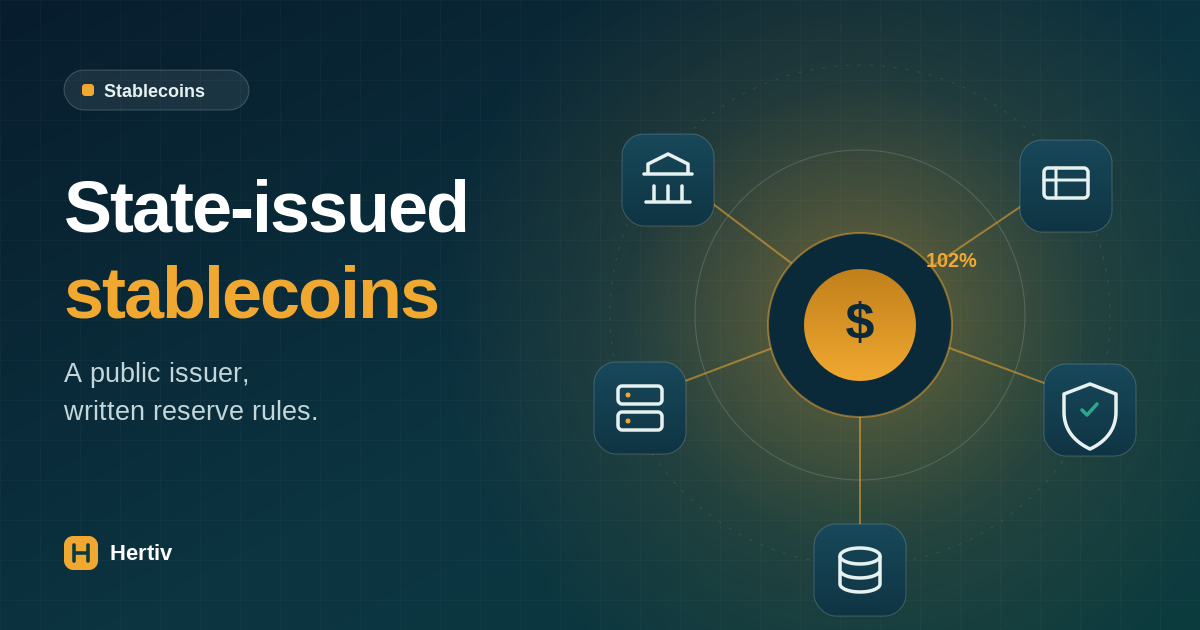
The best-known example is Wyoming's Frontier Stable Token, known as FRNT. Wyoming created a Stable Token Commission under a 2023 state law, and the commission launched FRNT on its mainnet in August 2025, with the token becoming available for public purchase in January 2026. FRNT is backed by US dollars and short-term US Treasury securities held in trust, with state law requiring reserves of 102 percent of the tokens in circulation.
The model differs from a private stablecoin in who stands behind it. With a private issuer, holders rely on the company's balance sheet, its disclosures and its regulator. With a state token, the issuer is a public body, the reserve rules are written into law, and the reserve manager and auditor are named in public records.
| Model | Who issues it | What backs it |
|---|---|---|
| State stablecoin | A state or its commission | Cash and Treasuries, by law |
| Private stablecoin | A licensed company | Cash and Treasuries, by licence |
| Central bank digital currency | A central bank | Central bank liability |
| Bank settlement coin | A bank, for banks only | Bank deposits |
State tokens are also distinct from central bank digital currencies, which are issued by a central bank rather than a state. For the basics of how stablecoins work, what a stablecoin is covers the mechanics.
Why are regulated enterprises paying attention?
Regulated enterprises are paying attention to state-issued stablecoins for three reasons: the issuer is public, the reserve rules are written down, and the legal framework is now clearer than it was. None of those makes the tokens risk-free, but they change the kind of due diligence a regulated firm has to do.
First, the issuer is a public body. A bank or payment firm assessing a state token can read the enabling law, the commission's published reserve policy and the audit reports, rather than relying on a private company's marketing. That transparency fits how regulated firms already assess counterparties.
Second, the reserve rules are specific. Wyoming's law requires 102 percent backing in cash and short-term Treasuries, with reserves managed by a named manager and checked by monthly attestations. A regulated firm can verify the rule and the attestation schedule instead of asking for private assurances.
Third, the federal framework has moved. The GENIUS Act, signed in July 2025, created a federal framework for payment stablecoins in the United States. State tokens sit in a different legal position from private issuers under that framework, so firms are watching how regulators treat them in practice, including which licences and disclosures apply.
What risks come with state-issued models?
State-issued stablecoins carry real risks, and the most important ones are legal uncertainty, small scale and the concentration of control in a new public body.
Legal treatment is still settling. The federal framework for payment stablecoins was written for private issuers, and how it applies to tokens issued by a state is still being worked out by regulators and lawyers. A firm that accepts a state token needs its own legal advice on how the token is treated in each jurisdiction where it operates.
Scale is the second risk. A state token starts with a small supply and few places to spend it. A payment firm cannot build a product on a token that its customers cannot easily buy, sell or redeem, and thin liquidity means large trades can move the price or fail to settle.
Concentration is the third risk. A state commission is a new kind of issuer, and its governance, staffing and political independence are untested over a long period. A change of administration or a budget dispute could affect the token's operations, so firms should read the governance rules, not just the reserve rules.
Technology risk is smaller but still present. FRNT launched across seven blockchains at once, which spreads the technical risk, but each chain carries its own smart contract and bridge risks, and a firm should check which chains its own systems can support.
Example: a payment firm planning around a state stablecoin
Example (hypothetical): a regulated payment firm moves 50,000 cross-border payments a month for small businesses, and it is considering accepting a state-issued stablecoin for settlement between its own accounts and a partner bank.
The firm's risk team starts with the reserve rule. If the token's law requires 102 percent backing, then 10 million tokens in circulation must be backed by at least 10.2 million dollars of cash and Treasuries, which is 200,000 dollars more than a one-to-one reserve. The team checks the latest attestation to confirm the ratio, rather than taking the rule on trust.
Next the team tests liquidity. It places a trial trade of 100,000 tokens through the exchange where the token is listed, and measures how long the trade takes and how far the price moves. If the trade takes more than a day or moves the price noticeably, the token is not yet usable for the firm's settlement volumes.
The firm decides to accept the token only for settlement between its own accounts, with a cap of 500,000 tokens, and to review the cap quarterly against the attestation reports. It does not offer the token to retail customers until liquidity and legal treatment are clearer.
What are the common mistakes?
The most common mistakes around state-issued stablecoins are treating a state issuer as risk-free, confusing the model with a central bank digital currency, and building on a token before checking liquidity.
- Treating state backing as a guarantee. A state token is backed by reserves, not by the full faith and credit of the state. Read the reserve rule and the attestation schedule.
- Confusing it with a CBDC. A state stablecoin is not a central bank digital currency. The issuer, the legal basis and the treatment are different.
- Skipping the liquidity check. A token with thin trading cannot settle real volumes. Test a trade before committing.
- Ignoring the governance. Who runs the commission, how it is funded and how it can change the rules matters as much as the reserves.
- Assuming federal rules apply cleanly. The federal stablecoin framework was written for private issuers. Get legal advice for the specific token and jurisdiction.
How should a regulated firm evaluate a state stablecoin?
A regulated firm should evaluate a state stablecoin by reading the law, checking the reserves, testing liquidity and getting legal advice, in that order.
- Read the enabling law. Find the statute that created the token, the commission's powers and the reserve requirement.
- Check the reserves. Read the latest attestation, confirm the reserve ratio and identify the reserve manager and custodian.
- Test liquidity. Place a trial trade at the size you would actually use, and measure time and price impact.
- Map the legal treatment. Get advice on how the token is treated in each jurisdiction where you operate.
- Start small and capped. Use the token for one internal settlement flow with a cap, and review it quarterly.
State-issued stablecoins are worth watching because they are a genuinely new issuer model, not because they are ready for every use. A firm that follows the steps above can use them where they fit without betting the business on them. For the infrastructure side, stablecoin development covers how issuance and reserves are built.
Key takeaways
- A state-issued stablecoin is a dollar token issued under a US state's authority, not by a private company
- Wyoming's FRNT is the first example, with 102 percent reserves required by state law
- Regulated firms value the public issuer, the written reserve rules and the published audits
- Legal treatment, thin liquidity and untested governance are the main risks
- State tokens are not central bank digital currencies; the issuer and legal basis differ
- Evaluate by reading the law, checking attestations, testing liquidity and starting with a capped use
Frequently asked questions
What is a state-issued stablecoin?
It is a dollar-pegged token issued under the authority of a US state, such as Wyoming's Frontier Stable Token (FRNT). The state or its commission issues the token and holds reserves of cash and short-term government securities, with the reserve rules written into state law.
How is a state stablecoin different from USDC or USDT?
The issuer is different. USDC and USDT are issued by private companies under licences and disclosures, while a state token is issued by a public body under a state law. The reserve rules and audit arrangements are public in both cases, but the counterparty is a government body rather than a company.
Is a state-issued stablecoin the same as a CBDC?
No. A central bank digital currency is issued by a central bank, such as the Federal Reserve, while a state stablecoin is issued by a US state. The issuer, the legal basis and the regulatory treatment are all different.
What backs Wyoming's FRNT token?
FRNT is backed by US dollars and short-term US Treasury securities held in trust, with Wyoming law requiring reserves of 102 percent of the tokens in circulation. Reserves are managed by a named manager and checked through monthly attestations.
Can a regulated firm use a state stablecoin today?
It can, but only after its own due diligence: reading the enabling law, checking the latest attestation, testing liquidity at real trade sizes and getting legal advice for each jurisdiction. Most firms start with a small, capped internal use rather than offering the token to customers.
Which states have issued stablecoins?
Wyoming is the first US state to issue one, with FRNT launched in August 2025. Other states, including North Dakota, have explored similar ideas through legislation or pilot programmes, but none had launched a public state-backed stablecoin at the time of writing.


