Stablecoins in Sales: How They Change Getting Paid
Stablecoins let a business accept payment in minutes and settle across borders without a bank in the middle. Here is how they work, what they cost, and the risks.
On this page
Short answer
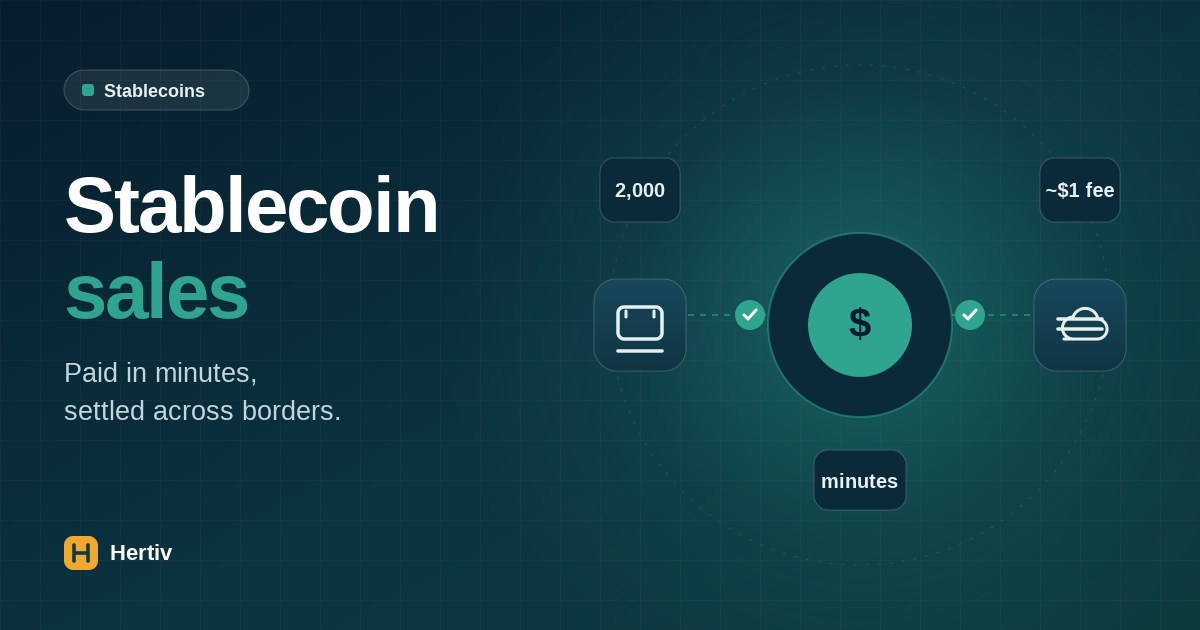
Stablecoins in sales are digital dollars, such as USDT and USDC, that a customer uses to pay for goods or services. The payment settles on a blockchain in minutes, usually for a small network fee, and the seller can hold the coins or convert them to local currency. They are most useful for cross-border orders, where card payments are slow and costly.
What are stablecoins in sales?
Stablecoins in sales are payments made in a digital token that is designed to hold a steady value, usually one token for one US dollar. A customer pays with a crypto wallet instead of a card, and the seller receives the same value in stablecoins within minutes.
The two most used stablecoins are USDT and USDC, both pegged to the US dollar. A business that accepts them does not have to hold crypto that changes in price: one dollar of goods costs one stablecoin, and the value stays flat while the payment moves.
Stablecoins sit between cards and bank transfers. They settle faster than a wire, cost less than a card, and work in countries where card networks are weak. That is why they show up first in cross-border sales, digital goods and business-to-business orders. See stablecoin use cases in retail for where merchants already use them.
How does a stablecoin sale work?
A stablecoin sale follows the same steps as a card sale, except the payment moves on a blockchain instead of through a card network. The seller shows a price and a wallet address, the buyer pays, and the payment is confirmed on the chain.
- Show the price. The checkout page shows the price in dollars and the matching amount in the chosen stablecoin.
- Customer pays. The buyer sends the stablecoins from a wallet to the seller's wallet address, usually by scanning a code.
- Confirm on the chain. The payment is confirmed in seconds or minutes, depending on the network, and the order moves to fulfilment.
- Convert or hold. The seller either holds the stablecoins, converts them to local currency, or uses them to pay a supplier.
- Record the sale. The transaction is logged in the accounts with the exchange rate used, so the books match the bank balance.
Most sellers use a payment gateway or a wallet service to handle these steps, rather than building the flow themselves. The gateway converts prices, watches for payment, and sends the money to the seller's account. Crypto payment gateway development covers how that piece is built.
What do stablecoins change for sellers?
Stablecoins change three things for a seller: how fast the money arrives, how much of the sale is lost to fees, and which customers can pay. The table below compares a card payment with a stablecoin payment for a typical cross-border order.
| Factor | Card payment | Stablecoin payment |
|---|---|---|
| Settlement time | 2-5 working days | Minutes |
| Fee on a $100 order | About $3 in card fees | Under $1 in network fees |
| Chargebacks | Buyer can reverse the payment | Payment is final once confirmed |
| Cross-border reach | Depends on card networks | Works anywhere with internet |
| Refunds | Card network handles it | Seller sends the coins back |
The biggest gain is cash flow: money that arrives in minutes instead of days can be used to pay suppliers sooner. The biggest trade-off is refunds, which become a manual step instead of a card network process.
What does accepting stablecoins cost?
Accepting stablecoins costs less than card payments on most orders, but the costs are split differently. The network fee is small, while the work of converting to local currency and keeping records is where the real cost sits.
| Cost part | What it is | Typical size |
|---|---|---|
| Network fee | Fee to move coins on the chain | A few cents to about $1 |
| Gateway fee | Service that handles checkout | See vendor site |
| Conversion | Changing coins to local currency | Under 1% on most services |
| Accounting | Recording each sale and rate | Staff time, or a tool |
Network fees differ by chain: some cost a few cents and some cost a dollar or more when the network is busy. A seller that takes many small payments should pick a low-fee chain, while a seller with large orders can ignore the fee entirely.
Example: a $2,000 cross-border order
Example (hypothetical): a software seller in Europe sells a $2,000 licence to a buyer in South America. On a card, the fee is 2.9 percent plus $0.30, which is $58.30, and the money arrives in three working days. The seller also pays a currency conversion charge on top.
On a stablecoin, the buyer sends 2,000 USDC and the network fee is about $1. The payment is confirmed in minutes, and the seller converts the coins to euros for a fee of under 1 percent, about $20. The total cost is about $21 instead of $58.30, a saving of about $37 on one order.
Across 100 orders a month, that saving is about $3,700, and the money arrives days earlier. The seller still needs to handle refunds by hand and keep records for tax, but for cross-border sales the numbers usually favour stablecoins.
What are the risks and limits?
The risks of stablecoins in sales are real, and they are different from card risks. A stablecoin can lose its peg, a wallet can be hacked, and the rules differ by country, so a seller needs to plan for all three.
- Peg risk. A stablecoin is only as stable as the reserves behind it. Hold the coins for a short time and convert to local currency on a schedule.
- Regulation. Some countries limit or ban stablecoin payments. Check the rules in every country you sell to before you switch on the option.
- Refunds. A stablecoin payment cannot be reversed. Write a clear refund policy and keep a small float of coins for refunds.
- Wallet security. A wallet key that leaks is money gone. Use a wallet with multi-signature approval for business funds.
- Accounting. Each sale must be recorded at the rate used. A gateway that exports records to your accounts saves hours of manual work.
None of these risks is a reason to avoid stablecoins, but each one needs a written answer before the first sale. A seller that converts quickly, keeps a refund float and checks local rules is in a far better position than one that accepts coins and hopes for the best.
What are the common mistakes?
The most common stablecoin sales mistakes are holding coins for too long, offering them without a refund plan, and forgetting that the rules change by country.
- Holding coins for weeks. A peg can slip, so convert on a fixed schedule instead of waiting for a good rate.
- No refund process. Customers who cannot get a refund will not pay this way twice.
- Ignoring local rules. A payment method that is legal in one country may be restricted in another.
- One wallet for everything. Mixing business funds with personal funds makes accounting and security harder.
- No price in dollars. Showing prices only in coins confuses buyers; always show the dollar price first.
Key takeaways
- Stablecoins settle in minutes and cost less than cards on cross-border orders
- USDT and USDC are the most used stablecoins; both are pegged to the US dollar
- The main gains are faster cash flow and lower fees; the main cost is conversion and record-keeping
- Payments are final, so refunds need a written process and a small float
- Convert on a fixed schedule and check the rules in each country you sell to
Frequently asked questions
Which stablecoin should a business accept first?
USDC is the usual first choice for businesses that want a regulated issuer and clear reserves, while USDT is the most widely held and accepted. Many sellers accept both and let the buyer choose. The choice matters less than the process around it: conversion schedule, refund float and record-keeping.
Do customers actually want to pay with stablecoins?
Some do, especially cross-border buyers and customers in countries with weak card networks. Most domestic customers still prefer cards. Offer stablecoins as an extra option rather than a replacement, and watch how many buyers choose it before investing more.
How do stablecoin refunds work?
The seller sends the coins back to the buyer's wallet address, usually at the dollar value of the original order. Because the payment cannot be reversed by a network, the seller needs a written refund policy and a small float of coins set aside for refunds.
Are stablecoin sales taxed differently?
In most countries a stablecoin sale is taxed like any other sale, on the dollar value at the time of the sale. The exact rules differ by country, so keep a record of each transaction with the rate used, and ask an accountant who knows digital assets before you start.
Can a small business accept stablecoins without building anything?
Yes. A payment gateway or a wallet service handles checkout, conversion and records, and the seller only needs to add the option to the checkout page. Building a custom flow only makes sense at high volumes or when the seller needs special features.
What happens if a stablecoin loses its peg?
The coins would be worth less than a dollar each, so a seller holding them would lose money. That is why sellers convert to local currency on a fixed schedule instead of holding coins for weeks. The risk is small but real, and a short holding period is the simplest protection.


