Stablecoins in Real Estate Deals: How They Work
Stablecoins can settle property deals in minutes instead of days, but escrow, title and law still matter. Learn how a stablecoin deal works.
On this page
Short answer
A stablecoin in a real estate deal is a dollar-pegged token used to pay for a property, usually held in escrow until the title transfers. It settles in minutes instead of days, but the legal steps, title checks and escrow rules stay the same as in a bank transfer deal.
What does a stablecoin do in a property deal?
A stablecoin in a property deal is a token pegged to a currency, usually the US dollar, that the buyer uses to pay the seller. Instead of a bank wire that takes days and passes through several banks, the buyer sends tokens to an escrow arrangement, and the seller receives them when the title transfers.
The stablecoin does not replace the legal deal. The contract, the title check, the escrow and the registration still happen, and they still decide whether the deal is valid. What changes is the payment rail: the money moves on a blockchain, in minutes, at any hour.
This matters most for cross-border deals, where wires are slow and costly, and for buyers whose funds already sit in digital assets. Teams working on this pattern often start with stablecoin payments to understand the rails before applying them to property.
How does a stablecoin property payment work?
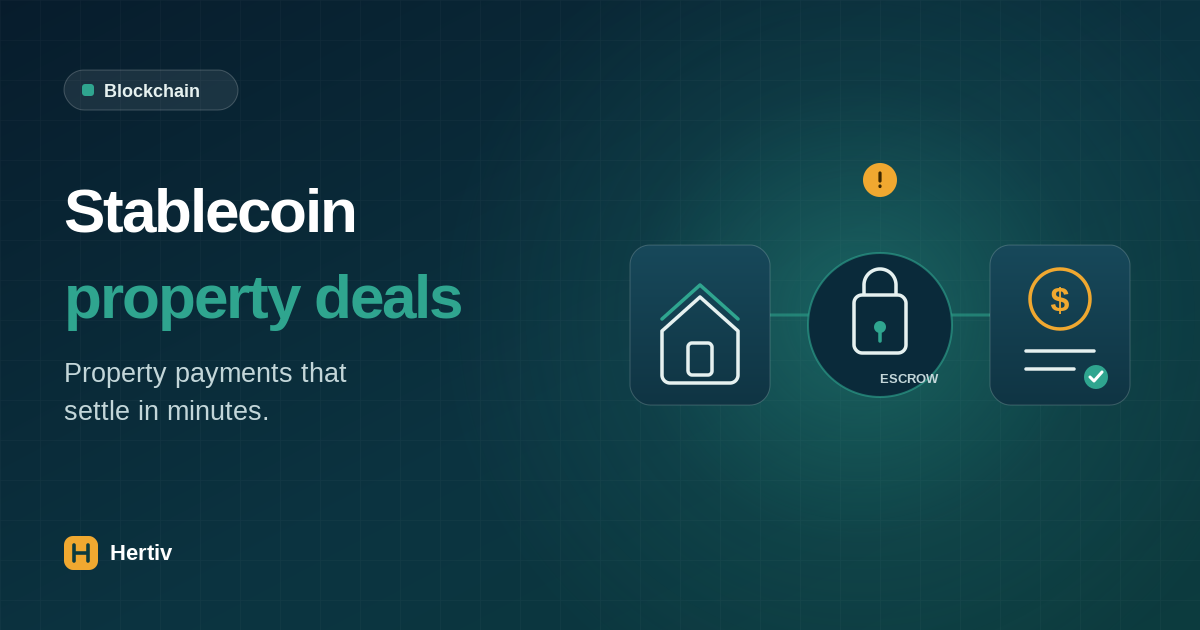
A stablecoin property payment works by holding the buyer's tokens in escrow until the agreed conditions are met, then releasing them to the seller when the title transfers. The escrow can be a regulated company or a smart contract, and the choice shapes the trust model.
A typical flow starts with the buyer and seller agreeing a price in the stablecoin, then the buyer deposits the tokens into escrow. The title is checked, the contract is signed, and the registration is prepared, all while the funds sit in escrow.
When the title transfers, the escrow releases the tokens to the seller, who can hold them or convert them to fiat. If the deal fails, the escrow returns the tokens to the buyer under the agreed terms. The key point is that the payment and the title move together, so neither side carries the other's risk alone.
Stablecoins vs bank transfers for property
Stablecoins and bank transfers both settle property deals, but they differ on speed, cost, hours and reversibility. The table below maps the main points so a buyer and seller can weigh them for one deal.
| Feature | Stablecoin payment | Bank transfer |
|---|---|---|
| Settlement time | Minutes | Days, often 1 to 5 |
| Available hours | Any hour, any day | Banking hours |
| Cross-border cost | Low network fee | Wire and exchange fees |
| Reversibility | Final once sent | Can be recalled in some cases |
| Price risk | Peg can drift slightly | Exchange rate can move |
| Legal standing | Varies by country | Well established |
Speed is the stablecoin's main advantage, and finality is its main risk: a mistaken transfer cannot be recalled the way a bank payment sometimes can. That is why escrow matters more, not less, when the payment moves on a blockchain. The wider picture of tokenised property is covered in the guide to STOs in real estate.
How to settle a property deal with a stablecoin
You settle a property deal with a stablecoin by agreeing the price and the escrow terms first, then moving the payment only when the title is ready to transfer.
- Agree the price and token. Fix the price in one stablecoin and the conversion rate, so neither side carries peg risk alone.
- Choose the escrow. Pick a regulated escrow company or a reviewed smart contract, and agree the release conditions in writing.
- Check the title. Confirm ownership, liens and planning status before any funds move.
- Deposit the tokens. The buyer sends the agreed amount to escrow and both sides confirm receipt.
- Sign and register. Sign the contract, complete the registration, and confirm the title has transferred.
- Release the payment. Escrow releases the tokens to the seller, who converts them or holds them as agreed.
Each step has a check before the next begins. The title check in particular should not be skipped: a payment that settles fast does not fix a title that was never clean. For the token side of the deal, real estate tokenization work often runs alongside the payment.
Example (hypothetical): buying a flat with a stablecoin
Example (hypothetical): a buyer purchases a flat for 240,000 stablecoin units, pegged to the dollar. The buyer deposits the full amount into escrow, and the seller agrees to accept the tokens once the title transfers.
The escrow fee is 0.5% of the price, which is 240,000 times 0.005, or 1,200 units. The network fee for the transfer is 5 units, and the legal and registration fees are 2,000 units, so the total extra cost is 1,200 plus 5 plus 2,000, which is 3,205 units.
The buyer therefore needs 240,000 plus 3,205, which is 243,205 units in total. A bank wire for the same deal might take three days and cost 1,800 units in wire and exchange fees, so the stablecoin route is faster but not free. The numbers are invented to show the arithmetic, not a real deal.
What are the common mistakes?
The most common mistakes in stablecoin property deals are skipping escrow, ignoring the peg, and assuming the token replaces the legal process.
- No escrow. Sending tokens directly to a seller before the title transfers leaves the buyer with no protection if the deal fails.
- Ignoring peg drift. A stablecoin can trade slightly above or below its peg, so the contract must fix the rate and who carries the difference.
- Assuming the token is the deal. The payment settles fast, but the title, contract and registration still decide ownership.
- Weak wallet security. A large payment needs a hardware wallet and a tested signing process, not a phone wallet used for small trades.
- No tax record. The deal must be recorded for tax in the relevant jurisdiction, including the token's value at the time of payment.
These mistakes share one root: treating a fast payment as a finished deal. The payment is one step; the title, the escrow and the records are what make the buyer the owner.
What legal checks come first?
The legal checks come before any tokens move, not after the payment settles. A property deal touches property law, tax rules and, in some places, rules on digital assets, and the answers change what the parties are allowed to do.
Before the deal, take advice from a lawyer who works in property and digital assets in the relevant jurisdiction, and keep a written record of that advice. Check whether the stablecoin payment is accepted for registration, what disclosures are required, and how the price is recorded for tax.
On safety, use a well-known stablecoin, a reviewed escrow arrangement and a hardware wallet for the signing. Set up a clear record of every transfer, and have a plan for what happens if the deal fails. This article is general information, not legal advice, and anyone settling a property deal with a stablecoin should take advice from a qualified professional in their own jurisdiction.
Key takeaways
- A stablecoin settles a property payment in minutes, but the title and escrow still decide ownership
- Hold the payment in escrow until the title transfers, so neither side carries the other's risk
- Fix the price and the conversion rate in the contract, so peg drift does not cause a dispute
- Speed is the advantage and finality is the risk: a mistaken transfer cannot be recalled
- Take legal and tax advice before any tokens move, not after the payment settles
Frequently asked questions
Can I buy a house with a stablecoin?
In some places yes, where the law accepts a stablecoin payment and the registration records the price. The payment is only one part of the deal: the contract, title check, escrow and registration still have to happen, and a lawyer in that jurisdiction should confirm the steps first.
Is a stablecoin property payment safe?
It can be, if the funds sit in escrow until the title transfers, the token is well known, and the signing uses a hardware wallet. The main risks are sending funds without escrow, a peg that drifts, and a deal that was never legally sound.
What happens if the deal falls through?
If the escrow terms cover it, the tokens return to the buyer. That is why the escrow agreement matters: it should state exactly when funds are released and when they are returned, so neither side has to argue about it later.
Do I still pay tax on a stablecoin property deal?
Yes, in most places. The price is recorded for tax at the token's value when the payment is made, and the usual property taxes and duties apply. Take tax advice in the relevant jurisdiction before the deal, since the rules differ by country.
Which stablecoin is used for property deals?
The most common choices are large dollar-pegged tokens with deep liquidity, because the price is stable and the seller can convert them easily. The parties should agree on one token in the contract and check that the seller can actually receive and use it.
Is this the same as tokenising a property?
No. Paying with a stablecoin uses a token as money, while tokenising a property turns the property itself into tokens that can be owned in shares. The two ideas often appear together, but they solve different problems.


