What Is Software Outsourcing, and How Does It Work?
Software outsourcing means hiring an outside team to build, maintain or support your software. Here are the models, when it makes sense, and how to choose a partner.
On this page
Short answer
Software outsourcing is the practice of hiring an outside team or company to build, maintain or support software, instead of doing all of the work with in-house staff, so you gain skills and speed without hiring a full team.
What is software outsourcing?
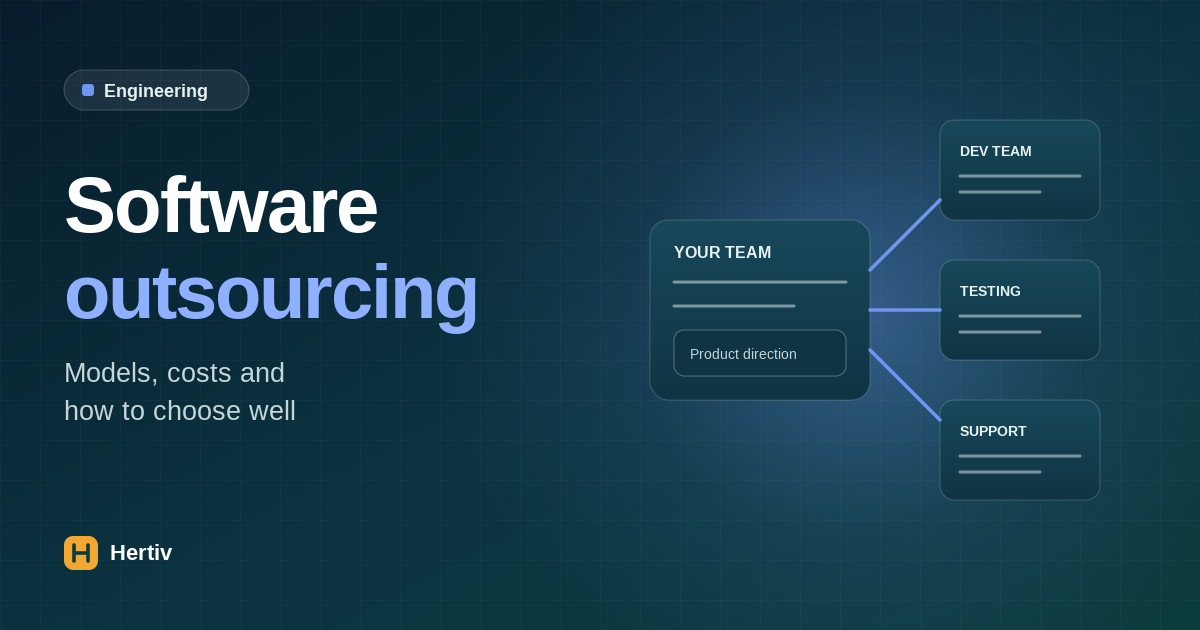
Software outsourcing is the practice of hiring an outside team or company to build, maintain or support software, instead of doing all of the work with in-house staff. The outside team takes on part of the product: it may build a whole app, handle one feature, or run testing and support while your own team keeps the product direction.
Outsourcing is not the same as hiring freelancers for a single task. An outsourcing partner usually works with you for months, follows your process, and is responsible for a defined piece of work. The arrangement can cover design, development, testing, DevOps or support, and the team may sit in the same country or in another time zone.
The reason teams outsource is usually one of three things: they need skills they do not have, they need to move faster than hiring allows, or the cost of a full in-house team is more than the product can carry. For a startup, software outsourcing companies for startups are often the first place to look, because those firms are used to small teams and tight budgets.
What are the main outsourcing models?
The main outsourcing models differ in who manages the work, who carries the risk, and how you pay. The right model depends on how much control you want and how clear your requirements are.
| Model | Who manages the work | Best when |
|---|---|---|
| Fixed-price project | The vendor, against a fixed scope | Requirements are clear and stable |
| Dedicated team | You do, with a team the vendor staffs | Work is ongoing and changes often |
| Staff augmentation | You do, with one or two extra people | You need a skill for a few months |
| Managed service | The vendor, against agreed service levels | Support or operations, not new features |
Fixed-price work suits a well-defined app with a clear scope, because the vendor carries the risk of overruns. A dedicated team suits a product that will keep changing, because you direct the work day to day.
Staff augmentation is the lightest option: you add a developer to your own team for a few months. The dedicated development team model is the one most growing products end up with, because it gives control without the cost of hiring.
When does outsourcing make sense?
Outsourcing makes sense when the work is clear, the skills are hard to hire, or speed matters more than owning every part of the team.
It fits well for a first version of an app, where the goal is to test the idea quickly; for a feature your team has never built, such as payments or a mobile app; and for support and maintenance, where the work is steady and the vendor can run it for less. It also fits when hiring would take months and the market will not wait.
It fits badly when the product idea is still changing every week, when the work needs deep knowledge of your own business that no outsider has, or when the requirements cannot be written down. In those cases, the back-and-forth with an outside team costs more than the work saves. A team that cannot explain what it wants in writing is not ready to outsource.
How do you choose an outsourcing partner?
You choose an outsourcing partner by checking their past work, their process, and how they communicate, in that order.
- Check similar work. Ask for two or three projects like yours, and talk to the client if you can. A vendor that has built your kind of app will make fewer mistakes.
- Test the process. Ask how they plan, estimate and report. A team that cannot explain its process will not follow one.
- Meet the actual team. The people who will do the work matter more than the sales team. Meet them before you sign.
- Start small. Give the vendor a small, well-defined piece first. A two-week trial tells you more than a long sales deck.
- Agree on the exit. Make sure the code, documentation and access belong to you from day one, so you can move if the partnership ends.
Cost matters, but the cheapest bid is rarely the best. A team that charges less and takes twice as long costs more in the end, and a team that cannot communicate will burn your time in meetings. Compare the dedicated team versus a freelance developer before deciding how much control you want to keep.
Example (hypothetical): a clinic outsources its booking app
Example (hypothetical): a small clinic chain with 12 sites wants a booking app for patients. Its own team has two developers, both busy keeping the existing systems running, and hiring two more would take about three months.
The clinic hires a dedicated team of three developers and one tester from an outsourcing partner, at $70 an hour, for six months. The team works 40 hours a week, so the cost is 4 people times 160 hours a month times $70, which is $44,800 a month, or $268,800 for six months.
The app launches in month five, a month early, and the clinic keeps its own developers on the systems they already run. Hiring four people in-house would have taken longer to start and cost more in the first year, because of recruitment, onboarding and the salary load. The clinic keeps the code and the documentation, and the partner moves to a support contract after launch.
What are the common mistakes?
The most common software outsourcing mistakes are vague requirements, choosing on price alone, and treating the vendor as a black box.
- Vague requirements. If you cannot describe what you want, the vendor will build the wrong thing and blame the brief.
- Choosing the cheapest bid. A low rate with a slow team costs more than a fair rate with a fast one.
- No single owner on your side. Someone inside your team must own the product and answer questions daily, or the work stalls.
- Skipping the trial. A small paid trial is cheap insurance. Skipping it is how bad partnerships last for months.
- Ignoring the exit. If the code and access are not yours from day one, leaving the vendor becomes a rebuild.
How do you manage an outsourced team well?
You manage an outsourced team well by treating it like your own team: daily contact, clear priorities, and a shared definition of done.
Set a short daily check-in, a weekly demo, and a single place where priorities live. Answer questions the same day, because a blocked developer costs the same whether they sit in your office or in another country. Review the work every week against a written definition of done, so quality does not drift.
Time zones need a plan, not hope. Agree on overlapping hours, write decisions down, and keep the handover in writing so nothing is lost overnight. The teams that do this well treat the vendor as a partner, not a supplier, and the work shows it. For a longer view, custom software development work follows the same habits, whether the team is in-house or outside.
Key takeaways
- Outsourcing means an outside team builds or supports your software under your direction
- Fixed-price, dedicated team, staff augmentation and managed service fit different needs
- It makes sense when the work is clear, the skills are hard to hire, or speed matters
- Check past work, process and the actual team, and start with a small paid trial
- Code, documentation and access must belong to you from day one
Frequently asked questions
How much does software outsourcing cost?
Costs vary widely by region, team size and model, so there is no single figure. As a rule, a dedicated team is billed by the hour or month, while a fixed-price project is billed against a defined scope. Teams should compare the full cost, including management time, not just the hourly rate.
Is outsourcing the same as offshoring?
No. Outsourcing means hiring an outside team, wherever it sits. Offshoring means hiring that team in another country, usually to cut cost. A team can outsource to a firm in its own city, and it can also hire offshore staff directly without an outsourcing partner.
What should be in an outsourcing contract?
A good contract covers the scope of work, the team, the rate and payment terms, who owns the code, the service levels, confidentiality, and how either side can end the agreement. The ownership clause matters most: code, documentation and access should belong to you from day one.
How do I keep quality high with an outside team?
Set a written definition of done, review the work every week, and run your own tests on what the vendor delivers. A short daily check-in and a weekly demo catch problems early. The vendor should follow your coding standards, and your team should review their code, not just their demos.
When should I not outsource?
Do not outsource when the product idea is still changing every week, when the work needs deep knowledge of your own business, or when you cannot write down what you want. In those cases the back-and-forth costs more than the work saves, and an in-house team is the better fit.
Can I outsource only part of a project?
Yes, and most teams do. A common split is to keep product direction and the core logic in-house, and outsource a mobile app, testing, or support. The split works when the boundary between the two teams is clear and one person owns the whole product.


