Software Development in the Middle East Explained
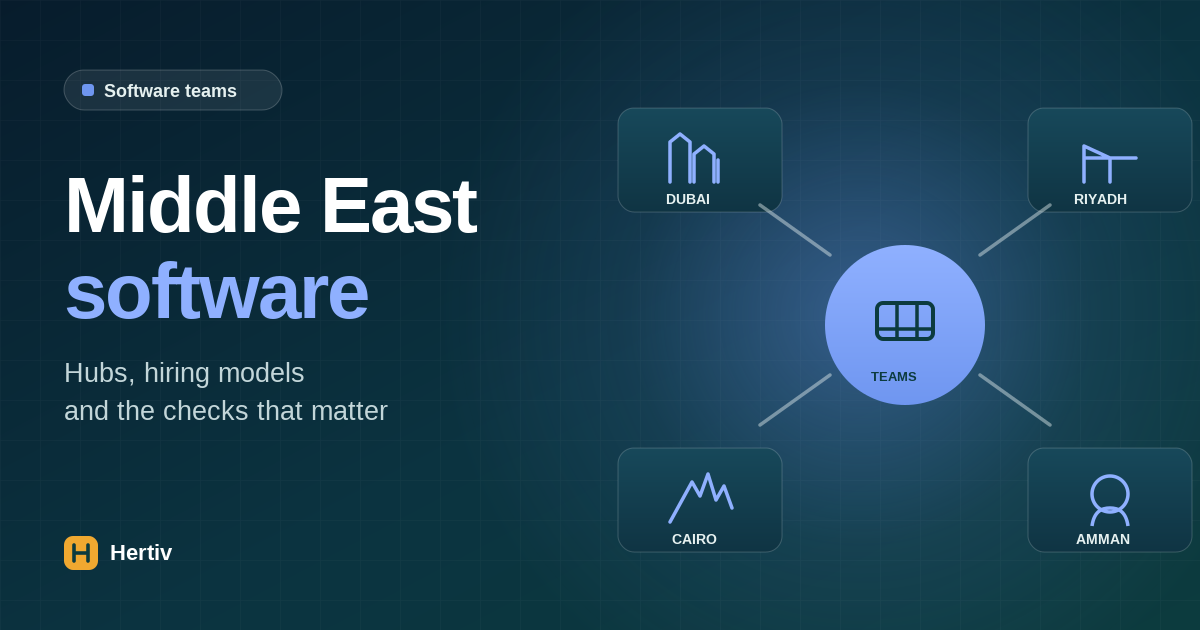
The Middle East has become a serious place to build software, with hubs in the UAE, Saudi Arabia, Egypt and Jordan. This guide explains the hiring models and costs.
On this page
Short answer
Software development in the Middle East is the building of apps, platforms and internal systems by teams based in the region, either as in-house staff, dedicated teams or outsourced partners. The region has grown from a market that bought software into one that builds it, with hubs in the UAE, Saudi Arabia, Egypt and Jordan, and with governments funding digital programmes that create steady demand for engineers.
What is software development in the Middle East?
Software development in the Middle East is the building of apps, platforms and internal systems by teams based in the region, either as in-house staff, dedicated teams or outsourced partners. The region has grown from a market that bought software into one that builds it, with hubs in the UAE, Saudi Arabia, Egypt and Jordan, and with governments funding digital programmes that create steady demand for engineers.
The work covers the same range as anywhere else: mobile apps, web platforms, payment systems, government services and enterprise software. What is different is the mix of drivers. Oil-funded diversification programmes in the Gulf create large public-sector projects, while Egypt and Jordan supply large numbers of engineers at lower rates than the Gulf states.
Time zones are a practical advantage for European clients. The region sits two to four hours ahead of most of Europe, so a team in Dubai or Cairo can overlap with a London or Berlin working day almost in full. For North American clients the overlap is shorter, usually a few hours in the morning.
English is the working language of most tech teams in the region, especially in the UAE, where the workforce is largely international. That reduces the friction of working across borders, though contracts and official documents in Saudi Arabia and Egypt may still need Arabic. A plain explainer of the hiring models is in what is a dedicated development team.
Which countries are the main tech hubs?
The UAE is the most established hub, with Dubai and Abu Dhabi hosting international companies, free zones and a large pool of engineers from many countries. Dubai Internet City and similar zones make it easy for a foreign company to set up an office, and the visa system is built around attracting skilled workers.
Saudi Arabia is the fastest-growing hub, driven by large public investment in digital services and new cities. Riyadh has the biggest domestic market in the region, and government projects create steady work for local and international firms. The pace is fast, but the rules for setting up and hiring are more involved than in the UAE.
Egypt is the region's largest source of engineers, with Cairo producing many graduates each year and rates that are lower than the Gulf. Many Egyptian engineers work remotely for Gulf or European clients, and Cairo has a growing number of outsourcing firms. Power and internet reliability vary by area, so teams usually work from offices with backup power.
Jordan and Israel round out the picture. Amman has a small but skilled engineering community and a strong startup scene for its size, while Tel Aviv is a deep tech hub with strengths in security and chip design. Both are worth a look for specialist skills, though the talent pools are smaller than Egypt's.
What hiring models do teams use?
Teams hiring in the Middle East usually choose one of four models, and the right one depends on how much control you need and how long the work will last.
| Model | Best for | Control | Typical commitment |
|---|---|---|---|
| In-house team | Long-term product work | Full | Permanent hires |
| Dedicated team | One product, 6 months or more | High | Monthly contract |
| Project outsourcing | A defined build | Medium | Fixed scope |
| Freelancers | Short tasks and fixes | Low | Per task |
A dedicated team is the most common choice for a company that wants engineers in the region without opening an office. The vendor hires and manages the people, while you direct the work day to day. It costs more than project outsourcing, but it keeps knowledge in the team over time.
Project outsourcing suits a defined build with a clear scope, such as a first version of an app. You pay for the outcome, not the hours, but changes to the scope cost extra and need a written process. Freelancers suit small tasks, though finding and managing them takes time that a vendor would otherwise handle.
What should you check before hiring a partner?
Before hiring a partner in the Middle East, check that the company is legally registered where it claims to be, and that it can issue invoices and sign contracts under the law of that country. A free-zone company in Dubai operates under different rules from a mainland company, and the difference matters for liability and tax.
Ask for references from clients in your industry and in your time zone, and speak to at least two of them. A partner that has built a payment app for a Gulf bank will understand local compliance better than one whose work is mostly retail websites, even if both show the same stack on their site.
Check the team's English and the overlap of working hours with your own team. A four-hour overlap is usually enough for daily stand-ups and reviews, but a two-hour overlap means most communication happens by message, which slows decisions. Agree the overlap in the contract, not just in conversation.
Finally, check how the partner handles data and intellectual property. The contract should say who owns the code, where it is stored and what happens if the relationship ends. Some countries in the region have data protection laws that require personal data to stay inside the country, so confirm this before any customer data moves.
What costs and timelines should you expect?
Costs in the Middle East vary widely by country. Engineers in the UAE and Saudi Arabia cost more than in Egypt or Jordan, because salaries and living costs are higher in the Gulf. A senior engineer in Dubai can cost as much as one in London, while a similar engineer in Cairo costs much less. The saving comes from the country, not from the skill level.
Timelines depend on hiring speed. In the UAE, a vendor can usually staff a small team within a few weeks because the talent pool is international and mobile. In Saudi Arabia, visas and work permits take longer, so a team can take a month or two to assemble. Plan the start date with the vendor, not around it.
Hidden costs to watch are visas, office space and travel. A company that hires in the Gulf pays for visas and sometimes housing, while a remote team in Egypt needs reliable power and internet, which may mean an office rather than home working. Ask for a full monthly cost that includes these, not just the hourly rate.
For a sense of how vendors present themselves, see software development companies and the range of firms operating in the region.
The UAE-specific list in artificial intelligence companies in the UAE shows the services on offer in the most established hub.
Example (hypothetical): a retailer builds an app with a Dubai team
Example (hypothetical): a retailer in London wants a first version of a shopping app and hires a dedicated team in Dubai: five engineers working 160 hours each per month, at $65 an hour. The monthly cost is 5 x 160 x $65 = $52,000, and the four-month build comes to 4 x $52,000 = $208,000.
The team overlaps with London from 10:00 to 14:00 Gulf time, which is 06:00 to 10:00 in London, so the daily stand-up happens at 10:00 Gulf time and reviews happen in the London afternoon by message. The overlap is short, so the retailer writes decisions down instead of relying on calls.
Two costs appear that the first quote did not include: $4,000 for visas and setup, and $6,000 for a month of extra testing after the first release. The real first-year cost is $208,000 + $4,000 + $6,000 = $218,000, which is still less than hiring the same team in London, but the gap is smaller than the headline rate suggested.
The lesson is to ask for the full monthly cost and the setup cost before signing. A vendor that lists visas, tools and testing separately is easier to compare than one that hides them in a single rate.
What are the common mistakes?
The most common mistakes when hiring software teams in the Middle East are choosing by rate alone, ignoring the legal setup, and underestimating the communication gap.
- Choosing the cheapest rate. A low hourly rate in one country can hide visa, office and travel costs that erase the saving. Compare the full monthly cost, not the headline rate.
- Skipping the legal check. A vendor that cannot show registration, or that works under a different entity than the one signing the contract, is a risk. Verify the entity before paying a deposit.
- Assuming the same working week. Some countries in the region work Sunday to Thursday, not Monday to Friday. Agree the working days and holidays in writing.
- No data rules in the contract. If customer data moves across borders, the contract must say where it is stored and who can see it. Some countries require it to stay inside the country.
- Too little overlap. A two-hour overlap is not enough for a team that needs daily decisions. Agree the overlap hours and the decision process before the work starts.
Key takeaways
- The Middle East now builds software, with hubs in the UAE, Saudi Arabia, Egypt and Jordan
- Costs vary by country, not by skill: Gulf rates are high, Egypt and Jordan are lower
- A dedicated team suits long-term work; project outsourcing suits a defined build
- Compare the full monthly cost, including visas and tools, not just the hourly rate
- Agree working days, overlap hours and data rules in the contract before starting
Frequently asked questions
Is it safe to outsource software to the Middle East?
It is as safe as the checks you run. Verify the vendor's registration, speak to two references in your industry, and put code ownership, data rules and exit terms in the contract. A vendor that passes those checks is no riskier than one anywhere else.
Which Middle East country is best for hiring developers?
It depends on the need. The UAE suits teams that need international talent and fast setup, Saudi Arabia suits large public-sector work, and Egypt suits large teams at lower cost. Jordan and Israel suit specialist skills in smaller teams.
What is the working week in the Middle East?
It varies by country. The UAE and Saudi Arabia now work Monday to Friday, while some other countries work Sunday to Thursday. Check the vendor's working days and public holidays before agreeing a schedule.
Do Middle East developers work in English?
Most tech teams do, especially in the UAE where the workforce is largely international. Contracts and official documents may still need Arabic in Saudi Arabia and Egypt, so confirm which language the contract is written in.
How long does it take to staff a team in the Gulf?
In the UAE a vendor can usually staff a small team within a few weeks. In Saudi Arabia visas and permits take longer, so allow a month or two. Ask the vendor for a staffing date in writing before signing.
Can customer data leave the country?
It depends on the country's data law. Some require personal data to stay inside the country, while others allow transfers under set conditions. Confirm the rule before any customer data moves, and write it into the contract.


