How to Build a Social Audio App Like Yalla
A social audio app like Yalla needs live voice rooms, a friend graph and fast moderation. Here is what to build first, and how to plan the first version.
On this page
Short answer
A social audio app like Yalla is a mobile app where people talk live in voice rooms instead of typing messages. Users join rooms, speak with friends or strangers, send virtual gifts and follow hosts. To build one you need low-latency voice streaming, rooms with hosts and moderation, a friend graph, and payments for gifts. The hard parts are audio quality at scale and keeping rooms safe.
What is a social audio app like Yalla?
A social audio app like Yalla is a mobile app built around live voice rooms, where people talk instead of typing. Yalla is a voice-based social app that grew popular in the Middle East, where users join group voice chats, play simple games together and send virtual gifts to hosts.
Unlike a messaging app, the main activity is talking. A room has a host, speakers and listeners. Listeners can raise a hand to speak, follow people they like, and move between rooms. Text chat, if it exists at all, plays a supporting role.
The format works well where voice feels more natural than typing, and where people want company rather than a feed to scroll. For a builder, the product is less about content and more about who is in the room and how the conversation flows.
How does a social audio app work?
A social audio app works by streaming live voice between everyone in a room, with as little delay as possible. When a user speaks, their voice is captured, compressed and sent to a voice server, which mixes the streams and sends the result back to every listener in the room.
The app keeps track of who is speaking, who has the floor and who is waiting. The host controls the room: they can invite a listener to speak, mute a speaker, or remove someone. A typical room holds a handful of speakers and many more listeners.
A typical session follows a short sequence:
- A user opens the app and sees live rooms and friends who are online.
- They join a room and listen, or raise a hand to speak.
- The host brings them up as a speaker.
- Listeners send gifts or follow the host.
- The room ends, and the app suggests similar rooms.
What features does a Yalla-like app need?
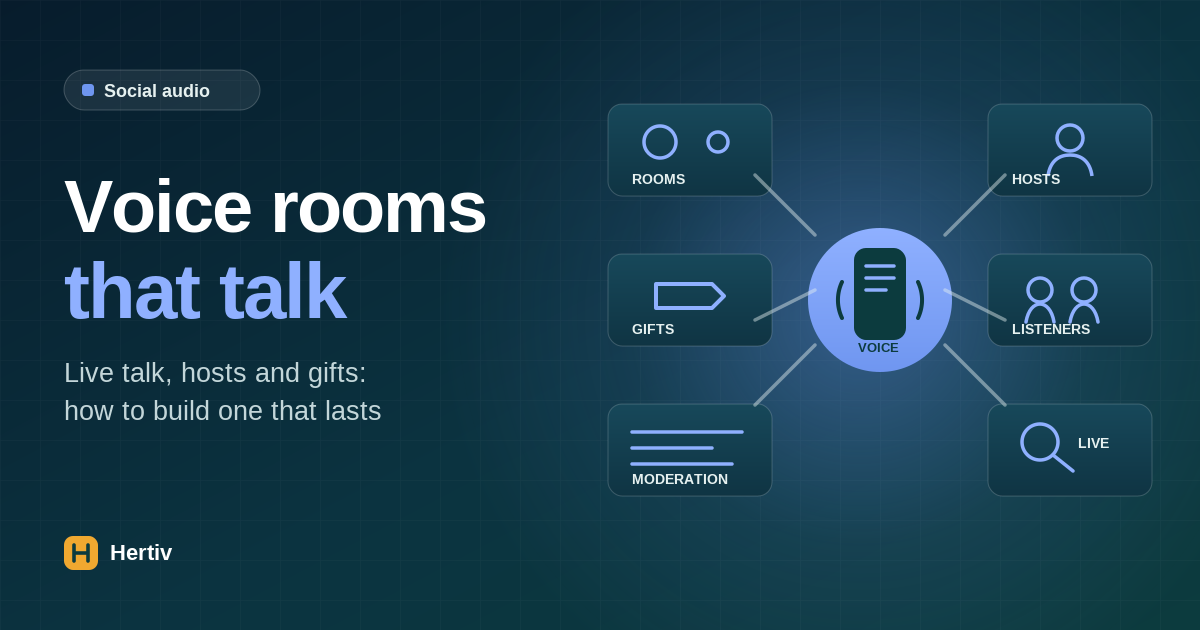
The features below are the core of a Yalla-like app. The table shows what each one does and why it matters for a first version.
| Feature | What it does | Why it matters |
|---|---|---|
| Live voice rooms | Hosts open rooms, speakers talk, listeners join | The core of the product |
| Friend graph | Follow friends and see when they are live | Brings people back daily |
| Gifts and wallet | Users buy coins and send gifts to hosts | Pays hosts and funds the app |
| Moderation tools | Mute, remove, report and block | Keeps rooms safe |
| Discovery and search | Find live rooms, hosts and topics | Helps new users find a room |
Everything else can wait. Profiles, games, leaderboards and themed rooms are useful later, but the first version must get voice quality, rooms and moderation right. For a sense of how similar apps are scoped, a Headspace-like app cost guide follows the same pattern of starting from the core feature.
A build plan also needs the usual app groundwork. A mobile app development checklist covers the steps that apply to any app, from the store listing to analytics, before the voice features are added.
How do you keep voice rooms safe?
Voice rooms are harder to moderate than text, because the conversation happens live and leaves no written record. A team needs a mix of automated checks and people: software that flags banned words or sudden spikes in reports, plus moderators who can join a room quickly.
Hosts carry most of the responsibility. Give them a one-tap mute and remove, and log who acted so abuse reports can be checked. Set clear rules for new accounts, such as limits on how many rooms a new user can open in a day, and a simple way for any listener to report a room.
How do social audio apps make money?
Social audio apps make money mainly from virtual gifts. Users buy coins with real money, send gifts during a live room, and the host keeps part of the value while the platform keeps the rest. The split, the payout rules and the payment fees all need to be clear before launch, or hosts lose trust.
Other income comes from subscriptions, such as extra rooms, badges or higher gift limits, and from ads shown in discovery rather than inside rooms. Ads inside a live voice room break the conversation, so most apps keep them out of the room itself.
A new app should start with one income stream and get it right. Gifts work only when hosts earn enough to keep coming back, so the first version should focus on paying hosts fairly and on time.
Example (hypothetical): a first version for one city
Example (hypothetical): a small team plans a first version aimed at one city. The team has two mobile developers, one backend developer, one designer and one part-time moderator, working for 16 weeks.
The build is about 1,200 hours of development at $55 an hour, which is $66,000. Design adds $10,000 and testing adds $8,000, so the build totals $84,000. Voice streaming and servers cost about $2,300 a month to run once the app is live: $1,500 for voice and $800 for servers.
If each active user costs about $0.30 a month in voice fees, 5,000 active users cost $1,500 a month, which matches the voice budget above. The team launches with 20 rooms a day and a waiting list of hosts, rather than opening to everyone at once, so the voice bill stays inside the budget while the app grows.
What are the common mistakes?
The most common mistakes when building a social audio app are treating voice as a chat feature, launching with no hosts, and skipping moderation until abuse appears.
- Copying a chat app. Voice rooms need host controls, hand-raising and low delay. A chat layout with a voice button does not work.
- Launching with empty rooms. A room with no speakers feels dead. Seed the first rooms with hosts you invite and pay.
- Skipping moderation. One bad room can drive users away. Have moderators and rules in place on day one.
- Charging for gifts too late. If gifts and payouts are not built in, hosts have no reason to stay.
- Ignoring audio quality. Echo, delay and dropouts end a room faster than any missing feature.
Before writing any code, check the idea with real listeners and hosts. How to validate an app idea shows a short way to test demand with a small group first.
Key takeaways
- A social audio app is built around live voice rooms, not text chat
- Voice quality, host controls and moderation decide whether rooms survive
- Gifts pay hosts, so the payout split must be clear from the start
- Launch with invited hosts and a small set of rooms, not an open app
- Start with one city and a small host list, and open up only when rooms stay full
Frequently asked questions
Is Yalla a voice chat app?
Yes. Yalla is a social app built around group voice chats, where users talk in live rooms, play simple games and send virtual gifts. It grew popular in the Middle East, and its core idea is live voice with friends rather than text messages or a photo feed.
How much does a social audio app cost to build?
It depends on the team and the scope, and prices vary by vendor, so check the vendor site. The hypothetical example in this article puts a first version at $84,000 to build, plus about $2,300 a month to run, with voice streaming as the largest running cost.
Do I need a licence to run a social audio app?
Rules differ by country, and some places require licences for voice services or payments. Check the rules where your users live before launch, and get legal advice on voice recording, age limits and payouts to hosts.
How do hosts earn money on a social audio app?
Hosts earn from virtual gifts that listeners buy with real money. The platform takes a share and the host keeps the rest, paid out on a set schedule. The exact split varies by app, so publish it clearly before hosts start.
What is the hardest part of building a social audio app?
Audio quality at scale and moderation. Voice must stay clear with little delay when many people join, and rooms need hosts and moderators who can act fast. Both problems get harder as the app grows, so plan for them from the start.
Can a social audio app work without gifts?
Yes, but it needs another income stream, such as subscriptions or ads in discovery. Gifts are the most common model because they pay hosts directly, which keeps good hosts on the app. Without them, hosts need another reason to return.


