How Do Smart Contracts Work in Real Estate?
Smart contracts in real estate automate parts of a property deal, such as escrow, rent splits and ownership records. Learn what they can and cannot do.
On this page
Short answer
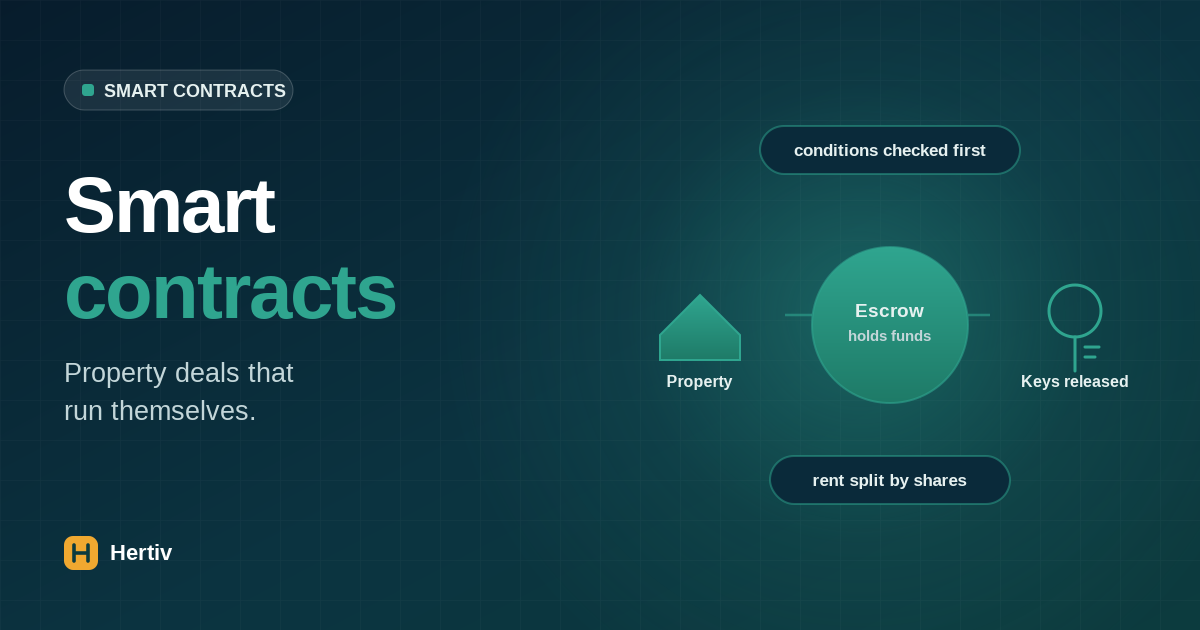
A smart contract in real estate is a program stored on a blockchain that runs agreed steps of a property deal automatically when its conditions are met, such as releasing funds from escrow or splitting rent between owners. It does not replace the legal paperwork or the people who check it; it carries out the parts of the deal that are clear, repeated and easy to verify.
How do smart contracts work in real estate?
A smart contract in real estate is a program stored on a blockchain that runs agreed steps of a property deal automatically when its conditions are met. Once it is deployed, it follows its code: if the buyer has paid and the checks have passed, it releases the funds; if a condition fails, it holds them.
The contract is useful because property deals involve many parties who do not fully trust each other: buyers, sellers, agents, lenders and notaries. A shared program that all sides can read removes the need for one party to hold the money and the paperwork, and it leaves a record that cannot be quietly changed afterwards.
But the contract only does what its code says. It cannot check that a roof is sound, that a seller really owns the flat, or that a local law allows the sale. Those checks still happen off the chain, and the contract usually waits for a trusted party to confirm them before it acts. For the general background, see Smart Contract Use Cases: 10 Worth Knowing.
What parts of a property deal can a contract handle?
Smart contracts handle the parts of a deal that are clear and repeatable. The table below shows the common uses and what each one actually does.
| Use | What the contract does | What still needs people |
|---|---|---|
| Escrow | Holds the deposit and releases it when conditions are met | Checking the sale terms and the identities |
| Rent splits | Divides rent between owners by their shares | Collecting rent and handling arrears |
| Tokenised ownership | Records who holds how many tokens in a property | Legal title and local registration |
| Access and keys | Releases a digital key when payment clears | Physical handover and maintenance |
Escrow is the most common use, because it is a simple rule: hold the money until both sides confirm, then release it. Rent splits follow close behind, because the shares rarely change and the calculation is the same every month.
How does a smart contract property sale work, step by step?
A smart contract property sale follows the same stages as a normal sale, with the contract taking over the steps that can be checked by code. These are the usual stages.
- List and agree terms. Buyer and seller agree the price and the conditions, and the terms are written into the contract.
- Deposit into escrow. The buyer sends the deposit to the contract, which holds it and cannot spend it.
- Checks run. Title, identity and finance checks happen off the chain, and a trusted party confirms each one to the contract.
- Funds released. When every condition is met, the contract sends the money to the seller and records the transfer.
- Ownership updated. The token or record showing ownership moves to the buyer, and the local registry is updated by the usual legal route.
If a condition fails, the contract returns the deposit instead of releasing it. That is the point of escrow: neither side can take the money while the deal is still open. The legal side is explained in What Is Smart Contract Development?.
What still needs lawyers, notaries and paper?
Almost everything that makes a sale legal still needs people. A smart contract cannot confirm that a seller owns a property, that a planning permission exists, or that a local law allows a foreign buyer. Those checks are done by lawyers, notaries and registries, and the contract only acts after they confirm.
Local law also decides whether a blockchain record counts as ownership. In most places it does not: the land registry or the title deed is the legal record, and the token is a useful extra, not a replacement. Anyone who tells you a token alone makes you the legal owner is skipping the hard part.
Disputes are the same story. If a buyer and seller disagree, a contract cannot hear both sides or weigh evidence. The deal needs a clear path back to mediation or a court, and that path should be written into the agreement before the contract is deployed.
What are the risks and checks before you rely on one?
The largest risk is a bug in the contract code. Once deployed, a contract is hard to change, so a mistake in how it releases funds can lock money away or send it to the wrong party. Every contract that handles money should be audited by an independent firm before it is used, and the audit report should be read, not just filed.
The second risk is bad input. A contract trusts what it is told, so if the party confirming the title check is careless or dishonest, the contract will still act. Check who confirms each condition, what evidence they use, and what happens if they are wrong.
The third risk is change. Laws, tax rules and registry practice move, and a contract written for one set of rules may not fit the next. Build in a way to pause the contract and a plan for moving to a new version, and keep the legal agreement as the document that governs the deal.
Example (hypothetical): splitting rent between three owners
Example (hypothetical): three owners hold a property in shares of 50 percent, 30 percent and 20 percent. The monthly rent is $3,000, and the smart contract splits it when the payment arrives: 50 percent is $1,500, 30 percent is $900, and 20 percent is $600, which adds up to $3,000.
Over a year the rent is 12 x $3,000 = $36,000. The owners receive $18,000, $10,800 and $7,200, which also adds up to $36,000. The contract does the same calculation every month, so no one has to chase the split or check the maths.
The example only works because the shares and the rent are fixed and the payment arrives on time. If the rent is late or a tenant pays in part, someone still has to handle the arrears, and the contract can only split what it actually receives.
What are the common mistakes?
The most common mistake is treating the contract as the legal sale. The code runs the payment steps; the law, the registry and the title deed decide who owns the property. Both matter, and confusing them is how deals go wrong.
- Skipping the audit. A contract that moves money without an independent audit is a risk no saving is worth.
- Trusting the input blindly. A contract acts on what it is told, so check who confirms each condition.
- No pause or upgrade path. If the law changes or a bug appears, you need a way to stop the contract.
- Hiding the fees. Network fees, audit costs and legal costs should be in the budget from the start.
Start with one narrow use, such as escrow or rent splits, and keep the legal paperwork as the governing document. If you are planning a build, talk to a team that knows both sides: see Hertiv's real estate tokenization service for the technical side.
Key takeaways
- A smart contract runs agreed steps when conditions are met
- Escrow, rent splits and tokenised ownership are the common uses
- Title, identity and legal checks still happen off the chain
- Audit the code and check who confirms each condition
- Start with one narrow use and keep the law as the governing record
- A token is not legal ownership until the registry says so
Frequently asked questions
Can a smart contract sell a house on its own?
No. A smart contract can hold funds in escrow, release them when conditions are met and record the transfer, but it cannot check title, confirm identity or change a land registry. The legal sale still needs lawyers, a notary where required and the registry.
What happens if a condition is never met?
The contract should return the deposit to the buyer instead of releasing it. That behaviour must be written into the contract before it is deployed, along with a time limit, so the money is not locked away forever.
Are smart contracts legal in real estate?
It depends on the country and the step involved. Holding and releasing funds by code is usually fine as part of a deal, but the legal transfer of ownership follows local law and the registry. Always get legal advice for the specific place before you rely on a contract.
How much does a real estate smart contract cost to build?
The cost depends on the scope, the audit and the legal work around it. A simple escrow contract is far cheaper than a full tokenised ownership platform. Ask vendors for a written quote that separates the build, the audit and the legal review.
What is the difference from tokenisation?
Tokenisation turns ownership into tokens that can be held and traded. A smart contract is the program that can manage those tokens, hold escrow and split rent. The two often work together, but they are different things: one is the ownership record, the other is the automation.
Do tenants need to understand the contract?
No. Tenants pay rent as usual, and the contract splits it behind the scenes. The owners and their advisers are the ones who need to understand the code, the audit and what happens when a payment is late.


