Smart Contracts in Sales: What They Automate
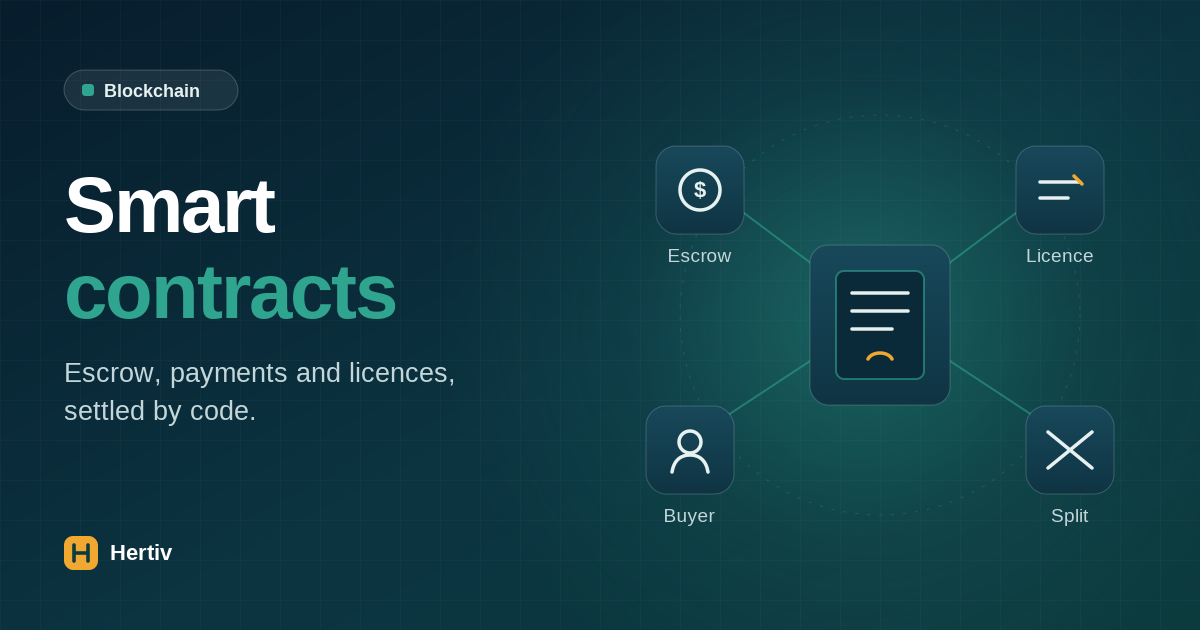
Smart contracts in sales automate escrow, payment release, licensing and revenue splits, so deals close without checks. Here is where they fit and where they fail.
On this page
Short answer
Smart contracts in sales are self-running programs on a blockchain that release payment, transfer a licence or split revenue once agreed conditions are met. They remove manual escrow and reconciliation from repeatable deals, but they only work where the terms can be written as clear rules and the payment asset lives on chain.
What are smart contracts in sales?
Smart contracts in sales are programs stored on a blockchain that carry out the agreed steps of a deal automatically once their conditions are met. Instead of a person holding funds in escrow and releasing them by hand, the contract holds the payment and releases it when the delivery, signature or milestone is recorded on chain.
They fit repeatable deals where the terms are clear and the payment asset is already on chain or tokenised. A software licence sale, a marketplace order or a revenue split between partners all have terms that can be written as rules. A negotiated enterprise deal with custom clauses does not.
| What the contract does | Example | What it replaces |
|---|---|---|
| Holds payment in escrow | Buyer funds held until delivery | Manual escrow agent |
| Releases payment on delivery | Funds move when tracking confirms receipt | Invoice chasing |
| Transfers a licence | Software licence token sent on payment | Manual licence provisioning |
| Splits revenue | Sale proceeds divided between partners | Monthly reconciliation |
| Handles refunds | Refund issued if delivery fails by a deadline | Support ticket refunds |
| Renews subscriptions | Recurring payment pulled on schedule | Dunning and retries |
The contract does not negotiate or judge. It executes exactly what was coded, so the terms must be right before the sale starts. That is why smart contract development puts so much weight on review and testing before deployment.
How does a smart contract sale work?
A smart contract sale works by moving each step of the deal onto the chain in order, so no step depends on someone remembering to do it. The buyer, the seller and the contract each have a defined role, and the money only moves when the agreed condition is met.
- Agree the terms. Price, delivery condition, deadline and refund rules are written into the contract before any money moves.
- Deploy and fund escrow. The buyer sends payment to the contract, which holds it rather than passing it to the seller.
- Deliver the goods or service. Delivery is recorded on chain, or an oracle reports an off-chain event such as a signed receipt.
- Verify the condition. The contract checks the recorded delivery against the agreed terms.
- Release or refund. Payment goes to the seller if the condition holds, or back to the buyer if the deadline passes without delivery.
- Keep the record. Every step stays on chain as an auditable trail for both parties.
Oracles are the weak point in this flow. A contract can only act on data it can verify, so an unreliable oracle can release payment for a delivery that never happened.
Where smart contracts help most in sales
Smart contracts help most where sales are frequent, standardised and digital. The value comes from removing the manual steps that repeat on every order, not from automating a single large deal.
- Marketplaces. Escrow and payout for many small sellers, where manual handling would cost more than the margin on each order.
- Digital goods and licences. A licence token or file access is released the moment payment confirms, with no provisioning queue.
- Revenue sharing. Co-created products, affiliates and creators get their share at the moment of sale instead of at month end.
- Subscription and usage billing. Recurring charges run on schedule, and access is cut automatically when payment fails.
- Cross-border sales. Settlement in a stablecoin removes correspondent banking delays for small international orders. See stablecoin payments for business for how that settlement works.
The common thread is volume and standard terms. If every deal is negotiated differently, the contract has to be rewritten each time, and the automation saves nothing.
What smart contracts cannot do in sales
Smart contracts cannot negotiate, exercise judgement or handle events they cannot verify. Treating them as a replacement for the whole sales process is the fastest way to build a system that fails on the first unusual order.
- Negotiate terms. Prices, discounts and custom clauses are agreed by people; the contract only executes what was agreed.
- Judge quality. A contract can check that a file was delivered, not that it is good. Quality disputes still need a human process.
- Verify off-chain events alone. Physical delivery, service quality and regulatory approval need an oracle or a human confirmation step.
- Change its mind. Once deployed, a contract cannot be edited. Upgrades need a proxy pattern or a new deployment, both of which must be planned in advance.
- Fix a bug for free. An error in the release logic can lock funds or pay the wrong party, which is why an audit matters before launch. Smart contract audit is the usual step before handling real money.
Example: a marketplace that settles on its own
Example (hypothetical): a digital marketplace processes 200 orders a month. Today, a staff member reviews each escrow release by hand, spending about 20 minutes per order checking payment, delivery confirmation and refund eligibility.
That is 200 orders times 20 minutes, or 4,000 minutes a month, which is about 67 hours of review work. With a smart contract, the delivery confirmation is recorded on chain and the contract releases payment automatically, so review is only needed for the orders that fail a check.
If automated checks clear most orders and staff review takes 5 minutes per order, the monthly review time falls to 200 times 5 minutes, or 1,000 minutes, which is about 17 hours. The marketplace saves roughly 50 hours a month, and sellers get paid faster because payment no longer waits for a person.
The saving only holds if the delivery check is reliable. If the oracle that reports delivery is wrong, the contract releases payment for orders that were never fulfilled, and the support cost of fixing those errors can exceed the hours saved.
What are the common mistakes?
The most common smart contract sales mistakes are coding ambiguous terms, trusting a single oracle, and skipping the dispute path.
- Ambiguous terms in code. A clause that reads clearly in a contract document can be vague when written as code. Define every condition with a number, a date or a verifiable event.
- One oracle, no fallback. If the only source of delivery data fails or is manipulated, the contract has no way to know. Use a second source or a manual override for high-value orders.
- No dispute path. Buyers need a way to raise a problem before the release deadline, or the contract will pay out while a complaint is still open.
- Ignoring gas costs. Every contract step costs a fee. On small orders the fee can exceed the margin, so check the economics per order, not per month.
- Deploying without an audit. Sales contracts hold customer money. A review by an independent auditor costs less than a single exploit.
How to start using smart contracts in sales
You start using smart contracts in sales by picking one repeatable deal type and automating only its settlement, not the whole sales process. A narrow first use case is easier to audit and easier to reverse if it does not work.
- Pick one deal type. Choose the most frequent, most standardised sale you have, such as licence renewals or marketplace orders.
- Write the terms as rules. Price, delivery condition, deadline and refund rule, each as a checkable condition.
- Choose the chain and payment asset. Match the chain to your customers and your fee budget, and settle in a stablecoin if price swings would confuse buyers.
- Build the oracle path. Decide how delivery is verified, and add a fallback or manual override for disputed orders.
- Audit, then pilot. Get an independent review, then run a small pilot with a capped value before moving real volume through the contract.
If you are building the sales flow into a product, crypto payment gateway development covers the settlement and payout side in more depth.
Key takeaways
- Smart contracts execute agreed terms automatically once conditions are met
- They fit repeatable, standardised sales, not negotiated one-off deals
- Escrow, payment release, licensing and revenue splits are the strongest use cases
- Oracles are the weak point: a contract can only act on data it can verify
- Build in a pause, an upgrade path and a dispute process before the first sale
Frequently asked questions
Do smart contracts replace sales staff?
No. They automate settlement steps such as escrow, payment release and revenue splits. Negotiation, relationship management, quality judgement and dispute handling still need people. The contract removes repetitive checks, it does not close deals.
Can smart contracts handle refunds?
Yes, if the refund rule is written into the contract. A common pattern is to refund automatically when a delivery deadline passes without confirmation. Disputed refunds still need a human review step before the deadline.
What happens if the delivery data is wrong?
The contract will act on the data it receives, so a wrong oracle report can release payment for a delivery that never happened. That is why high-value sales use a second data source or a manual override for disputed orders.
Are smart contracts legally binding?
It depends on the jurisdiction and how the agreement is written. Many teams use a written agreement alongside the contract, so the code executes the deal and the document governs the legal relationship. Get legal advice before relying on code alone.
Which blockchain should I use for sales contracts?
Choose based on your customers, fee budget and settlement asset. Low-fee chains suit small orders, while larger ecosystems suit sales where buyers already hold the asset. Test the full flow on a test network before committing.
How much does it cost to run a sales contract?
Costs include development, audit, deployment and a fee for every transaction the contract executes. On small orders the transaction fee can exceed the margin, so model the cost per order rather than per month before launching.


