Smart Contracts in Ecommerce: What Online Shops Automate
Smart contracts in ecommerce release payments, rewards and refunds automatically when agreed conditions are met. Here is where they fit in an online shop.
On this page
Short answer
Smart contracts in ecommerce are code on a blockchain that moves money or rewards automatically when agreed conditions are met, such as delivery confirmation or a return scan. They suit escrow, marketplace payouts, refunds and loyalty, where payment waits on a clear event, and they need a reliable data feed and a reviewed contract before real money flows through them.
What are smart contracts in ecommerce?
Smart contracts in ecommerce are self-executing agreements stored on a blockchain that release a payment, a reward or a refund automatically once agreed conditions are met. They replace manual checks in the checkout and after-sales flow with code that both the buyer and the seller can inspect before the order is placed.
They are not a payment method on their own. A smart contract sits next to the shop's payment and order systems, watches for events such as delivery confirmation or a return scan, and then moves money or points according to rules written in advance.
| Use | What the contract does | Condition that triggers it |
|---|---|---|
| Escrow payment | Holds the buyer's payment | Delivery confirmed |
| Marketplace payout | Splits an order between sellers | Order marked delivered |
| Refunds and returns | Returns money automatically | Return scan received |
| Loyalty rewards | Issues points or tokens | Purchase or review completed |
| Supplier payment | Pays a supplier on receipt | Goods received and checked |
| Subscriptions | Renews or cancels access | Payment date or cancel request |
The common thread is conditional money movement. Wherever an online shop holds money until something happens, a contract can carry out that step without a person chasing it. For the mechanics behind them, see how smart contracts work.
How does a smart contract work in an online shop?
A smart contract in an online shop runs as a short programme on a blockchain, and it only moves money or points when the conditions written into it are met. The shop, the buyer and the seller all see the same rules before the order starts, so there is less room for argument later.
The flow usually runs in five steps:
- Agree the terms. The shop writes the conditions into the contract: what is sold, what it costs, and what event releases the payment.
- Take the payment. The buyer pays into the contract, which holds the funds instead of sending them straight to the seller.
- Watch for the event. The contract reads a signal, such as a delivery confirmation from the courier or a return scan at the warehouse.
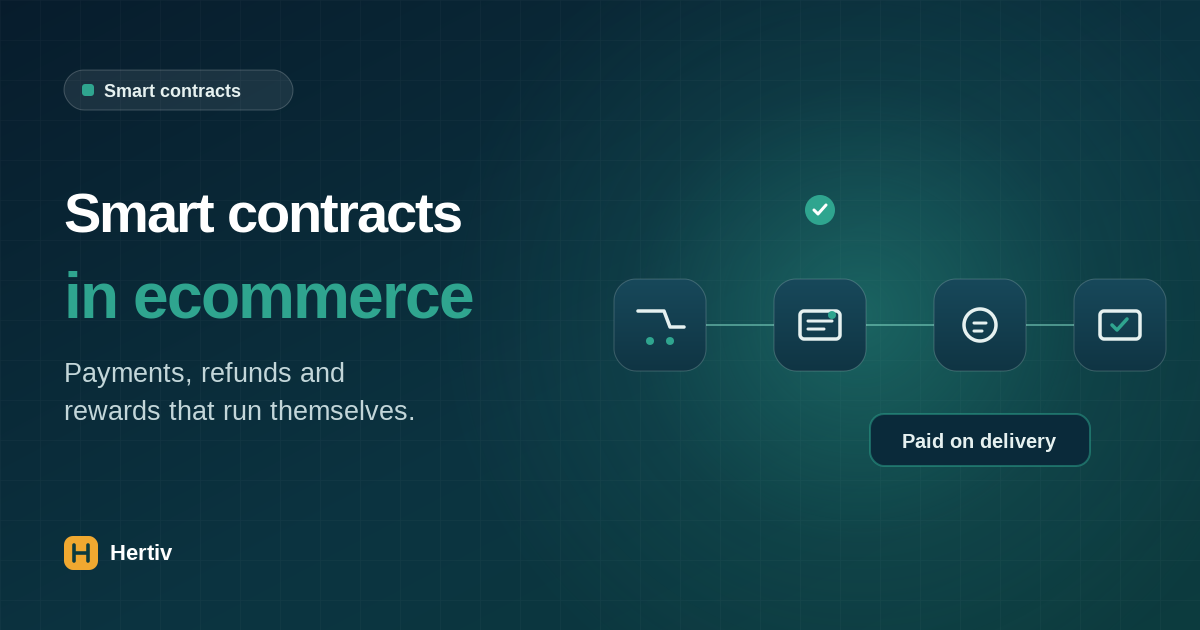
- Release or refund. When the signal arrives, the contract sends the money to the seller, or returns it to the buyer if the order fails.
- Keep a record. Every step is written to the blockchain, so both sides can check what happened and when.
The signal in step three usually comes from an outside data feed, because a contract cannot see the real world on its own. That feed is the part to choose with care: if it reports a delivery that never happened, the contract still pays. Shops that use contracts in finance already plan for this, as described in smart contracts in finance.
Where do ecommerce teams use smart contracts today?
Ecommerce teams use smart contracts most where money waits on an event, and where several parties share one order. Marketplaces are the clearest case: one checkout can involve the buyer, the seller, the courier and the platform, and the contract splits the payment between them once the order is delivered.
Escrow is the second common use. A buyer pays for a high-value item, the money sits in the contract, and it is released only when the delivery is confirmed. If the item never arrives, the refund path is already written in, so the buyer does not have to open a dispute and wait for a person to decide it.
Loyalty and returns are the third group. A contract can issue reward points the moment a purchase or a review is confirmed, and it can refund a returned order the moment the warehouse scans it in. Both jobs are repetitive, and both are easy to get wrong by hand. The pattern is the same one used for tokenised rewards in shops, covered in tokenization in ecommerce.
What changes for buyers and sellers?
For buyers, the main change is that the rules are visible before they pay. They can see what releases the payment, what happens if the item never arrives, and how long a refund takes. That visibility matters most for first-time buyers and for high-value orders, where trust is the reason a sale does not happen.
For sellers, the main change is speed and fewer disputes. Payouts arrive when the delivery is confirmed instead of at the end of a settlement cycle, and the refund rules are applied the same way every time. A seller who ships on time gets paid on time, without chasing a platform for the money.
There are limits, though. A contract cannot judge quality, so a buyer who receives a damaged item still needs a human process. Fees for running the contract and for moving money on the chain also add up on small orders. The honest test is whether the order value and the dispute rate justify the setup, rather than whether the technology is new.
What do you need before you start?
Before writing a contract, a shop needs the order flow mapped on paper: what happens from checkout to delivery, who gets paid, and what goes wrong. If that flow is not clear to the team, a contract will only freeze the confusion into code.
A workable sequence:
- Pick one flow. Start with escrow or marketplace payouts, not with every payment in the shop.
- Choose the chain and the payment token. Pick a chain your team can support, and a stable payment option if prices must stay fixed.
- Decide the data feed. Agree which system confirms delivery or returns, and what happens if it goes quiet.
- Get the contract checked. Have the code reviewed by someone who audits smart contracts before real money flows through it.
- Run a small pilot. Put a small share of orders through the contract, watch the exceptions, and fix the rules before scaling up.
Keep a manual override path for the pilot. A contract that cannot be paused or corrected when the data feed is wrong will turn a small data error into a payment error, and that is the failure shops remember.
Example (hypothetical): a marketplace that pays sellers itself
Example (hypothetical): a small marketplace sells handmade goods from 40 sellers. Each week it handles 40 orders worth 25 units each, so 1,000 units of sales pass through the platform. Paying sellers by hand takes 20 minutes per order, which is 40 times 20, or 800 minutes, about 13 hours a week.
The marketplace puts escrow and payouts into a smart contract. The buyer pays into the contract, the courier confirms delivery, and the contract sends the seller their share the same day. Five orders a week have a problem, such as a late delivery or a return, and those still need 20 minutes of human work each, which is 100 minutes, or about 1 hour and 40 minutes.
The weekly payout work falls from about 13 hours to under 2 hours, saving roughly 11 hours a week. The saving comes from the 35 routine orders, not from the exceptions, which still need a person. That is the right way to judge the change: routine work disappears, and the team spends its time on the orders that actually need judgement.
What are the common mistakes?
The most common mistakes in ecommerce smart contracts are automating a flow that was never written down, trusting a data feed without a backup, and treating the contract as finished once it is deployed.
- Automating a messy flow. If the refund and delivery rules are unclear to the team, the contract will enforce the confusion.
- One data feed, no backup. A courier feed that stops reporting leaves payments stuck, so plan a second source or a manual release.
- Skipping the audit. A small bug in a payment contract can move real money, so get the code reviewed before launch.
- Using contracts for tiny orders. Chain fees can eat the margin on low-value sales, so set a minimum order value.
- No way to pause. Ship without a pause or upgrade path, and a bad rule stays live until someone rewrites the contract.
Key takeaways
- Smart contracts suit payments that wait on a clear event, such as delivery or a return scan
- Marketplaces use them to split one checkout between buyer, seller, courier and platform
- A contract cannot judge quality, so damaged or wrong items still need a human process
- The data feed that reports delivery is the part to choose with care, since the contract trusts it
- Start with one flow, get the code reviewed, and pilot on a small share of orders
Frequently asked questions
What is a smart contract in ecommerce?
A smart contract in ecommerce is code on a blockchain that holds a payment and releases it, refunds it or issues a reward automatically once agreed conditions are met. It replaces manual payout and refund steps with rules both sides can inspect before the order starts.
Do smart contracts replace payment gateways?
No. A smart contract sits next to the payment gateway and the order system, not instead of them. The gateway still takes the card or wallet payment, and the contract decides when the money moves on to the seller or back to the buyer.
Which ecommerce jobs suit smart contracts best?
Escrow for high-value orders, marketplace payouts, automatic refunds on returned goods, and loyalty rewards all suit contracts well. Each one waits on a clear event, such as delivery confirmation or a return scan, which the contract can check.
What happens if the delivery data is wrong?
The contract follows the data it is given, so a wrong delivery report can release a payment early. That is why shops pick a reliable data feed, keep a backup source, and keep a pause or manual release path for the pilot.
Are smart contracts worth it for small shops?
They usually pay off only where order value or dispute volume justifies the setup and the chain fees. A small shop with few disputes is often better served by its existing payment and refund process until volume grows.
Can a smart contract be changed after launch?
Most contracts cannot be changed once deployed, which is why the rules are written carefully and the code is reviewed first. Some designs include a pause function or an upgrade path, and those should be agreed before real money flows through.


