Smart Contracts for Financial Agreements: How They Work
A smart contract can hold a loan, an escrow or a trade payment and carry it out when conditions are met. Here is how financial agreements work on-chain.
On this page
Short answer
A smart contract for a financial agreement is code on a blockchain that holds the terms of a deal, such as a loan or an escrow, and carries them out when the agreed conditions are met. The money moves only when the conditions are true, which removes the wait for manual checks. The contract still needs clear terms, reliable data about the outside world, and a way to handle disputes.
What is a smart contract for a financial agreement?
A smart contract for a financial agreement is code on a blockchain that holds the terms of a deal, such as a loan, an escrow or a trade payment, and carries the terms out when agreed conditions are met. The code, not a clerk, checks the conditions and moves the money, so payment happens as soon as the terms are satisfied rather than after days of manual checks.
The idea is not new. Written contracts have always set out who pays whom, when, and what happens if a term is missed. A smart contract turns those written terms into rules the software can check: a date passes, a delivery is confirmed, a balance is enough, and the payment is released. The difference from a normal contract is that the code can act on its own once it has the facts it needs.
| Agreement | What the contract does | What it needs |
|---|---|---|
| Loan | Releases funds and collects repayments on schedule | Repayment dates and collateral terms |
| Escrow | Holds payment until delivery is confirmed | A delivery confirmation both sides trust |
| Trade finance | Pays when shipping documents are presented | Document checks from an agreed source |
| Derivatives | Pays out when a price crosses an agreed level | A price feed both sides accept |
| Insurance payout | Pays a claim when a defined event is confirmed | Proof of the event from an agreed source |
For a closer look at how these contracts differ from paper agreements, see smart contracts compared with traditional contracts.
How does a smart contract carry out a financial agreement?
A smart contract carries out a financial agreement in a fixed sequence. The parties agree the terms, the terms are written as code, the money or asset is locked in the contract, and the contract waits for the facts that prove the conditions are met. When those facts arrive, the contract releases the payment and keeps a record of every step.
- Agree the terms. The parties settle amounts, dates, conditions and what happens if a term is missed.
- Write the code. A developer turns the terms into contract code, with each condition written as a check.
- Lock the funds. The payer deposits the money or asset into the contract, so it cannot be spent elsewhere.
- Connect the data. The contract is linked to an agreed source for outside facts, such as a delivery or a price.
- Release on conditions. When the facts prove the conditions are met, the contract moves the payment.
- Keep the record. Every step is written to the chain, so both sides can see what happened and when.
The data step is the one most teams underestimate. A blockchain cannot see a delivery, a credit score or a market price on its own, so the contract reads that information from an agreed source, often called an oracle. If the source is wrong or slow, the contract still acts on what it was given, which is why the choice of data source matters as much as the code.
If you are new to writing these contracts, how to write a smart contract explains the tools and the first contract in more detail.
Which financial agreements work best on-chain?
The agreements that work best on-chain are the ones with clear, checkable conditions and a small number of parties. A loan with a fixed schedule, an escrow that releases on delivery, or a trade payment tied to a shipping document all fit that shape, because the contract can verify the condition and act without judgement. Agreements that need interpretation, such as a disputed quality claim, fit less well.
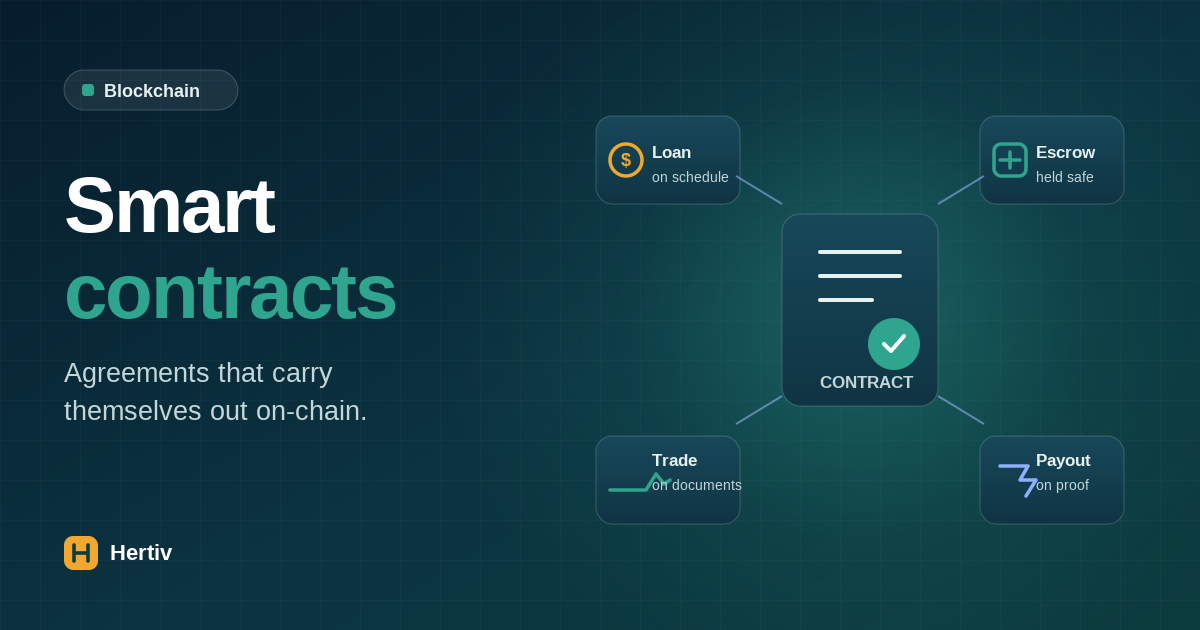
- Loan with fixed repayments. Dates and amounts are known in advance, so the contract can collect and release on schedule.
- Escrow for a sale. One condition, one payment, and a clear result when the delivery is confirmed.
- Trade finance with documents. Payment follows the presentation of agreed shipping documents.
- Recurring subscription payments. A fixed amount on a fixed date, released while the service is active.
- Collateral release. Collateral returns to the borrower automatically when the loan is repaid in full.
Derivatives and insurance payouts sit in the middle. A derivative that pays out when a price crosses a level is easy to code, because the price is a number from a feed. An insurance claim that needs a human to judge damage is harder, because the judgement cannot be reduced to a number without losing what matters.
For the wider set of uses in decentralised finance, see smart contracts in DeFi use cases.
Example (hypothetical): an escrow for a machine sale
Example (hypothetical): a buyer agrees to pay $20,000 for a used printing machine, and both sides want protection. The buyer locks $20,000 in a smart contract, the seller ships the machine, and a delivery confirmation from the agreed courier tells the contract the machine arrived. The contract then releases the payment to the seller.
The contract charges a fee of 2% of the payment, which is $20,000 x 2% = $400, so the seller receives $20,000 - $400 = $19,600. If the delivery confirmation never arrives within 30 days, the contract returns the full $20,000 to the buyer. Both sides know these numbers before they sign, because the rules are written into the contract itself.
The example shows why escrow suits smart contracts: one condition, one payment, and no room for argument about the result. The same shape works for freelance work, property deposits and any deal where one side pays after the other side delivers.
What are the limits of smart contract agreements?
Smart contracts have real limits. They can only act on facts they can read, they cannot judge intent, and a bug in the code is a bug in the agreement itself. A contract that pays the wrong party because of a coding error has still carried out its code, even if no one intended that result. That is why audits and testing matter before real money is locked in.
- Data depends on outside sources. The contract is only as good as the facts it is fed.
- Code bugs become agreement bugs. An error in the code is an error in the deal.
- Legal standing varies by country. Code is not yet treated as a contract everywhere.
- Disputes need a human process. The code cannot settle an argument about quality or intent.
- Upgrades are hard once deployed. A live contract is difficult to change without a plan built in first.
Legal standing is the limit teams most often overlook. In many places, a smart contract is not yet treated as a contract in court, so the parties still need a written agreement alongside the code. The written agreement should say which version governs if the two disagree, and how disputes are settled.
What are the common mistakes?
The most common mistakes teams make with smart contract agreements are writing vague terms into code, trusting a single data source, and locking in large sums before testing with small ones.
- Vague terms the code cannot check. A term such as "good quality" has no number or date attached, so the code cannot test it.
- One data source with no fallback. If the only source fails or lies, the contract has nothing else to check.
- Large sums locked before a test run. A first deployment should use small amounts until the contract proves itself.
- No dispute process written down. The parties need to know what happens when the code and the real world disagree.
- No plan for upgrades or fixes. A contract that cannot be fixed is a contract that fails in public.
A second mistake is treating the contract as finished once it is deployed. A deployed contract is hard to change, so a team needs a plan for fixes, upgrades and the day a data source stops working. The plan should be written down before launch, not improvised after a problem.
How do you start building one?
You start by writing the agreement on paper before you write any code. The paper version forces the parties to agree the conditions, the amounts, the deadlines and the fallback, which is exactly the information the code needs. Only then does a developer turn those terms into a contract, test it, and deploy it.
- Write the agreement on paper. Settle conditions, amounts, deadlines and the fallback before any code exists.
- Pick the chain and the token. Choose where the contract will live and which asset it will move.
- Write and test the contract. Build it in small pieces and test each condition with known inputs.
- Audit and test on a testnet. Have the code reviewed, then run it on a test network with small sums.
- Deploy with small sums first. Start with a small agreement, prove it works, then scale up.
Keep the first version small. A contract that handles one agreement type with one data source teaches a team more than a large contract that tries to cover every case, and it is far easier to audit.
A development partner for smart contract development can help with the audit and the deployment if your team has not built one before.
Key takeaways
- A smart contract turns agreement terms into code that acts when conditions are met
- Loans, escrow and trade payments fit best because their conditions are checkable
- Outside facts arrive through an agreed data source, which must be chosen with care
- Code bugs become agreement bugs, so audit and test before real money is locked in
- A written agreement should sit beside the code, with a dispute process agreed in advance
Frequently asked questions
Can a smart contract replace a written financial agreement?
Not yet in most places. A smart contract can carry out the payment terms, but the legal standing of code as a contract varies by country, so most deals still need a written agreement alongside the code. The written agreement should say which version governs if the two disagree.
What happens if the data source gives the contract wrong information?
The contract acts on what it was given, so a wrong price or a false delivery confirmation can trigger a wrong payment. That is why teams use more than one data source, add checks on the values, and keep a dispute process for the cases the code cannot judge.
Do smart contract agreements work for loans?
Yes, for loans with fixed terms. The contract can hold collateral, release funds on a schedule, and return collateral when the loan is repaid. Variable terms, credit checks and renegotiation still need people, because they depend on judgement rather than a checkable fact.
How much does it cost to build a smart contract for a financial agreement?
It depends on the agreement, the chain and the audit. A simple escrow contract costs far less than a lending platform with many agreement types. Get a quote from a development team after writing the terms on paper, and budget for an audit before launch.
What is an oracle in a smart contract agreement?
An oracle is an agreed source that feeds outside facts into a contract, such as a price, a delivery confirmation or a date. The contract cannot see the outside world on its own, so it trusts the oracle. Choosing a reliable oracle matters as much as writing correct code.
Can a smart contract agreement be changed after deployment?
Usually not without a plan built in from the start. A deployed contract is hard to change, so teams use upgradeable patterns or a new contract for new terms. Decide how fixes and upgrades will work before launch, and write it into the written agreement.


