Smart Contract Security Gates: What to Check Before Deploy
A smart contract security gate is a pass-or-fail checkpoint in the release pipeline. This guide covers five gates, what each one checks, and what blocks a deploy.
On this page
Short answer
Smart contract security gates are pass-or-fail checkpoints placed between code, testing, audit and deployment. Each gate checks one thing — code quality, test coverage, audit findings or upgrade safety — and a failed gate blocks the release until the issue is fixed. Gates turn security from a one-off audit into a repeatable step in every release.
What is a smart contract security gate?
A smart contract security gate is a pass-or-fail checkpoint in the release pipeline that a contract must clear before it moves to the next stage. Each gate checks one thing, such as code quality, test coverage or audit findings, and a failed gate stops the release until the problem is fixed.
Gates turn security from a single audit at the end of a project into a repeatable step in every release. A team that ships often needs this discipline most, because small changes can introduce the same flaws a full audit would catch.
Gates also create a written record: each pass or fail, who approved it, and what changed since the last check. That record is what makes smart contract security a process rather than a one-off event.
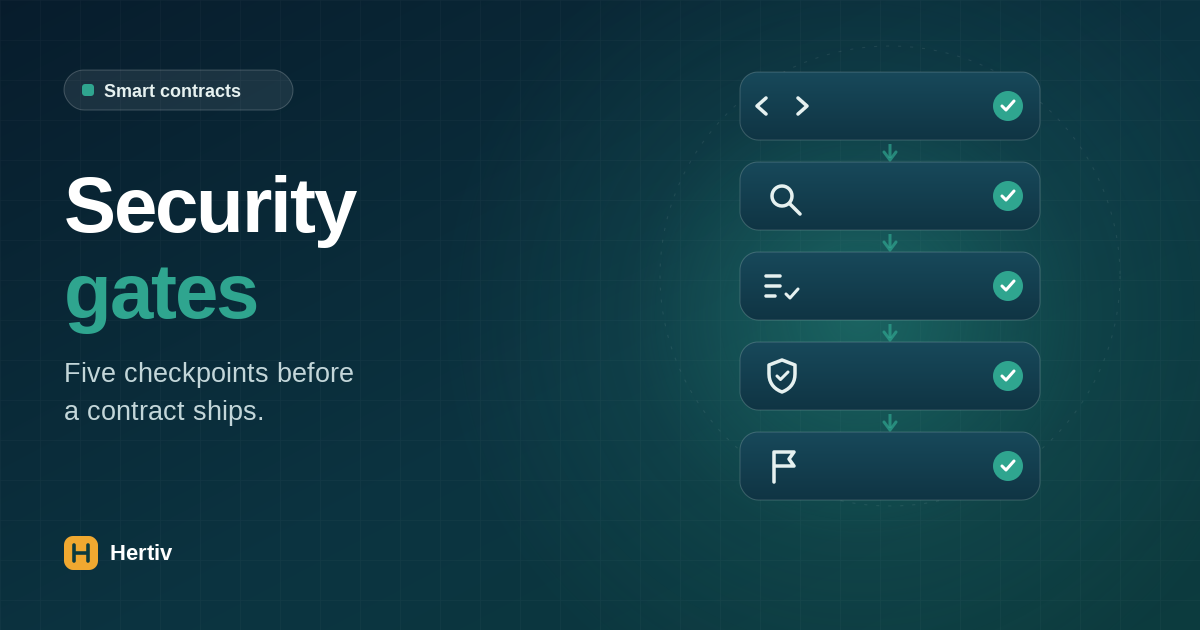
A typical pipeline has five gates:
- Code review. A second developer reads every change.
- Static analysis. Automated tools flag known risky patterns.
- Tests. Unit and integration tests prove the code behaves as planned.
- Audit. An independent reviewer checks the finished code.
- Deploy check. Upgrade, timelock and monitoring are confirmed before launch.
Which gates does a release need?
A release needs the gates that match its risk. A small fix to a view function needs fewer checks than a new lending pool, but no contract should reach mainnet without at least a review, tests and a deploy check.
| Gate | What it checks | Pass criteria | Who approves |
|---|---|---|---|
| Code review | Logic and readability | Two approvals, no open comments | Senior developer |
| Static analysis | Known risky patterns | Zero high-severity findings | Security engineer |
| Tests | Behaviour and edge cases | Full suite green, coverage target met | Developer |
| Audit | Design flaws and assumptions | High findings fixed or accepted in writing | Auditor |
| Deploy check | Upgrade and monitoring | Timelock set, pause tested, alerts live | Release owner |
Skip a gate only in writing, with a named owner and a date to revisit the decision. An undocumented skip becomes the norm, and the next release inherits a weaker pipeline without anyone choosing it.
How does the code review gate work?
The code review gate works by putting every change in front of a second developer who was not the author. The reviewer reads the diff against the design, checks each function for the flaws listed in the team's checklist, and leaves comments the author must answer before the change moves on.
A review passes when two reviewers approve and no comment is left open. Keep reviews small: a change under a few hundred lines gets a careful read, while a large pull request gets skimmed. Split big changes into smaller ones so each gate review stays honest.
The reviewer also checks the change against the contract's threat model. If the change adds a new external call, a new admin role or a new way to move funds, the reviewer flags it for a second look and a test that covers the new path.
How do testing and analysis gates work?
Testing and analysis gates run automatically on every change. Static analysis tools scan the code for known risky patterns, such as unchecked external calls and unsafe arithmetic, while the test suite runs unit tests for each function and integration tests for the full flow. The patterns they look for overlap with the flaws in smart contract vulnerabilities that teams already know to avoid.
The gate passes when the full suite is green and no high-severity finding is open. A failing test blocks the merge, and a new finding must be fixed or recorded as accepted risk by a named owner. Fuzz tests add value here: they call functions with random inputs and catch edge cases a written test would miss.
Keep the suite fast enough to run on every change. A suite that takes an hour gets skipped in practice, while one that runs in minutes becomes part of the habit. Measure coverage for the functions that move funds, and treat a drop in coverage as a failed gate.
How does the audit gate work?
The audit gate brings in an independent reviewer who reads the finished code with fresh eyes. The auditor checks the design, the assumptions behind it and the code itself, then reports findings ranked by severity. The gate passes only when every high-severity finding is fixed or accepted in writing by a named owner.
Plan the audit early, because a good auditor needs weeks of lead time and the code must be frozen while they work. Changing code mid-audit restarts their review and wastes the slot. After the audit, fix the findings, re-test, and ask the auditor to confirm the fixes before the deploy gate opens. A smart contract audit works best as one gate inside this system, not as the whole system.
A small change after the audit still needs a check. If the fix touches a function that moves funds, run the tests and ask for a short re-review of that part. Treating the audit as a one-time stamp, rather than a gate that re-opens, is how audited contracts still ship with flaws.
Example: a lending contract passes five gates
Example (hypothetical): a team ships a lending contract that lets users deposit tokens and borrow against them. The release passes through five gates: code review, static analysis, tests, audit and deploy check. Two gates fail on the first pass and the release waits.
Static analysis flags an unchecked external call in the withdraw function, and the audit finds that a price feed can be read before it updates. The team fixes both, adds a test for each case, and re-runs the suite. The second pass is clean: 5 gates passed, 0 open high-severity findings, 214 tests green.
At the deploy gate the team confirms the timelock is set to 48 hours, the pause function is tested, and alerts are live for large withdrawals. The contract ships a week late but with a written record of every check, which is exactly what the gates are for.
What are the common mistakes?
The most common mistakes are treating the audit as the only gate, letting a gate pass on a verbal promise, and skipping gates when a deadline slips.
- One gate only. An audit without review, tests or a deploy check leaves gaps the audit never sees.
- Verbal passes. A gate that passes on a chat message has no record and no owner.
- Skipped under pressure. A deadline is the worst time to drop a check, because rushed code needs it most.
- Frozen findings. A high-severity finding marked accepted with no owner and no date stays open forever.
- No re-check after fixes. A fix that is never re-tested can introduce a new flaw while closing the old one.
Fix the process, not just the finding. When a gate fails, record what failed, who owns the fix and when it will be re-checked, so the same failure does not repeat on the next release. A smart contract audit works best when it sits inside this gate system rather than replacing it.
Key takeaways
- A security gate is a pass-or-fail checkpoint; a failed gate blocks the release
- Five gates cover most releases: review, static analysis, tests, audit and deploy check
- Every gate needs written pass criteria and a named approver
- Fixes after an audit need a re-check before the deploy gate opens
- A skipped gate should be recorded in writing, with an owner and a date
Frequently asked questions
How many security gates does a smart contract release need?
At least five: code review, static analysis, tests, audit and a deploy check. A small fix can use a lighter version of the same gates, but skipping one entirely removes the record of what was checked. The number matters less than the rule that a failed gate always blocks the release.
Who approves each gate?
Each gate has a named approver: a senior developer for code review, a security engineer for static analysis, the auditor for audit findings, and a release owner for the deploy check. Approval is recorded in writing, so the team can see later who cleared each stage and what they checked.
Do small changes need all five gates?
A small change still passes through the gates, but the checks are lighter: a short review, the automated suite, and a deploy check. The audit gate only re-opens when the change touches code that moves funds or changes access rules. The point is a record, not paperwork for its own sake.
What happens when a gate fails?
The release stops at that gate until the issue is fixed or accepted in writing by a named owner with a date. The team records what failed, who owns the fix, and when it will be re-checked. A gate that can be waved through on a verbal promise is not a gate.
Is an audit enough on its own?
No. An audit checks the code at one point in time, but it cannot catch changes made after it, gaps in testing, or a broken deploy step. Gates around the audit, such as review, tests and a deploy check, catch the problems an audit never sees.
How do gates work with upgrades?
Upgrades get their own deploy gate: the team confirms the timelock, tests the pause function, and checks monitoring and alerts before the upgrade goes live. An upgrade that changes how funds move should also re-open the audit gate for the changed code.


