SLM vs LLM: Which Model Size Fits Your Product?
A small language model is far smaller and cheaper than a large one, but it handles a narrower range of tasks. Pick by what your product asks it to do.
On this page
Short answer
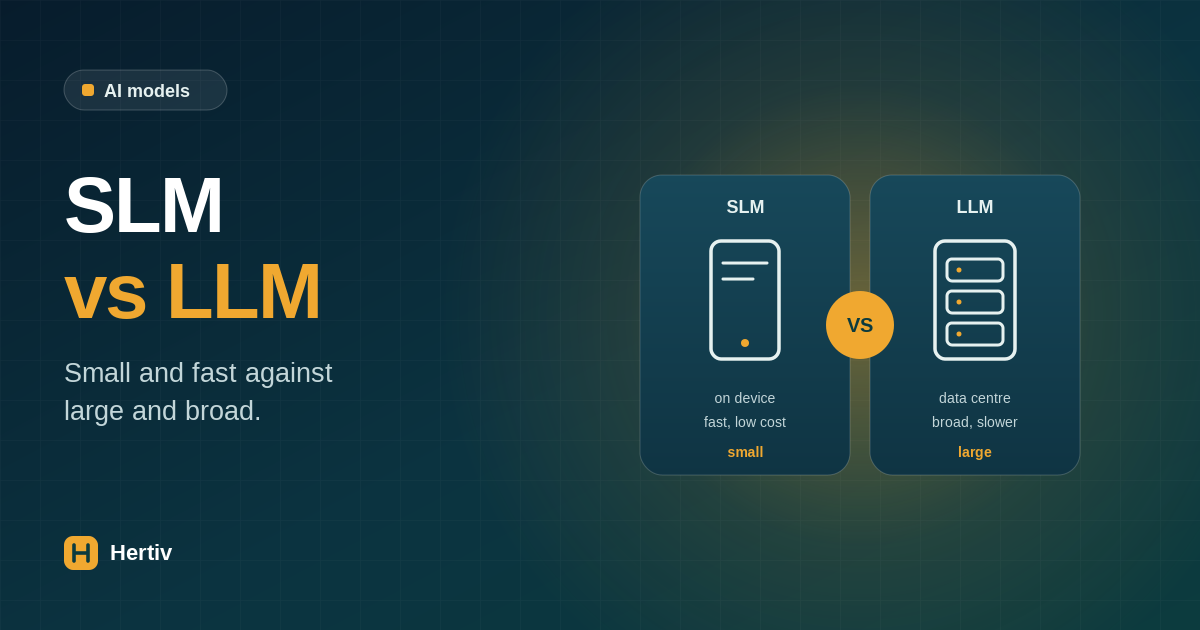
A small language model, or SLM, is a language model with far fewer parameters than a large language model, or LLM, designed to run faster and cheaper on narrower tasks. An LLM is a model with billions of parameters trained on broad data, while an SLM is a compact model tuned for a specific job, such as classification, extraction or short drafting.
What is the difference between an SLM and an LLM?
A small language model, or SLM, is a language model with far fewer parameters than a large language model, or LLM, designed to run faster and cheaper on narrower tasks. An LLM is a model with billions of parameters trained on broad data, while an SLM is a compact model tuned for a specific job, such as classification, extraction or short drafting.
Parameters are the numbers a model learns during training. A large model may have hundreds of billions of them; a small model may have a few hundred million or a few billion. More parameters usually mean broader knowledge and stronger reasoning, but also more computing power, slower replies and higher cost per request.
The practical difference is scope. An LLM can attempt almost any text task, from writing code to summarising law, while an SLM does one kind of task well and struggles outside it. That is not a flaw: a model that only needs to sort support tickets does not need to know how to write poetry.
| Factor | Small language model | Large language model |
|---|---|---|
| Size | Millions to a few billion parameters | Tens to hundreds of billions of parameters |
| Where it runs | On a phone, laptop or small server | Usually in a data centre or by API |
| Speed | Fast, often under a second | Slower, seconds per reply |
| Cost per request | Very low | Much higher |
| Best for | One repeated, narrow task | Open-ended, varied tasks |
What is a small language model?
A small language model is a compact model built to do a limited set of tasks well, often on modest hardware. It is trained or fine-tuned on data from one domain, such as support tickets, medical notes or code, and it answers from that narrow base.
Because it is small, an SLM can run on a phone, a laptop or a single small server. That makes it useful where the internet is slow, where data must stay on the device, or where replies must arrive in under a second. A phone keyboard that suggests the next word is a small model doing one job.
Small models also cost far less to run. A company that classifies 100,000 documents a day can do it with a small model for a fraction of what a large model would charge, and the answers are often just as good for a task this narrow. The trade-off is that the model will fail on questions outside its training.
What is a large language model?
A large language model is a model trained on a huge range of text, which gives it broad knowledge and the ability to handle tasks it was never directly taught. It can draft, summarise, translate, reason through a problem and write code, often in the same conversation.
That breadth is what makes LLMs useful as general assistants and copilots. A support agent that must answer any question a customer asks, or a research tool that must read unfamiliar documents, needs the range a large model provides.
The cost of that breadth is size. Large models need data-centre hardware or a paid API, replies take longer, and each request costs more. They also need more guardrails: a model that can do anything can also produce a confident wrong answer on a topic it barely knows. See the top LLM tools for the models teams most often compare.
SLM vs LLM: side-by-side comparison
The choice between an SLM and an LLM comes down to four questions: how varied are the tasks, how fast must replies be, where must the data stay, and what can each request cost.
| Question | Choose an SLM when | Choose an LLM when |
|---|---|---|
| Task variety | One repeated task, such as sorting or extracting | Many different tasks in one product |
| Latency | Replies must be instant or offline | A few seconds of waiting is fine |
| Data location | Data must stay on the device | Data can go to a cloud API |
| Volume | Millions of small requests a day | Lower volume, higher value per request |
| Accuracy needs | Good enough on a narrow task | Needs broad knowledge and reasoning |
Many products use both. A common pattern is to route simple requests to a small model and send only the hard ones to a large model. The small model handles the bulk cheaply, and the large model is there for the cases that need it.
When to choose an SLM
Choose an SLM when the task is narrow, repeated and well defined. Sorting tickets by topic, pulling fields from invoices, flagging toxic comments and suggesting the next word are all tasks where a small model is often as accurate as a large one, at a fraction of the cost.
Choose an SLM when replies must be fast or offline. A voice assistant in a car, a translation tool on a phone and a code completion feature in an editor all need answers in well under a second, which a small model on the device can deliver.
Choose an SLM when data cannot leave the device or the building. Health, legal and defence work often has this rule, and a small model running locally keeps the data where it belongs. Self-hosting is a related option, covered in what self-hosting an LLM costs.
Finally, choose an SLM when volume is high and each request is worth little. A million small classifications a day will bankrupt a large-model budget, while a small model handles them for very little.
Example (hypothetical): routing between an SLM and an LLM
Example (hypothetical): a company handles 100,000 support requests a day, each averaging 500 tokens. All of them go to a large model first.
Assume the large model costs $5 per million tokens and a small model costs $0.20 per million tokens for this example. All large: 100,000 times 500 equals 50,000,000 tokens a day, or 50 million, at $5 per million, which is $250 a day.
Now route 90 percent of requests to the small model and keep 10 percent on the large model. Small: 45 million tokens at $0.20 per million equals $9. Large: 5 million tokens at $5 per million equals $25. Total: $9 plus $25 equals $34 a day, down from $250.
The saving is $216 a day, or about $6,480 a month, as long as the small model handles its 90 percent well. That last condition is the whole job: measure the small model's accuracy on real requests before routing traffic to it.
Common mistakes when choosing between SLM and LLM
The most common mistakes are choosing the largest model by default, and choosing a small model for a task it cannot do.
- Starting with the largest model. Test the small model on real tasks first; it may already be good enough.
- Using an SLM for open-ended reasoning. Small models fail quietly on tasks outside their training.
- Judging by demo, not by data. A model that looks smart in a demo can fail on your own documents.
- Ignoring latency and cost at scale. A reply that costs a few cents is fine once, and ruinous a million times a day.
- No fallback path. When the small model is unsure, the request should go to the large model or a human.
- Skipping evaluation. Without a test set of real cases, you cannot tell which model is actually better.
Before committing to either, a short AI proof of concept with a fixed test set will show which size fits your tasks. The test set matters more than the model choice.
Key takeaways
- An SLM is small, fast and cheap; an LLM is broad, slower and dearer
- Small models suit one repeated task; large models suit varied work
- SLMs can run on a device, which helps privacy and speed
- Routing simple requests to an SLM can cut costs sharply
- Always test on your own data before choosing a model size
Frequently asked questions
How small is a small language model?
There is no fixed line, but small models usually have from a few hundred million to a few billion parameters, while large models have tens to hundreds of billions. The useful test is not the parameter count but whether the model handles your task well on your data.
Can an SLM replace an LLM completely?
Rarely. A small model can replace a large one for a narrow, repeated task, but it cannot match the breadth of a large model on open-ended work. Most products that save money use both, routing simple requests to the small model.
Do SLMs work offline?
Yes, that is one of their main strengths. A small model can run on a phone, laptop or small server with no internet connection, which suits privacy-sensitive work, remote locations and features that must answer instantly.
Are SLMs less accurate than LLMs?
On narrow tasks they are often just as accurate, because the task is well defined and the model is tuned for it. On broad or reasoning-heavy tasks they are usually worse. Accuracy depends on the task, so test both on your own cases.
What does SLM stand for?
SLM stands for small language model. LLM stands for large language model. The letters describe size, not a different kind of technology: both are language models trained to predict text, just at very different scales.
How do I pick between an SLM and an LLM?
List your tasks, test both sizes on a sample of real cases, and compare accuracy, speed and cost per request. Pick the smallest model that passes your accuracy bar, and keep the large model as a fallback for hard cases.


