How to Scale and Secure a DeFi Staking Platform
A DeFi staking platform must handle growing deposits and rewards without breaking. This guide covers scaling, security checks and the mistakes that cost teams most.
On this page
Short answer
To scale and secure a DeFi staking platform, separate reward logic from deposits, design for peak load, and audit every contract change before it ships. Use time locks and multi-signature control for upgrades, monitor deposits and withdrawals in real time, and keep an incident plan ready. Growth and security are the same job: each new feature must pass both a load test and a security review.
What is a DeFi staking platform?
A DeFi staking platform is a set of smart contracts that lets users lock tokens and earn rewards, usually in exchange for helping secure a network or provide liquidity. Users deposit tokens, the platform tracks each stake, and rewards are paid out over time according to rules written in the contracts.
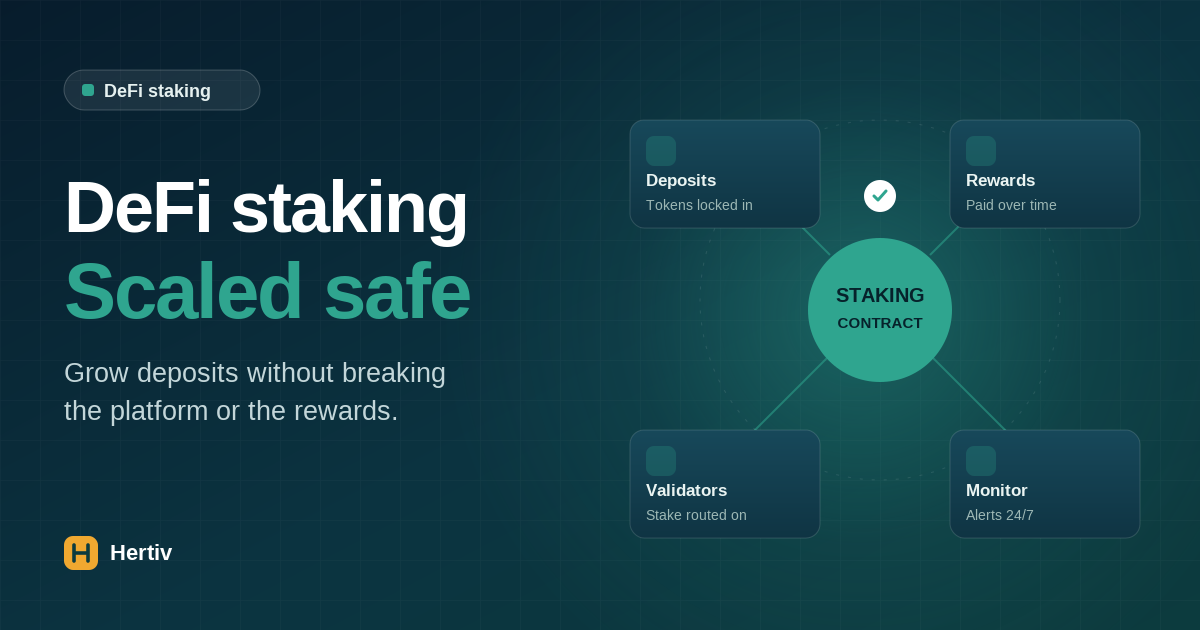
The platform has several parts that must work together:
| Part | What it does | Why it matters |
|---|---|---|
| Staking contract | Holds deposits and records stakes | Directly holds user funds |
| Reward logic | Calculates and pays rewards | Errors here drain the reward pool |
| Validator or delegation layer | Routes stake to validators | Sets yield and slashing risk |
| Frontend and API | Shows balances and lets users act | Most load lands here first |
| Monitoring | Watches deposits, exits and prices | Catches problems early |
Scaling and security are linked because the staking contract holds the funds. A design that cannot handle growth will fail under load, and a design that is not checked will fail under attack. Both need attention from the first version, not after launch. Teams planning a build usually start with DeFi development to map the contracts before writing code.
How are staking rewards calculated?
Staking rewards are calculated from the amount staked, the time it stays locked, and the reward rate set by the platform. Most platforms pay rewards in blocks or per day, and the rate falls as total deposits rise, because the same reward pool is shared across more tokens.
Three choices shape the reward model:
- Fixed or variable rate. A fixed rate is simple to explain but hard to fund when deposits grow fast. A variable rate adjusts with total stake and is easier to sustain.
- Lock period. Longer locks pay more because they give the platform stable deposits. Short locks or no lock attract more users but make deposits less predictable.
- Compounding. Some platforms restake rewards automatically, which grows a user's stake without new deposits. This adds code paths that need testing.
Reward maths must be exact. Rounding errors look small per user but add up across thousands of stakes, and a reward formula that can be gamed by depositing and withdrawing quickly will be found fast. Write the formula down, test it with edge cases, and have an auditor check it separately from the rest of the code.
How to scale a staking platform
You scale a staking platform by keeping heavy work off the chain, batching what remains, and designing every part for the busiest day rather than the average one.
A practical sequence:
- Cache reads. Balances, reward estimates and history should come from an indexer or cache, not from repeated chain calls. The frontend should rarely talk to the chain directly.
- Batch writes. Group reward claims and validator updates into batches where the design allows it, so gas costs and chain load stay in check as users grow.
- Queue withdrawals. Large exits should move through a queue with clear timing, so a rush of unstaking cannot drain liquidity or block the contract.
- Move to a lower-cost chain or layer 2 when volume justifies it. High gas costs push small stakers out first, which narrows the user base to large holders.
- Load test with realistic numbers. Test with the deposit count, claim rate and withdrawal volume you expect at three times current size, not at today's size.
- Keep the database and indexer in step. If the frontend shows a different balance from the contract, support tickets follow within hours.
Scaling is mostly about removing work from the critical path. Anything a user does not need in real time should happen in the background, and anything that touches funds should be as simple as the design allows.
Security controls that matter most
Security for a staking platform starts with the contracts, because they hold the funds, and extends to every key, upgrade path and admin action around them.
The controls that matter most:
- Independent audit before launch and after every material change. An audit is not a one-time event; each new feature needs the same review. Smart contract audit work should cover reward maths, access control and upgrade paths, not just the headline functions.
- Multi-signature admin control. No single key should be able to change reward rates, pause the platform or move funds. Require several signers and keep the signer set reviewed.
- Time locks on upgrades. Contract changes should wait a fixed period before taking effect, so users and monitors can see what is coming and react.
- Pause and emergency exit. The team needs a tested way to stop deposits or withdrawals during an incident, and a way for users to exit if the platform itself is compromised.
- Real-time monitoring. Watch large deposits, unusual withdrawals, failed transactions and admin actions, and alert a human around the clock.
- Bug bounty. A public bounty with clear scope invites researchers to report problems before attackers use them.
None of these controls helps if the team cannot use them under pressure. Rehearse the incident plan the way you rehearse a launch, including who decides, who signs and how users are told what is happening.
Example (hypothetical): a staking platform doubles deposits
Example (hypothetical): a staking platform holds 2,000,000 tokens from 10,000 stakers, so the average stake is 200 tokens. The reward rate is 8% per year, paid from a reward pool funded by protocol fees.
At 8% per year, the pool pays 160,000 tokens a year, which is 2,000,000 times 0.08. An average staker with 200 tokens earns 16 tokens a year, or about 1.33 tokens a month, since 16 divided by 12 is 1.33.
Deposits then double to 4,000,000 tokens with the same reward pool. The rate falls to 4% per year, because 160,000 divided by 4,000,000 is 0.04. The average staker now earns 8 tokens a year instead of 16, unless the team tops up the pool or changes the rate.
The lesson is that growth changes the economics, not just the load. The team should decide in advance how the rate responds to deposits, publish the rule, and test the reward maths at two and four times current size before growth arrives.
What are the common mistakes?
The most common mistakes in DeFi staking platforms are reward maths nobody tested at scale, admin keys held by one person, and upgrades shipped without a review.
- Reward formulas that break at scale. A formula tested with ten users can overflow, round badly or pay out too much with ten thousand.
- Single-key admin control. One compromised key should never be enough to change rates or move funds.
- Upgrades without a time lock. Instant upgrades leave users no time to exit if a change is hostile or wrong.
- No withdrawal queue. Without one, a rush of exits can block the contract or drain liquidity.
- Monitoring that nobody watches. Alerts that go to an inbox nobody reads are the same as no alerts.
- Copying another platform's contracts. Forked code inherits bugs, and the reward parameters of one platform rarely fit another.
- Ignoring the frontend. A phishing copy of the frontend can steal more than a contract bug, so domain, wallet prompts and transaction previews need care.
A launch checklist for scaling and security
A launch checklist keeps scaling and security together, so neither is treated as an afterthought once users arrive.
- Write down the reward formula and test it at two and four times expected deposits.
- Complete an independent audit, fix the findings, and publish the report.
- Put admin actions behind multi-signature control with a time lock.
- Set up monitoring and alerts for deposits, withdrawals, admin actions and failed transactions.
- Load test the frontend, API and indexer at three times expected peak traffic.
- Rehearse the incident plan, including pausing, communicating with users and restoring service.
- Launch a bug bounty with a clear scope and a way to pay researchers.
After launch, repeat the audit and load test after every material change. A platform that grows safely is one that treats each release as a new launch, not as a small edit. If the team needs help designing the contracts, blockchain development support can cover the architecture before code is written.
Key takeaways
- Separate reward logic from deposits so a reward bug cannot touch staked funds
- Reward rates must be tested at two and four times current deposits, not just at launch size
- Multi-signature control and time locks should guard every admin action and upgrade
- Withdrawals need a queue so a rush of exits cannot block the platform
- Monitoring and a rehearsed incident plan matter as much as the audit itself
Frequently asked questions
How much does it cost to build a DeFi staking platform?
Cost depends on contract complexity, audits, frontend and infrastructure, and on whether the team builds on an existing chain or a layer 2. Budget for at least one independent audit and for ongoing monitoring, because both are part of the build, not extras added later.
How do staking rewards stay sustainable as deposits grow?
Rewards stay sustainable when the rate adjusts with total deposits or when the reward pool grows with protocol fees. A fixed rate funded from a fixed pool falls as deposits rise, so the team should publish the rule and test it at several deposit sizes before launch.
What is slashing, and does it affect stakers?
Slashing is a penalty that removes part of a validator's stake when it misbehaves, such as signing conflicting blocks or staying offline. Stakers who delegate to a slashed validator can lose part of their stake, which is why validator choice and limits per validator matter.
Should a staking platform use multi-signature control?
Yes. Admin actions such as changing reward rates, pausing the platform or upgrading contracts should need several signers, so one compromised key cannot cause damage. The signer set should be reviewed regularly and include people who can act outside working hours.
How long should contract upgrades wait before taking effect?
A time lock of several days is common, because it gives users and monitors time to read the change and exit if they disagree. The exact period depends on the platform, but instant upgrades are a risk: they remove the only window users have to react.
What should monitoring watch on a staking platform?
Monitoring should watch large deposits and withdrawals, failed transactions, admin actions, reward pool balance and validator health. Alerts should reach a human around the clock, and the team should rehearse what happens when an alert fires, not just set it up.


