Russia Crypto Law: What Is Legal and What Is Not
Russia treats crypto as property, not money: owning, trading and mining are legal under defined rules, but domestic payments are banned. Here is the framework.
On this page
Short answer
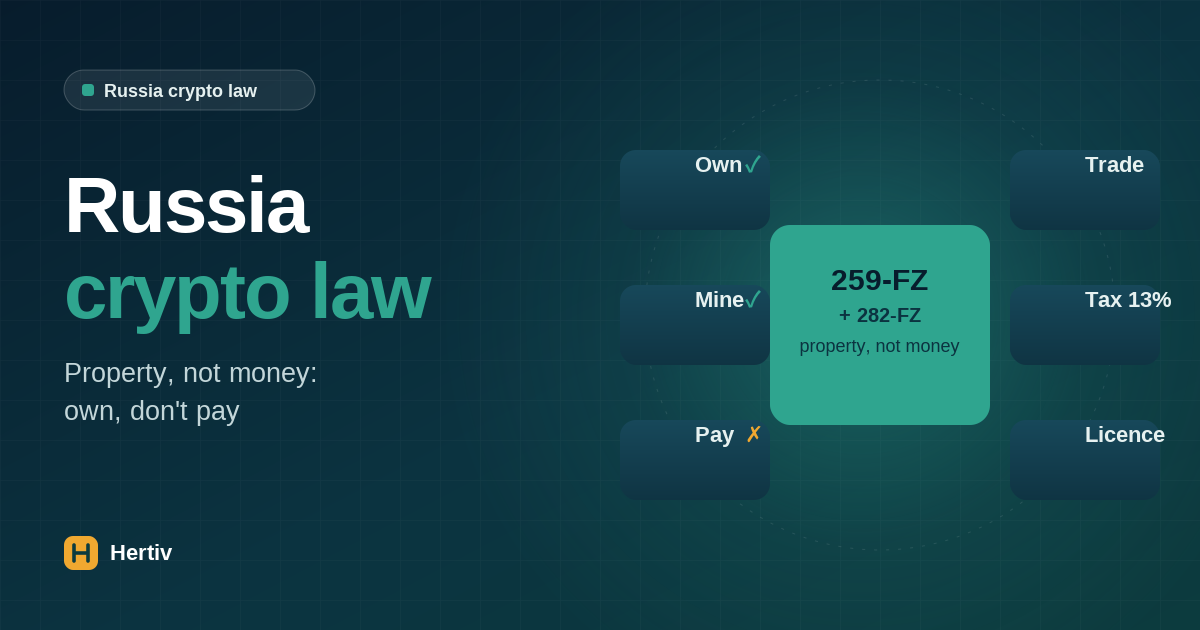
Russian crypto law treats cryptocurrency as property, not money. Owning, buying, selling and mining are generally legal under defined rules, while domestic payments in crypto are banned. Federal Law No. 259-FZ set the base framework in 2020, mining was legalised in 2024, and a 2026 law opened licensed trading.
What does Russian crypto law say?
Russian crypto law treats cryptocurrency as property, not as money. You can own it, buy it, sell it and mine it under defined rules, but you generally cannot use it to pay for goods or services inside Russia, because the ruble is the only legal means of payment.
The framework rests on Federal Law No. 259-FZ of July 2020, which took effect in January 2021 and recognised digital currency as a form of property-like digital value. It also created digital financial assets, which are tokenised rights issued and traded only on platforms licensed by the Bank of Russia. The central bank is the main regulator, and its stance has moved from proposing a full ban in early 2022 to supporting regulated crypto use.
Two later laws filled in the picture. Mining was legalised in 2024 under a separate law, and Federal Law No. 418-FZ, effective from January 2025, classified crypto as property for tax purposes. A further law in 2026 opened licensed trading. The rules differ by activity, so the right question is never whether crypto is legal, but which activity you mean.
What is legal and what is banned in Russia?
Crypto activity in Russia is split into what is allowed, what is allowed with conditions, and what is banned. Owning, buying and selling crypto are generally permitted, while domestic payments are the hard line that has not moved.
| Activity | Legal position | Main condition |
|---|---|---|
| Owning crypto | Generally legal | Ownership does not make it legal tender |
| Buying and selling | Generally permitted | Gains create tax reporting duties |
| Domestic payments | Generally banned | Cannot pay for goods or services in crypto |
| Mining | Legal under regulation | Registration, reporting and electricity limits |
| Cross-border trade settlement | Permitted in limited arrangements | Only through the experimental legal regime |
| Advertising crypto as payment | Restricted | Cannot pitch crypto as a payment method |
The payment ban is the part most people get wrong. A Russian business generally cannot accept crypto for a domestic sale, and advertising that pitches crypto as a payment method is restricted. The ban does not apply to people resident in Russia for fewer than 183 days a year, or to foreign entities without a Russian branch. For the wider compliance picture, see how to comply with the Travel Rule.
How is crypto mining regulated in Russia?
Crypto mining is legal in Russia, but it is regulated, and the rules depend on scale. The mining law signed in 2024 brought an activity that had lived in a grey area into a formal framework with registration, reporting and electricity limits.
Companies and individual entrepreneurs must enter a register kept by the Federal Tax Service. Private individuals can mine without registration below a monthly electricity threshold of 6,000 kWh; above that, registration applies. Regional restrictions can also apply, and mining in some regions has been limited where the power grid is under strain.
Mining income is taxed on the market value of the coins at the time they are received, with deductions for mining-related expenses, and mining and crypto sales are exempt from VAT. The mined coins themselves can also be used in cross-border settlements under the experimental regime, which is one reason mining matters to the wider framework.
How is crypto taxed in Russia?
Crypto is taxed as property in Russia. Federal Law No. 418-FZ, signed in November 2024 and effective from January 2025, placed crypto on par with traditional financial instruments such as securities for tax purposes.
Personal income tax on crypto gains follows a two-tier structure: 13% on annual gains up to 2.4 million rubles, and 15% on gains above that threshold. Mining income is taxed on the market value of coins when received, less deductible expenses. Crypto mining and crypto sales are exempt from VAT.
The practical point is that gains are reportable even though crypto is not legal tender. A person who sells crypto at a profit has a tax duty, and the law now guarantees court protection for crypto owners regardless of whether the assets were declared before. Keeping records of purchase prices and sale dates is what makes that duty manageable.
What changed with the 2026 trading law?
The 2026 trading law, Federal Law No. 282-FZ, signed in August 2026 and in effect from 1 September 2026, is Russia's first full framework for crypto trading and custody. It wraps exchanges, digital depositories, brokers and clearing houses into one system supervised by the Bank of Russia.
Only firms on a state registry may run exchanges after 1 July 2027, and registered exchanges need at least 15 million rubles of their own capital and must join a self-regulatory body. Banks must reject transfers they suspect are routed through an unregistered provider.
Non-qualified retail investors face a knowledge and suitability test, and after passing they may buy up to 300,000 rubles of approved crypto per year through each licensed intermediary. The Bank of Russia proposed bitcoin, ether and USDT as the first assets for regulated retail trading.
The same date brought the digital ruble into wider use, with the 12 largest banks required to support it and full rollout to all banks by September 2028. Domestic crypto payments remain banned, but exporters and importers can settle cross-border contracts in crypto without transaction limits under the experimental regime. How other countries handle the same question is covered in the best countries to launch a stablecoin.
Example: tax on a crypto gain in Russia
Example (hypothetical): a Russian resident sells crypto during the year and makes a gain of 3,000,000 rubles, after deducting the purchase cost and fees.
The gain crosses the 2.4 million ruble threshold, so it is taxed in two parts. The first 2,400,000 rubles are taxed at 13%, which is 2,400,000 x 0.13 = 312,000 rubles. The remaining 600,000 rubles are taxed at 15%, which is 600,000 x 0.15 = 90,000 rubles. The total tax is 312,000 + 90,000 = 402,000 rubles.
The same person also holds crypto bought through a licensed intermediary. The retail cap of 300,000 rubles a year applies per intermediary, so using two licensed intermediaries would allow up to 600,000 rubles of purchases a year, which is 300,000 x 2. That cap limits buying, not the tax: any gain on a later sale is taxed under the same two-tier rule.
What are the common mistakes?
The most common mistakes about Russian crypto law are treating the rules as one blanket ban or one blanket permission, and forgetting that the framework keeps changing.
- Calling crypto banned. Owning, trading and mining are legal under defined rules; only domestic payment is broadly banned.
- Paying a supplier in crypto. A domestic payment in crypto is generally prohibited, even between willing parties.
- Mining without registering. Businesses must register, and individuals above the 6,000 kWh monthly threshold must too.
- Ignoring the tax duty. Gains are taxed as property at 13% up to 2.4 million rubles and 15% above, and records matter.
- Trusting an unregistered exchange. After July 2027 only registered firms may run exchanges, and banks can block transfers to others.
Key takeaways
- Crypto is legal as property in Russia, but it is not legal tender and cannot pay for domestic goods or services
- Federal Law No. 259-FZ of 2020 set the base framework; mining was legalised in 2024 and taxed as property from 2025
- Mining needs registration above 6,000 kWh a month for individuals, and always for businesses
- Crypto gains are taxed at 13% up to 2.4 million rubles and 15% above that threshold
- The 2026 trading law caps retail buyers at 300,000 rubles a year per licensed intermediary
- Cross-border trade settlement in crypto is permitted only through the experimental legal regime
Frequently asked questions
Is cryptocurrency legal in Russia?
Yes, as property. Owning, buying, selling and mining crypto are generally legal under defined rules, and crypto gains are taxed as property. What is banned is using crypto as a domestic means of payment, because the ruble is the only legal tender.
Can I pay for goods or services with crypto in Russia?
Generally no. Russian persons cannot accept digital currency as payment for domestic goods or services, and advertising that pitches crypto as a payment method is restricted. The ban does not apply to people resident fewer than 183 days a year or to foreign entities without a Russian branch.
Is crypto mining legal in Russia?
Yes, since the mining law of 2024. Companies and individual entrepreneurs must register with the Federal Tax Service, and private individuals can mine without registration below 6,000 kWh of electricity a month. Mining income is taxed on the market value of coins when received.
How is crypto taxed in Russia?
Crypto is taxed as property. Personal income tax on gains is 13% on annual gains up to 2.4 million rubles and 15% on gains above that threshold. Mining and crypto sales are exempt from VAT, and mining expenses are deductible.
What is the 2026 crypto trading law?
Federal Law No. 282-FZ, signed in August 2026 and in effect from 1 September 2026, created a licensed market for crypto trading, custody and cross-border settlement supervised by the Bank of Russia. Only registered firms may run exchanges after 1 July 2027.
Can Russian companies settle foreign trade in crypto?
Yes, in limited arrangements. Since September 2024 an experimental legal regime overseen by the Bank of Russia has permitted approved businesses to use digital currencies for international trade settlements, including deals involving mined coins.


