How Does RPA Work in Manufacturing?
RPA in manufacturing automates repetitive tasks such as order entry, inventory updates and quality reports. Here is where it fits, how it works and where it fails.
On this page
Short answer
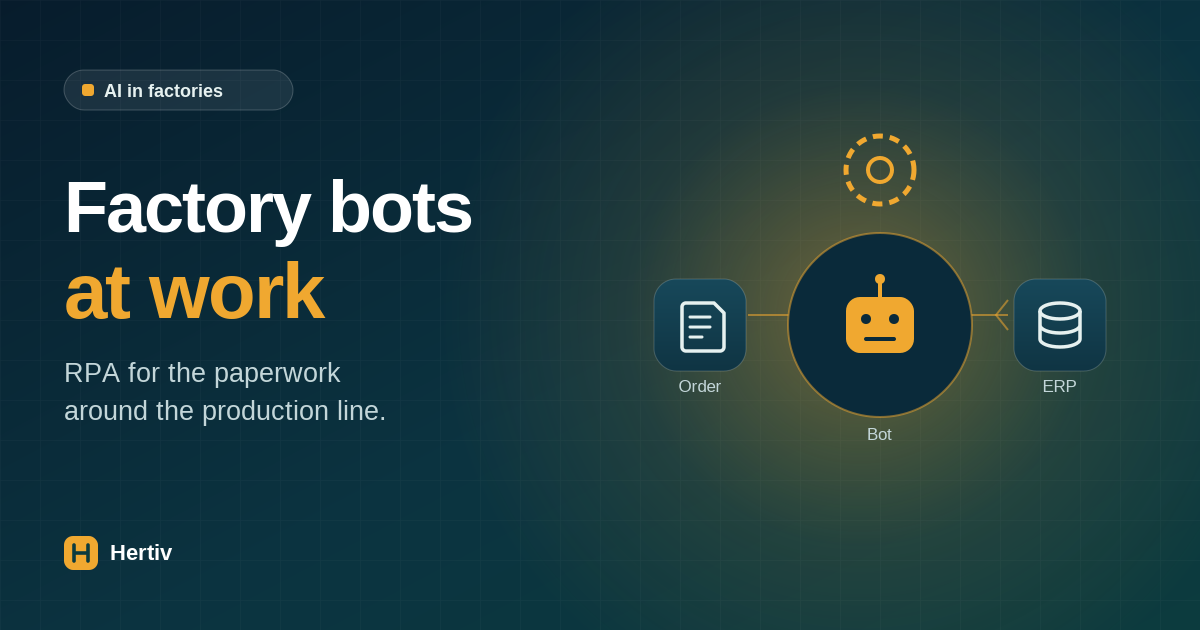
RPA in manufacturing uses software bots to carry out repetitive, rule-based tasks in factory systems, such as entering orders, updating inventory and filing quality reports. A bot follows the same steps a person would, but faster and without skipping steps. It suits high-volume work with clear rules, not decisions that need judgement.
What is RPA in manufacturing?
RPA in manufacturing is the use of software bots to carry out repetitive, rule-based tasks in factory systems, such as entering orders, updating inventory, filing quality reports and chasing supplier invoices. A bot follows the same steps a person would, clicking through the same screens and systems, but it does not get tired and it does not skip a step.
RPA is not a robot arm and it is not artificial intelligence. It does not decide what to do; it does what it is told, in the order it is told. That limit is also its strength: for work that is the same every time, a bot is faster and more consistent than a person doing it by hand.
The work it suits best is high volume, low judgement and spread across systems that do not talk to each other. If a task needs a person to weigh options or handle exceptions, RPA alone will not do it. RPA versus AI agents explains where bots end and AI begins.
Where does RPA fit on the factory floor?
RPA fits the office side of manufacturing more than the production line. The line itself is run by machines and control systems; the paperwork around it is where bots earn their keep.
| Process | What the bot does | Why it fits |
|---|---|---|
| Order entry | Copies orders from email or a portal into the ERP | Same fields every time |
| Inventory updates | Moves stock counts between the warehouse system and the ERP | Repetitive and rule-based |
| Quality reporting | Pulls test results into a daily report for the quality team | Same format, every day |
| Maintenance scheduling | Creates work orders when a machine hits its service interval | Triggered by a clear rule |
| Supplier invoices | Matches invoices to purchase orders and flags mismatches | High volume, clear checks |
| Compliance records | Files batch records and certificates in the right folders | Audit trail matters |
A good test is whether the task can be written down as a checklist with no judgement calls. If the checklist has more than a few "it depends" steps, the task is a poor fit for RPA on its own.
How does an RPA bot work, step by step?
A bot is built by recording and refining the steps a person takes, then letting the bot repeat them on a schedule or when a trigger fires.
- Map the task. Write down every click, field and decision, including what happens when data is missing.
- Build the bot. The developer records the steps in an RPA tool and adds checks for common errors.
- Test with real data. Run the bot on past orders or invoices and compare its output with what a person produced.
- Set the trigger. The bot runs on a schedule, when a file arrives, or when a system event fires.
- Add exception handling. Anything the bot cannot handle goes to a human queue with the reason attached.
- Monitor and maintain. Systems change, screens move, and a bot that is not maintained breaks quietly.
Step five is the one teams skip. A bot without a clear exception path either stops and blocks the queue, or worse, it keeps going and writes bad data into the ERP.
What results can a plant expect from RPA?
The honest answer is that results depend on the task, and anyone promising a fixed return is guessing. What RPA reliably delivers is speed on repetitive work, fewer copy errors, and a record of everything it did.
- Faster cycle times. A bot processes an order or invoice in minutes, at any hour, without a queue forming overnight.
- Fewer entry errors. The bot copies fields exactly, so typos and transposed digits drop.
- A full audit trail. Every run is logged, which helps quality and compliance teams.
- Staff time back. People move from data entry to the exceptions and decisions that need judgement.
The gains fade if the underlying process is broken. Automating a bad process just produces bad results faster, so the first step is always to fix the process, then automate it. What AI and RPA are covers how the two fit together in a plant.
Example (hypothetical): a mid-size parts plant
Example (hypothetical): a parts plant processes 1,000 supplier orders a month. Each order takes a person 12 minutes to enter, so the team spends 1,000 × 12 = 12,000 minutes, or 200 hours, a month on order entry alone.
A bot is built for $45,000 and runs for $800 a month. It enters each order in about a minute, so the 200 hours of entry work falls to a small exception queue.
Valuing the freed time at $30 an hour, the plant saves 200 × $30 = $6,000 a month in staff time, less $800 of running cost, for a net gain of $5,200 a month. The $45,000 build pays for itself in $45,000 ÷ $5,200, or about 9 months.
The saving is only real if the freed hours go to useful work. If the team has nothing better to do, the gain is speed, not money. That is still worth having, but it should be planned for, not assumed.
What are the common mistakes?
Most RPA projects in manufacturing stall for the same reasons: the wrong tasks were picked, or nobody owned the bots after launch.
- Automating a process nobody mapped. The bot copies a broken workflow instead of fixing it.
- Picking tasks with too many exceptions. The bot hands most work back to people, so little is saved.
- No maintenance owner. A system update breaks the bot and nobody notices for weeks.
- Measuring bots built instead of hours saved. That rewards activity over results.
- Skipping security review. A bot ends up with broader system access than any person has.
How do you start RPA in a plant?
Start small, with one process, one owner and one measure of success. A single working bot teaches a plant more than a six-month programme plan.
- Pick one high-volume task with clear rules, such as order entry or invoice matching.
- Map it end to end, including every exception and who handles it today.
- Build the bot and test it against a month of real past work.
- Run it in parallel with the manual process for two weeks, then compare results.
- Move the freed staff time to exception handling and improvement, and write that down.
If the pilot works, the next tasks are easier to pick, because the team now knows what a good RPA task looks like. AI agents for operations covers the next step, where bots start making simple decisions as well as following rules.
Key takeaways
- RPA is a software bot that follows fixed steps, not a robot arm and not AI
- It fits high-volume, rule-based office work around the factory, such as order entry and invoice matching
- Every bot needs an exception path, or it blocks the queue or writes bad data
- Fix the process before automating it, or the bot will just produce bad results faster
- Start with one process, one owner and one measure of success, then expand
Frequently asked questions
What is RPA in manufacturing?
RPA in manufacturing is the use of software bots to carry out repetitive, rule-based tasks in factory systems, such as entering orders, updating inventory and filing quality reports. A bot follows the same steps a person would, but faster and without skipping steps.
Is RPA the same as AI?
No. RPA follows fixed steps and cannot decide what to do. AI can weigh options and handle variation. Many plants use both: RPA for the repetitive steps and AI for the judgement calls, with people handling the exceptions.
Which manufacturing tasks suit RPA best?
Order entry, inventory updates, quality reporting, maintenance scheduling, supplier invoice matching and compliance filing. The common thread is high volume, clear rules and data spread across systems that do not talk to each other.
How much does RPA cost in a plant?
It depends on the task and the tool. A single bot for one process can cost tens of thousands of dollars to build, plus a monthly running cost. The payback depends on the hours saved, so measure the task before you build.
What happens when a bot meets data it cannot handle?
It should stop that item and send it to a human queue with the reason attached. A bot without an exception path either blocks the queue or writes bad data into the ERP, so the exception path must be designed in from the start.
Does RPA replace factory workers?
It replaces repetitive data-entry work, not the judgement work around it. In most plants the freed time goes to exception handling, quality checks and improvement work that only people can do.


