How Robotic Process Automation Works in Banking
Robotic process automation lets banks run routine work with bots that follow fixed rules. Here is where it helps, where it fails, and how to put it in place.
On this page
Short answer
Robotic process automation in banking is the use of software bots to carry out repetitive, rule-based tasks such as copying data between systems, checking documents and reconciling accounts. A bot follows the same steps a person would, using the same screens, but it works around the clock and does not make typing errors. It does not decide; it executes a fixed process.
What is robotic process automation in banking?
Robotic process automation in banking is software that mimics the clicks and keystrokes a person uses to do routine work. A bot logs into a system, reads a form, copies figures into another system, and files the result. The bank's systems do not change; the bot works through the same screens a member of staff uses.
Banks use it because so much banking work is structured and repeated. A loan application, a payment instruction or a compliance check follows the same steps every time, and the rules for each step are written down. That makes the work a good fit for a bot, which follows rules exactly and never gets tired. The work that needs judgement, such as deciding whether a loan should be approved, stays with people.
RPA is not the same as artificial intelligence. A bot does not learn or reason; it runs a script. When a task needs a decision that is not written in a rule, the bot stops and hands the case to a person. Banks often pair RPA with AI tools that read documents or score risk, which is where AI and RPA together add more value than either alone.
Which banking processes does RPA handle?
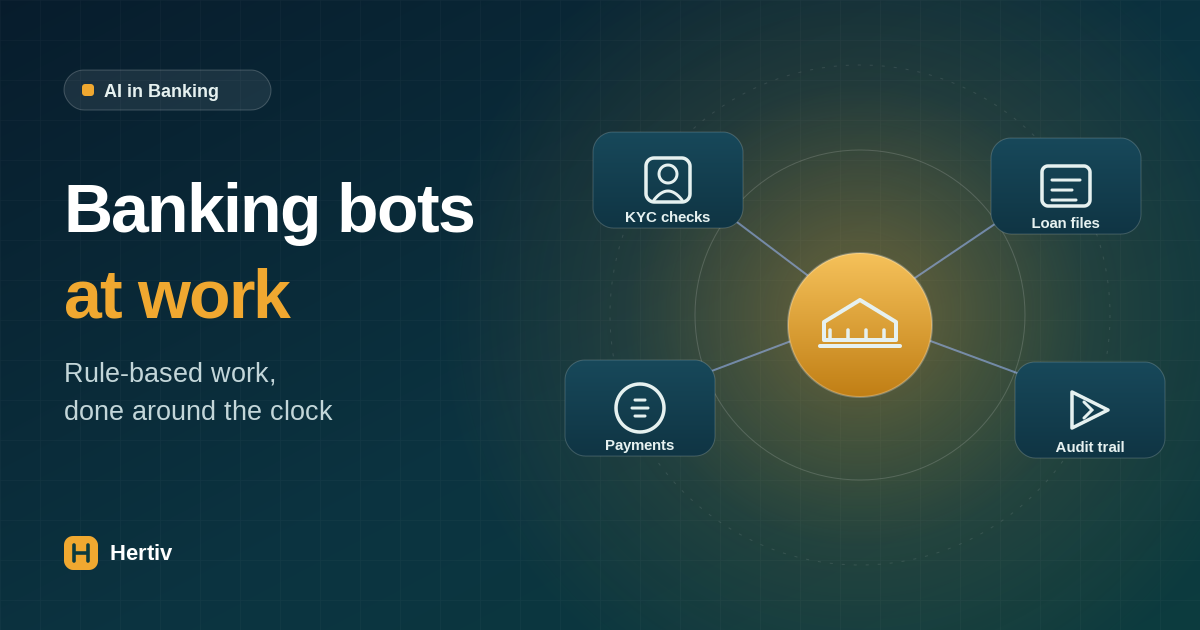
Banks use RPA where the volume is high, the steps are fixed and the data is digital. The table below shows the processes where bots are most common, what the bot does, and what changes for the team.
| Process | What the bot does | What changes |
|---|---|---|
| Account opening checks | Copies identity data and runs watchlist checks | Files are complete before a person reviews them |
| Loan document handling | Collects payslips and statements, checks they match | Missing documents are flagged the same day |
| Payment processing | Validates instructions and posts them to the ledger | Payments are processed outside office hours |
| Reconciliation | Matches transactions between systems and lists breaks | Staff work only on the unmatched items |
| Regulatory reporting | Pulls figures from source systems into report formats | Reports are drafted faster with fewer copy errors |
The strongest results come from processes that already have a written procedure. If a process lives only in one person's head, automating it first means writing it down, which is useful on its own. A process with frequent exceptions is a poor fit, because every exception needs a person anyway and the bot spends most of its time handing work back.
Compliance work is a common starting point. Banks must check identities, screen names against lists and keep records of every decision. Bots do the repetitive gathering and checking, while people review the cases the bot flags. That split keeps a human in charge of the decision, which regulators expect.
How does a bank put RPA in place?
A bank puts RPA in place by picking one process, proving the bot works, and then expanding step by step. A pilot that takes weeks teaches the team more than a year-long plan that never starts.
- Pick a process with a clear owner. Choose a process with high volume, fixed steps and a manager who will answer questions about the rules.
- Write the process down. Record every step, every decision and every exception, including what happens when data is missing or wrong.
- Build the bot in a test environment. Let the bot run on copied data first, and compare its output with the manual result line by line.
- Run it alongside staff. Let the bot handle a share of live cases while staff check the output, then raise the share as confidence grows.
- Set up monitoring and access control. Give the bot its own login, log every action, and set alerts for failures and unusual volumes.
- Plan for change. Assign someone to update the bot when a screen changes, a form changes or a rule changes.
The last step is the one teams forget. A bot breaks when the system it works through changes, and banking systems change often. A bot with no owner becomes a liability within months, because it fails silently and staff go back to manual work without telling anyone.
Security matters from the start. A bot holds credentials that can move money or read customer data, so it needs its own identity, the narrowest permissions that fit, and the same review cycle as a staff login. For the wider picture, see how RPA compares with AI agents.
RPA or AI agents: which fits a banking task?
RPA and AI agents solve different problems in a bank. RPA is right when the task is fixed and repeated; an AI agent is right when the task needs reading, judgement or a conversation. Many banks use both, with RPA doing the structured steps and an agent handling the parts that need interpretation.
| Question | RPA bot | AI agent |
|---|---|---|
| Can the task be written as fixed steps? | Yes, that is what it does | It can adapt the steps |
| Does the task need reading free text? | No, it needs structured data | Yes, it can read and summarise |
| Who decides the outcome? | The rules decide; people handle exceptions | The agent drafts a decision for review |
| What breaks it? | A changed screen or form | Unclear instructions or bad data |
| Best first use | Reconciliation, data entry, checks | Document review, customer messages |
A practical test is to ask whether the task could be given to a new starter with a checklist. If yes, a bot can probably do it. If the task needs someone to read a letter, weigh two options and explain a decision, it needs a person, possibly helped by an AI agent that drafts the work.
Banks that mix the two usually start with RPA, because the return is easier to measure. Once the structured work is automated, the remaining work is the judgement work, and that is where AI agents earn their place. For finance teams, AI agents for finance cover the agent side of this split.
What are the risks and limits of RPA in banking?
The main risk of RPA in banking is that a bot does the wrong thing at speed. A person who copies a figure wrong affects one case; a bot with a wrong rule affects every case it touches until someone notices. That is why testing, monitoring and limits on what a bot can do matter more than the bot itself.
- Fragile automation. Bots work through screens, so a redesigned screen or a renamed field can break them overnight.
- Hidden errors. A bot that files a wrong value in the right format looks correct, so errors surface late, often at audit time.
- Credential risk. A bot login with broad permissions is a target, so it needs the same controls as a privileged staff account.
- Process debt. Automating a bad process makes it run faster, not better, and hides the need to fix the process itself.
- Audit gaps. If the bot's logs are not kept and reviewed, the bank cannot prove what the bot did or why.
RPA also has a hard limit: it cannot handle work that is not rule-based. A customer complaint, a fraud pattern that does not match a known rule, or a loan case with unusual documents all need a person. Banks that expect RPA to replace judgement end up with bots that hand most cases back and staff who trust the system less.
Example (hypothetical): automating KYC document checks
Example (hypothetical): a mid-size bank opens 1,200 new accounts a month. Each application needs identity documents checked against a list, and a staff member spends 12 minutes per application on the checking step. That is 1,200 times 12 minutes, or 240 hours a month, which is most of one full-time role.
The bank builds a bot that reads the documents, runs the watchlist check and files the result. The bot takes 2 minutes per application, so the same 1,200 applications take 40 hours of bot time.
Staff now spend their time only on the cases the bot flags, which are about 120 a month, at 10 minutes each, or 20 hours. The checking step falls from 240 staff hours to 20 staff hours plus 40 bot hours.
The saving is 220 staff hours a month, but the real gain is speed: applications that passed the checks are ready the same day instead of waiting in a queue. The bank keeps a person in charge of the final decision, and the bot's log records every check for audit. If the document format changes, the bot owner updates the bot before it runs again.
What are the common mistakes?
The most common RPA mistakes in banking are automating a process nobody has written down, giving a bot too much access, and walking away once it works.
- Automating an undocumented process. If the steps are not agreed, the bot encodes one person's habits and breaks on everyone else's cases.
- Starting with the hardest process. A complex, exception-heavy process makes a poor pilot and teaches the team nothing.
- Too much access. A bot that can read and change anything is a security risk; give it only the systems and fields it needs.
- No owner after launch. Screens change, forms change, rules change. A bot without an owner stops working and nobody notices.
- Measuring only speed. A bot that is fast but wrong costs more than a slow process, once rework and audit findings are counted.
Key takeaways
- RPA bots follow fixed rules through the same screens staff use, and they do not decide
- Banking fits RPA where volume is high, steps are fixed and data is digital, such as reconciliation and checks
- A pilot on one well-documented process, run alongside staff, beats a large rollout that never starts
- Bots need their own login, narrow permissions, logs and an owner who updates them when systems change
- Judgement stays with people; RPA and AI agents split the work between fixed steps and interpretation
Frequently asked questions
Is RPA safe for banks?
Yes, when the bot has its own login, narrow permissions and logged actions, and when a person reviews the cases it flags. The risk comes from bots with broad access and no monitoring, not from the technology itself.
How much does RPA cost a bank?
Costs vary with the number of bots, licences and the team that maintains them, so ask vendors for a quote based on your processes. The main ongoing cost is the owner who updates bots when screens and rules change; see vendor site for pricing.
Does RPA replace bank staff?
No. It takes over the repetitive steps and leaves the judgement, exceptions and customer conversations to people. Most banks redeploy staff to the cases bots cannot handle rather than removing roles.
What is the difference between RPA and AI in banking?
RPA follows fixed steps exactly and cannot read free text or make judgements. AI tools can read documents, spot patterns and draft decisions. Banks often use both, with RPA doing the structured steps.
How long does a banking RPA pilot take?
A single well-documented process can go from design to live pilot in a few weeks. The slow part is usually agreeing the process steps and the exceptions, not building the bot.
Can RPA handle regulatory reporting?
It can gather figures and draft reports, which cuts copy errors and speeds the work. A person still reviews and signs off the report, because the bank remains responsible for what it files.


