Real-World LLM Examples: 6 That Work in Production
LLMs already answer support tickets, review contracts and summarise meetings in production. These six examples show where they work and what to check first.
On this page
Short answer
Real-world LLM examples are production systems where a large language model does a defined job with real data and a human or a check in the loop. The strongest examples are support search over help-centre content, contract review, invoice questions, meeting summaries, code review help and policy answers. They work because the model is grounded in the team's own documents and every answer can be checked against a source.
Which LLM examples work in production?
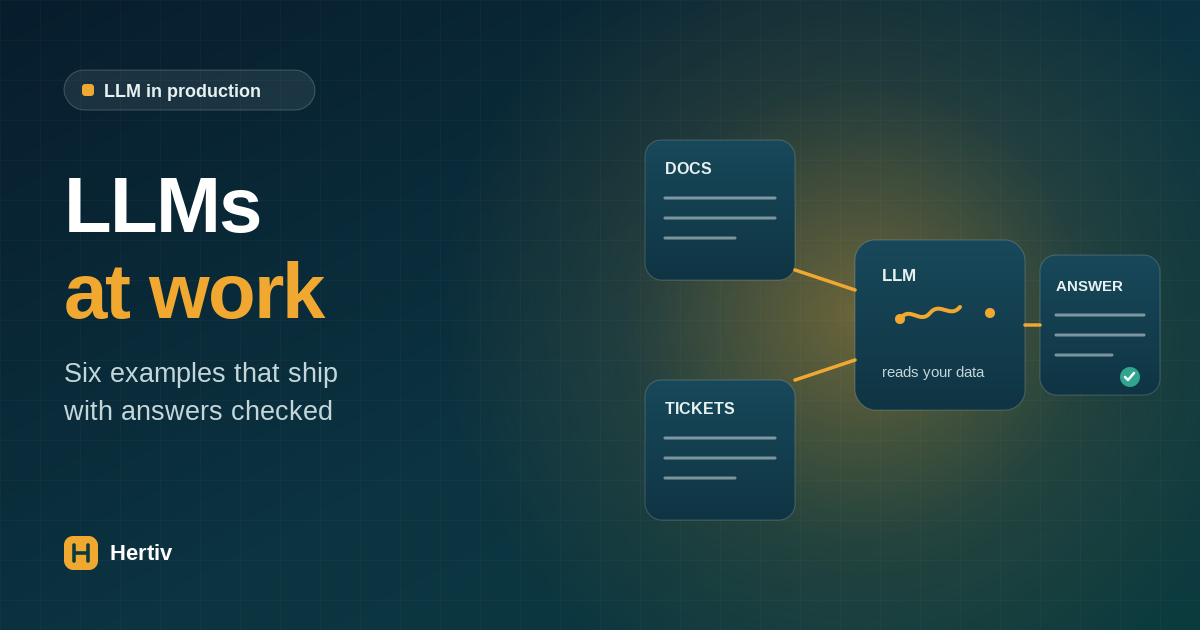
Large language models already do real work in production, and the examples that last share one pattern: the model does a defined job with the team's own data, and a human or an automated check reviews the output before it reaches a customer.
The six examples below are in daily use at real companies. None of them lets the model act alone, and none of them depends on the model being right every time. They work because the cost of a wrong answer is small and the check is cheap.
| Example | What the model does | What checks it |
|---|---|---|
| Support search | Answers tickets from help-centre content | Cited sources, agent review |
| Contract review | Flags risky clauses in drafts | Lawyer review, clause list |
| Invoice questions | Answers questions over invoices | Matched records, totals |
| Meeting summaries | Turns calls into actions | Transcript, owner check |
| Code review help | Comments on pull requests | Tests, human reviewer |
| Policy answers | Answers staff questions over policies | Cited policy text |
Start with one row. A single support or document use case shipped with an evaluation set teaches a team more than a pilot across the whole company. Teams looking for new product ideas rather than production examples should see LLM startup ideas instead.
Support search and contract review
1. Support search: best for teams drowning in tickets
Support search lets an agent or a customer ask a question and get an answer drawn from the help centre, past tickets and product docs, with the source shown next to the answer. The agent reads the cited passage before sending anything.
It works because the check is built in: if the model cannot find a source, it says so instead of guessing. Teams that ship this usually start with their ten most common questions and grow from there.
Pros
- Faster answers with sources attached
- Agents stay in control
- Easy to measure with resolved tickets
Cons
- Needs clean, current help-centre content
- Weak when the docs are out of date
2. Contract review: best for legal teams with heavy volume
Contract review uses a model to read a draft and flag clauses that differ from the company standard terms: payment terms, liability caps, renewal dates and termination rights. A lawyer still reviews the flagged items.
It works because the model narrows the pile rather than deciding it. A lawyer who reads ten flagged clauses is faster than one who reads a forty-page draft from scratch.
Pros
- Cuts review time on routine contracts
- Flags what humans miss when tired
- Works on the team's own clause library
Cons
- Needs a clear list of standard terms
- Struggles with unusual or handwritten clauses
Invoice questions and meeting summaries
3. Invoice questions: best for finance teams
Invoice questions let staff ask plain questions over invoices and purchase orders: which invoices are overdue, what did we pay this supplier last quarter, which line items changed. The model reads the documents and answers with the numbers attached.
It works because every answer can be checked against a record. If the total does not match the invoice, the error is visible at once, and the team fixes the data rather than the model.
Pros
- Answers in seconds, not hours
- Every figure can be checked
- Cuts repetitive finance queries
Cons
- Needs clean invoice data
- Fails on scanned or handwritten invoices
4. Meeting summaries: best for teams with many calls
Meeting summaries turn a call transcript into decisions, owners and deadlines, and post them where the team works. The model does the drafting; a human approves the summary before it is shared.
It works because the transcript is the source of truth, and anyone can check a summary against it. The risk is a missed action, so most teams keep the owner check in place for months after launch.
Pros
- No one takes notes by hand
- Actions have owners and dates
- Easy to check against the transcript
Cons
- Misses tone and side conversations
- Needs good audio to transcribe well
Code review help and policy answers
5. Code review help: best for busy engineering teams
Code review help reads a pull request and comments on likely bugs, missing tests and style breaks, before a human reviewer looks at it. The reviewer still approves the merge.
It works because the tests and the reviewer are the safety net. A wrong suggestion costs a comment, not a broken release, and the model catches the routine issues that tire reviewers out.
Pros
- Catches routine issues early
- Reviewers focus on design, not style
- Runs on every pull request
Cons
- Suggests fixes that do not fit the codebase
- Needs tuning to avoid noisy comments
6. Policy answers: best for large staff bases
Policy answers let staff ask how many days of leave they have, what the travel rules are, or how to report an expense, and get an answer quoted from the policy itself. The source is shown, so staff can read the rule in full.
It works because policies are written to be quoted, and a wrong answer is easy to spot. HR teams report fewer repeat questions, and staff stop guessing at rules they cannot find.
Pros
- Answers quoted from the policy
- Fewer repeat questions to HR
- Works in any language the policy is written in
Cons
- Needs policies kept up to date
- Cannot handle cases the policy does not cover
How to choose an LLM example to build
Choose the example where a wrong answer is cheap and the check is easy. Support search and policy answers fit that test well, because the source is shown and a human reads the answer before it goes out.
- Pick a job a human already reviews. If no one checks the output today, the model will not be checked either.
- Check the data. The documents the model reads must be current, or the answers will be wrong in confident language.
- Build an evaluation set. Write twenty questions with known answers, and test every change against them.
- Ship to a small group. Let ten users try it for two weeks before the whole company sees it.
- Measure the check rate. Track how often the human changes the answer; if it rises, stop and fix the data.
If the evaluation set is hard to write, the use case is probably too vague to build. A team that wants to test a model properly should read how to test AI models before writing any code.
What are the common mistakes?
The most common mistakes are letting the model act alone, feeding it stale documents, and skipping the evaluation set. A short LLM evaluation checklist catches most of these before launch.
- No human in the loop. A model that answers customers directly, with no review, will eventually say something wrong in public.
- Stale documents. A model grounded in last year's policy gives last year's answers.
- No evaluation set. Without known-good answers to test against, every change is a guess.
- One giant pilot. Six use cases at once means six failures to debug at the same time.
- Trusting fluency. A smooth, confident answer is not a correct one, and the smoother it sounds, the less people check it.
Key takeaways
- The LLM examples that last do a defined job with the team's own data and a check in the loop
- Support search, contract review, invoice questions, meeting summaries, code review and policy answers are the strongest examples
- A wrong answer must be cheap and the check must be easy, or the use case is not ready
- Build an evaluation set of known-good answers before you ship
- Start with one use case and a small group of users
Frequently asked questions
How much does it cost to build an LLM example like these?
It depends on the data and the volume. A support search over a clean help centre can be a small project, while a contract review system needs a clause library and lawyer time. See vendor site for model pricing, and budget for the evaluation set.
Do these examples need fine-tuning?
Usually not. Most of them work with a general model grounded in the team's own documents, which is cheaper and easier to update than a fine-tuned model. Fine-tuning makes sense only when the task needs a specific style or format the base model cannot follow.
What data does an LLM example need?
It needs the documents the model will read: help-centre pages, contracts, invoices, transcripts or policies. The data must be current and clean, because the model can only answer from what it is given.
How do you stop an LLM from making things up?
Ground it in your own documents, show the source next to every answer, and keep a human in the loop. If the model cannot find a source, it should say so instead of guessing. An evaluation set catches drift over time.
Can a small team ship one of these examples?
Yes. Support search and policy answers are the usual first picks for small teams, because the data already exists and the check is simple. Start with ten common questions, ship to a small group, and grow from what you learn.
What is the first step to build an LLM example?
Pick one job a human already reviews, gather the documents it needs, and write twenty questions with known answers. That evaluation set is the foundation: without it, you cannot tell whether a change made the system better or worse.


