Blockchain Real Estate Companies: 6 Real-World Examples
Blockchain is already used to buy, sell and finance property, from tokenised rentals to on-chain closings. Here are six companies doing it in the real world.
On this page
Short answer
Blockchain is already used in real estate to record ownership, split property into tokens, speed up closings and open property investment to smaller buyers. The companies below are real businesses operating today, each using blockchain in a different part of the property market. This guide explains what each one does and what to learn from it.
Which companies use blockchain in real estate?
Blockchain real estate companies use a shared ledger to record property rights, issue tokens backed by property, or move money for property deals. The shared record cuts the need for each party to keep its own copy, and tokens let many investors hold a share of one property.
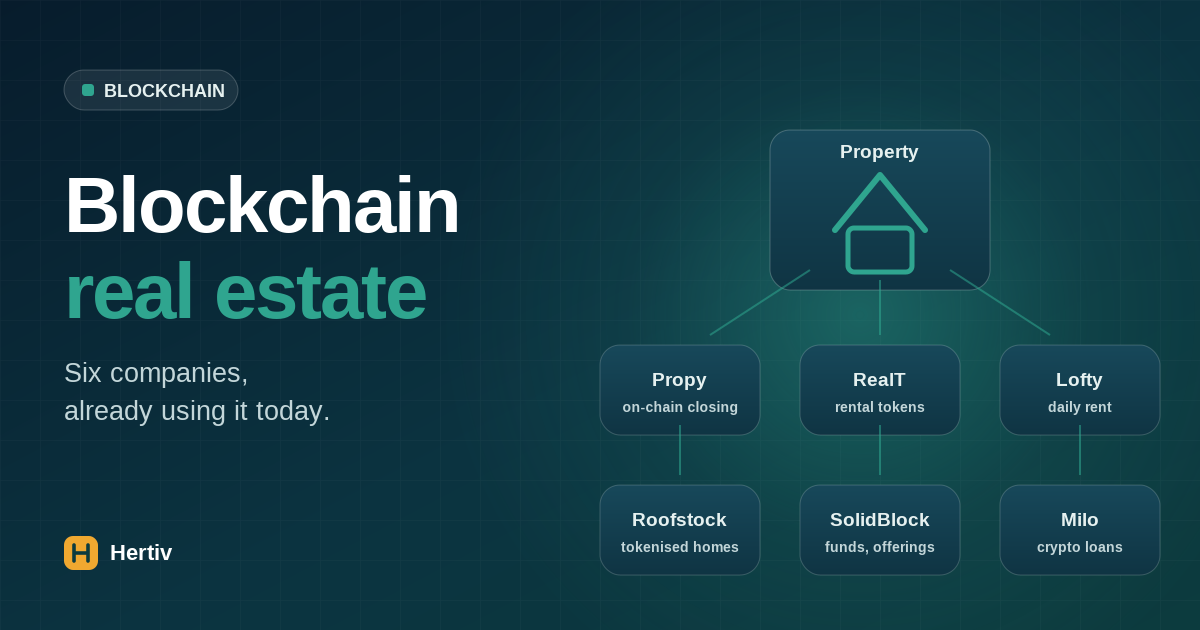
The six companies below were chosen because each covers a different use: closings, fractional rentals, tokenised funds, on-chain deeds, property finance and investor reporting. Together they show what blockchain can do in property today, and where it still needs the old systems alongside it.
| Company | What it does | Who it serves |
|---|---|---|
| Propy | Property sales and closings on-chain | Buyers, sellers and agents |
| RealT | Fractional rental property tokens | Small investors |
| Lofty | Fractional rental shares with daily rent | Small investors |
| Roofstock onChain | Tokenised single-family rentals | Investors and owners |
| SolidBlock | Tokenised funds and property offerings | Funds and developers |
| Milo | Crypto-backed home loans | Home buyers with crypto |
No prices or returns are listed here, because property deals and token terms change often, so check the vendor site for current terms. The focus is on what each company does and how its model works.
Blockchain real estate companies for buying and owning
1. Propy: best for on-chain property closings
Propy is a real estate platform that records property sales on a blockchain. It handles offers, documents and payments in one place, and records the deed transfer on-chain, so the buyer, seller and agent share one record of the deal instead of passing paper between offices.
Propy shows that blockchain can sit on top of the existing legal process rather than replacing it. The deed still needs the local land registry, but the shared record makes the closing faster to check and harder to dispute.
Pros:
- One shared record for the whole closing
- Works with the existing legal process
- Payments and documents in one place
Cons:
- Still needs the local land registry
- On-chain closing is not yet standard everywhere
2. RealT: best for fractional rental property tokens
RealT sells tokens backed by rental properties in the United States, letting investors buy a small share of a house and receive a share of the rent. Each token stands for a share of a company that owns the property, and rent is paid to token holders regularly.
RealT is one of the longest-running examples of fractional property tokens. It shows the model works at small scale, and it also shows the limits: the tokens are shares in a company, not direct ownership of the house, and the property still needs a manager.
Pros:
- Small investors can buy a share of a rental property
- Rent is shared with token holders
- Long-running model with many properties
Cons:
- Tokens are company shares, not direct ownership
- Property management still needs people on the ground
Blockchain real estate companies for fractional investing
3. Lofty: best for fractional rental shares with daily rent
Lofty is a platform that sells fractional shares in rental properties and pays rent to holders daily. Investors buy shares from as little as a small amount, and the platform handles the property, the tenants and the rent, while the blockchain records who owns each share.
Lofty shows how tokenisation can lower the entry point for property investment. The trade-off is the same as with any fractional model: the investor owns a share, not the house, and returns depend on the property and the manager.
Pros:
- Low entry point for rental property investment
- Rent paid daily to shareholders
- Platform handles tenants and upkeep
Cons:
- Shares, not direct ownership of the house
- Returns depend on the property manager
4. Roofstock onChain: best for tokenised single-family rentals
Roofstock onChain is the blockchain arm of Roofstock, a marketplace for single-family rental homes. It issues a token that stands for ownership of a single home, so the home can be bought and sold as a token, with the deed held by a company tied to that token.
This model keeps one home per token, which makes the link between the token and the property easy to follow. It also shows the main limit of tokenised homes: selling the token still needs a buyer who wants that specific house.
Pros:
- One token per home, easy to follow
- Built on an established rental marketplace
- Deed and token are linked clearly
Cons:
- Each token is tied to one specific house
- Resale still needs a buyer for that home
Blockchain real estate companies for funds and finance
5. SolidBlock: best for tokenised funds and property offerings
SolidBlock is a platform that helps funds and developers tokenise property projects and raise money from investors. It handles the offering, the investor checks and the token issuance, so a developer can sell shares in a project without building the platform itself.
SolidBlock shows the business-to-business side of property tokenisation. Its customers are funds and developers, not small investors, and its value is the compliance and issuance plumbing that a single project would find hard to build alone.
Pros:
- Built for funds and developers, not only small investors
- Handles issuance and investor checks
- Suits large projects and portfolios
Cons:
- Not aimed at small investors
- Needs the fund to bring its own investors
6. Milo: best for crypto-backed home loans
Milo is a lender that offers home loans backed by crypto assets, letting buyers use their crypto holdings as security instead of selling them. The loan is recorded and managed with blockchain tools, while the mortgage itself follows the normal legal process for home loans.
Milo shows a different use of blockchain in property: not tokenising the house, but using crypto as collateral for the loan that buys it. The model suits buyers who hold crypto and want to keep it, but it carries the risk that a fall in crypto prices changes the loan terms.
Pros:
- Buyers keep their crypto while borrowing
- Home loans for crypto holders
- Normal mortgage process alongside
Cons:
- Loan terms can change if crypto prices fall
- Suits only buyers who hold enough crypto
How to choose a blockchain real estate company
Choosing a blockchain real estate company starts with knowing what you want: to buy a home, to invest a small amount, to raise money for a project, or to borrow against crypto. Each company above serves a different need, so the right one follows from your goal.
- Name your goal: buying, investing, raising funds or borrowing.
- Check what the token stands for: a share in a company, a token per home, or a loan, and read the terms.
- Confirm the legal shape: check how ownership is recorded and which registry still matters.
- Ask who manages the property: tokens do not fix roofs or collect rent, so the manager matters.
- Start small: try a small amount first and check the full journey before committing more.
Read the terms on the vendor site before you act, because token terms, fees and availability change. A company that is clear about its terms is a better sign than one that hides them.
Common mistakes with blockchain real estate
The most common mistake is thinking a token is the same as owning the house. In most of these models the token is a share in a company that owns the property, or a claim on its income, and the legal ownership sits elsewhere. Read the terms to know what you actually hold.
Another mistake is assuming tokens are easy to sell. A token can only be sold if a buyer wants that property or that share, and the market for a single home is small. Treat tokenised property as a long-term holding, not as cash you can take out at once.
A third mistake is ignoring the rules. Property tokens touch securities rules that differ by country, and the platform must follow them. Check that the company follows the rules of your market, and ask for the documents that prove it.
Key takeaways
- Blockchain real estate covers closings, fractional investing, funds and loans.
- A token is usually a share or a claim, not direct ownership of the house.
- Check the legal shape, the property manager and the terms before investing.
- Start small and treat tokenised property as a long-term holding.
Frequently asked questions
What is blockchain real estate?
Blockchain real estate means using a shared ledger to record property rights, issue tokens backed by property, or move money for property deals. It can speed up closings, split property into small shares and give many parties one record of a deal.
Can I buy a house with blockchain?
Yes, in some markets. Platforms such as Propy record the sale and the deed transfer on-chain, but the deed still needs the local land registry. Blockchain changes how the deal is recorded, not the legal need to register ownership.
Is tokenised property a safe investment?
Tokenised property carries the same risks as property, plus the risks of the token model, such as resale limits and platform risk. Read the terms, check the manager and the legal shape, and treat it as a long-term holding rather than quick cash.
What is fractional property ownership?
Fractional ownership means many investors each hold a share of one property and share the rent and the costs. Tokens make it easy to record and transfer those shares, and platforms such as RealT and Lofty use them for rental properties.
Do I need crypto to invest in tokenised property?
Not always. Some platforms accept normal payment methods, while others need crypto. Check the payment options on the vendor site before you sign up, because they differ by platform and by market.
What is the difference between Propy and RealT?
Propy focuses on property sales and closings recorded on-chain, while RealT sells fractional tokens backed by rental properties. One helps you buy a home, the other helps you invest a small amount in a rental property.


