RAG Integration: Process and Cost Explained
RAG integration connects a language model to your own documents so answers cite real sources. Here is the process, the cost drivers and how to judge if it works.
On this page
Short answer
RAG integration connects a retrieval-augmented generation system to your own documents and tools, so a language model answers from your content instead of from memory alone. The work covers document preparation, retrieval, generation, guardrails and evaluation, and cost depends mostly on engineering time and document volume.
What is RAG integration?
RAG integration is the work of connecting a retrieval-augmented generation system to your own documents and tools, so a language model answers from your content instead of from memory alone. The model retrieves relevant passages, then drafts an answer grounded in those passages.
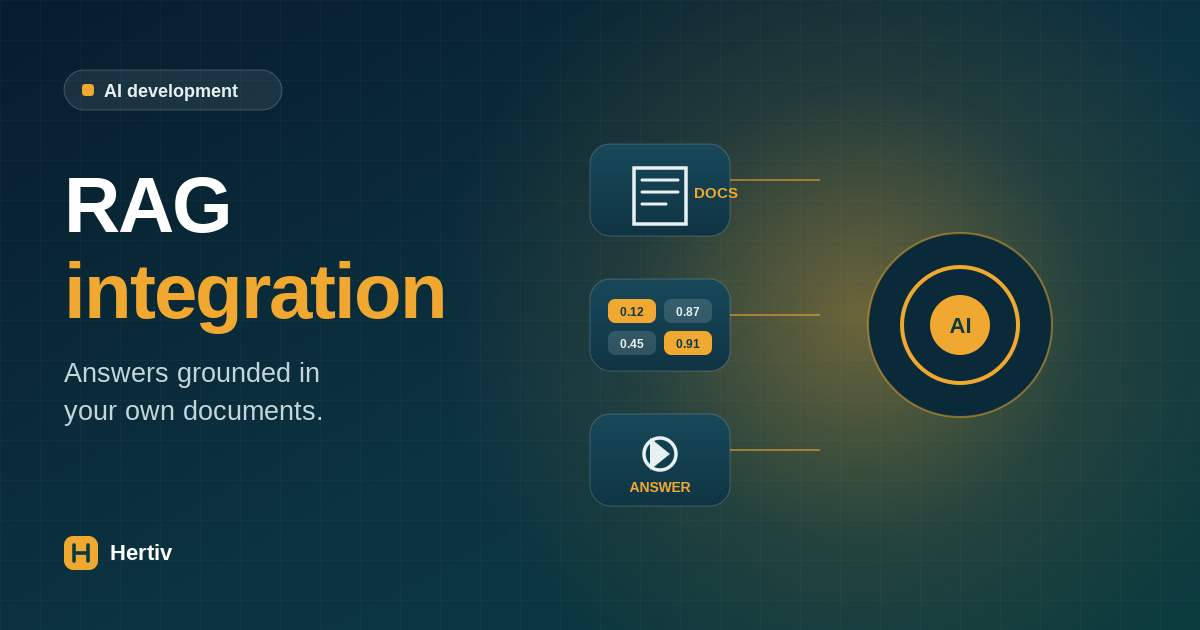
A typical setup has four parts: a document store, an embedding model that turns text into searchable vectors, a retriever that finds the most relevant passages, and the language model that writes the answer. Integration means wiring those parts to your help centre, wiki, CRM or file store, and adding the logging and checks that make the answers trustworthy.
RAG is different from fine-tuning. Fine-tuning changes the model itself, while RAG changes what the model can look up. Most teams start with RAG because it is faster to build, easier to update when documents change, and lets you show the sources behind each answer.
The work is mostly engineering, not model research. See RAG development for how the pieces fit together in a production system.
What does the RAG integration process look like?
The RAG integration process follows a fixed sequence: audit the documents, prepare them for search, build the retrieval pipeline, connect the model, and then evaluate before launch. Skipping the evaluation step is the most common reason a RAG project disappoints.
- Audit the documents. List every source the system may answer from, remove duplicates and outdated pages, and decide who owns each source.
- Chunk and embed. Split documents into passages of a few hundred words, then convert each passage into a vector the retriever can search.
- Build the index. Store the vectors and their source links in a vector database, with filters for team, product or region where needed.
- Connect retrieval to generation. The user question retrieves the top passages, which are passed to the model with a prompt that requires citations.
- Add guardrails. Block or flag questions outside the document set, limit what the model can claim, and log every answer with its sources.
- Evaluate on real questions. Run a fixed set of real user questions with known good answers, and fix retrieval before tuning prompts.
- Launch with a fallback. When the retriever finds nothing useful, the system should say so or hand off to a human, not invent an answer.
Expect the document audit to take longer than planned. Most organisations find several conflicting versions of the same policy, and cleaning them is part of the project.
What drives the cost of RAG integration?
RAG integration cost comes from engineering time, document preparation, hosting and model usage. Engineering time is usually the largest part, because the integration is custom even when the components are standard.
| Cost part | What it covers | What pushes it up |
|---|---|---|
| Engineering | Pipeline, prompts, guardrails, UI | Custom sources and permissions |
| Document work | Cleaning, chunking, ownership | Many sources and duplicates |
| Vector hosting | Index storage and search | Document volume and filters |
| Model usage | Embeddings and generation calls | Question volume and answer length |
| Evaluation | Test sets and review tooling | High accuracy requirements |
Model usage is usually the smallest cost at pilot scale and grows with traffic. Embedding a document set is a one-off cost, while generation is paid per question, so traffic forecasts matter more than document counts for the monthly bill.
For a framework comparison before you choose the stack, see best RAG frameworks for startups.
Should you build it yourself or use a managed service?
The choice is between building the pipeline yourself, using a managed RAG service, or hiring a team to build it for you. The right answer depends on how much control you need over sources, permissions and evaluation.
Building yourself gives full control over chunking, retrieval and prompts, and it suits teams with engineers who will maintain the system. It costs more upfront and needs ongoing ownership of the index and the evaluation set.
A managed service is faster to start and cheaper to run at small scale, but you accept its retrieval behaviour and its limits on custom sources. It suits a pilot or a single use case with standard documents.
Hiring a specialist team fits when the use case touches regulated data or many internal systems. The team builds the pipeline, sets up evaluation and hands over a documented system your engineers can run. See RAG development companies for startups for how to shortlist one.
Whichever route you take, keep the evaluation set in your hands. If you cannot measure answer quality on your own questions, you cannot tell whether a change helped or hurt.
Example (hypothetical): a support search pilot for a software company
Example (hypothetical): a software company with 5,000 help articles wants a support search pilot that answers staff questions from its own docs. The team scopes a four-week build.
Two developers work four weeks at 40 hours a week, which is 320 hours. At $85 an hour, engineering costs $27,200. Embedding the document set costs $1,200 in one-off model calls, and the vector index setup adds $800. The pilot budget is therefore $29,200, plus $600 a month in running costs for hosting and generation calls.
The team evaluates on 100 real staff questions with known good answers. Retrieval finds a useful passage for 82 of them, and the model answers 74 correctly with a citation. The team fixes the worst 18 questions by cleaning the source articles and adjusting chunk size, which lifts correct answers to 84 before launch. The pilot ships to one support team first, with a human handoff for anything the system cannot cite.
How do you know the RAG system is working?
You know a RAG system is working when retrieval finds the right passages and the answers cite them, measured on a fixed set of real questions. Without that measurement, quality debates stay anecdotal and every change is a guess.
Track three numbers on your evaluation set:
- Retrieval hit rate. How often the correct passage is in the retrieved set. If this is low, fix documents and chunking before touching prompts.
- Answer accuracy. How often the answer is correct and supported by the cited passage, judged by a human on a sample.
- Handoff rate. How often the system says it cannot answer or hands off. A rising handoff rate usually means documents are missing, not that the model is worse.
Review a sample of real answers every week after launch. Documents change, and a retrieval system that was accurate in January can drift as new pages appear and old ones go stale.
For the broader question of whether a model is ready for users, see LLM development and the evaluation steps it covers.
What are the common mistakes?
The most common mistakes are treating retrieval as solved, skipping evaluation, and letting the model answer when it has no source. Each one produces confident wrong answers, which are worse than no answer at all.
- Dirty documents. Duplicate and outdated pages make the retriever return conflicting passages, so clean sources before building the index.
- Chunks too large or too small. Large chunks bury the answer in noise, small chunks lose context. Test both on your own questions.
- No evaluation set. Without fixed test questions, you cannot tell whether a change improved anything.
- Answering without a source. If retrieval finds nothing useful, the system must say so or hand off, not guess.
- Ignoring permissions. A retriever that ignores document permissions can leak internal pages to the wrong team.
- One launch, no owner. Someone must own the index, the test set and the weekly review, or quality decays quietly.
Key takeaways
- RAG grounds model answers in your documents; fine-tuning changes the model itself
- Document cleaning and chunking decide retrieval quality more than model choice
- Engineering time is the largest cost; model usage grows with question volume
- Keep the evaluation set in your hands, whoever builds the system
- A system that cannot cite a source should say so or hand off, never guess
Frequently asked questions
How long does RAG integration take?
A narrow pilot usually takes a few weeks, from document audit to a launch with one team. Production rollout adds permissions, evaluation tooling and change management, which take longer than the model work itself.
Is RAG cheaper than fine-tuning?
Usually yes at the start, because RAG needs no model training and updates when documents change. Fine-tuning becomes worth considering when you need consistent format or tone at scale, and only after you have an evaluation set.
What documents work best for RAG?
Clean, current documents with one owner each: help articles, policies, product guides and FAQs. Duplicate or outdated pages confuse retrieval, so remove or merge them first before building the index.
Do we need a vector database?
Yes, in practice. A vector database stores the embedded passages and finds the closest matches for a question quickly. Small pilots can start with a simple index, but production systems need the filtering and scale a vector store provides.
How much does RAG cost to run each month?
Running cost depends on question volume, answer length and hosting. Embedding the document set is a one-off cost, while generation is paid per question. Ask vendors for current prices on their own sites before forecasting.
Can RAG work with private or regulated data?
Yes, when permissions are enforced in retrieval and logs are kept. The retriever must respect document access rules so it never surfaces a page to someone who cannot read it, and answers should be logged for review.


