RAG Development Companies for Startups: How to Choose
RAG lets a language model answer from your own documents instead of guessing. Here are six firms that build RAG systems for startups, and how to pick one.
On this page
Short answer
RAG development companies build systems that let a language model answer from a startup's own documents. The best choice depends on your document set, your budget and how much of the system your team wants to run itself.
RAG development companies for startups at a glance
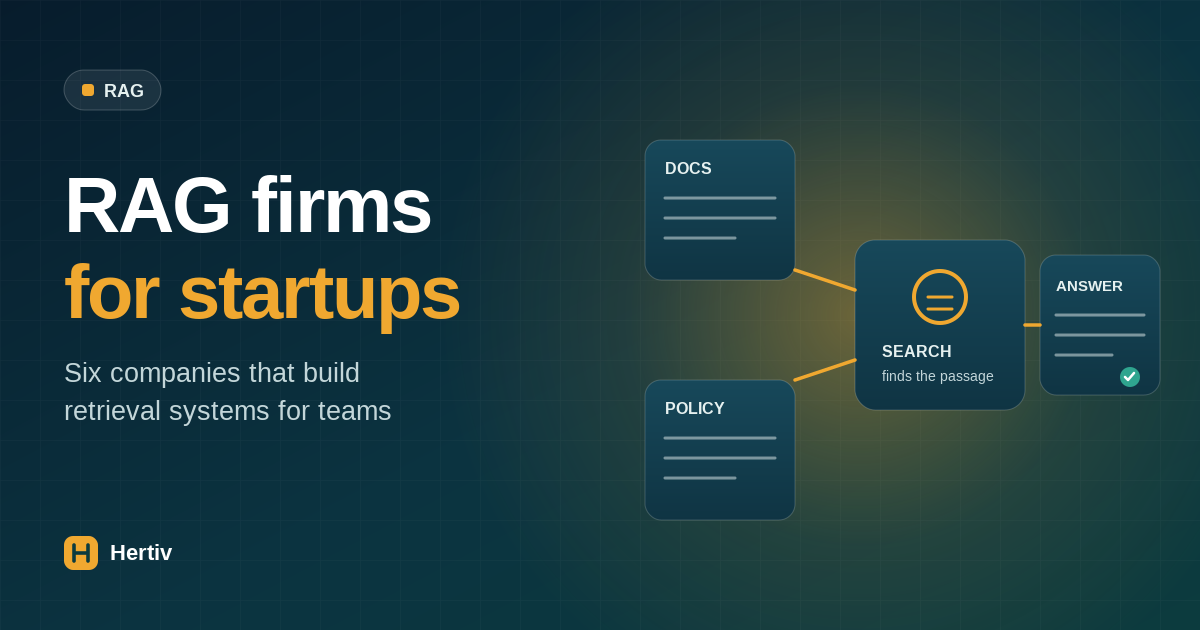
A retrieval-augmented generation (RAG) system lets a language model answer from your own documents instead of guessing. For a startup, the work is usually a short pilot: connect the documents, build the search step, add the model, and put a person in the loop to check answers before they reach customers.
| Company | Focus | Typical engagement | Best for |
|---|---|---|---|
| Thoughtworks | Engineering and data platforms | Pilot, then production build | Teams with messy data estates |
| Globant | Product and AI engineering | Product team, fixed scope | Customer-facing assistants |
| EPAM Systems | Enterprise software and AI | Discovery, build and support | Regulated industries |
| SoftServe | Software and data engineering | Build with handover | Teams that want to own the code |
| Cognizant | Consulting and AI services | Programme with governance | Large rollouts with many teams |
| Nagarro | Digital product engineering | Small team, short build | Startups with a tight budget |
Every firm below offers RAG work, but they differ in size, process and the kind of client they serve best. The table is a starting point: the right choice depends on your documents, your budget and how much of the system you want to run yourself. The same retrieval-first thinking applies to RAG startup ideas that teams build in-house.
Thoughtworks
1. Thoughtworks: best for teams with messy data estates
Thoughtworks is a global technology consultancy known for engineering-led delivery. Its RAG work usually starts with the data: finding where documents live, cleaning them, and building the retrieval step before the model is connected at all.
That order matters, because retrieval quality decides whether the answers are useful. A team that skips the data work often ends up with a model that answers fluently from the wrong documents, and no amount of prompt tuning fixes that. Testing matters here: teams measure retrieval with the methods in how to test AI models.
Pros
- Strong engineering discipline and testing habits
- Experience with large, messy document sets
- Clear focus on measuring retrieval quality
Cons
- Senior teams, so day rates are high for a small startup
- Minimum engagement size may exceed a pilot budget
- Less of a fit for a simple, single-document assistant
Globant
2. Globant: best for customer-facing assistants
Globant is a digital product company that builds customer-facing software, including AI assistants for support, sales and onboarding. Its RAG projects tend to be product work: an assistant that sits inside an app or a website and answers customer questions from the company's own help content.
Because the work is product-shaped, the team thinks about the whole experience: how the answer is shown, what happens when the model cannot find the answer, and how support staff take over a conversation.
Pros
- Product and design skills alongside the engineering
- Experience with customer-facing AI assistants
- Can staff a full product team quickly
Cons
- Better suited to product builds than one-off pilots
- Large-company process can feel slow for a tiny team
- Costs rise with the size of the team
EPAM Systems
3. EPAM Systems: best for regulated industries
EPAM Systems is a large software engineering company that works with banks, insurers and healthcare firms, among others. Its RAG work usually sits inside a bigger programme, with document access rules, audit logs and review steps built in from the start.
For a startup in a regulated market, that structure is useful. The model never sees documents it should not see, every answer can be traced to a source, and the review process is part of the system rather than an afterthought.
Pros
- Deep experience with regulated data and access rules
- Can handle large document volumes and many users
- Structured delivery with testing and documentation
Cons
- Engagements tend to be large and formal
- Not the cheapest route to a first pilot
- Decision-making can be slower than at a small firm
SoftServe
4. SoftServe: best for teams that want to own the code
SoftServe is a software engineering company that builds products for clients and hands the code over. Its RAG work usually covers the full build: document ingestion, search, the model layer and the interface, with the startup's engineers involved so they can run it afterwards.
That handover matters for a startup that plans to keep the system in-house. If the vendor leaves and nobody on the team understands the retrieval step, the system becomes a black box that nobody dares to change. A handover plan is part of what RAG project ideas cover when teams scope the build.
Pros
- Full build with a handover to your own engineers
- Experience across data engineering and AI
- Can work as a small, focused team
Cons
- Your team needs engineers able to take over the system
- Quality depends on the specific team assigned
- Less suited to ongoing operations work
Cognizant
5. Cognizant: best for large rollouts with many teams
Cognizant is a large consulting and technology services company that runs AI programmes across many departments at once. Its RAG work is usually part of a wider effort: one retrieval layer serving support, sales and internal knowledge search, with shared governance.
For a startup that has grown past the pilot stage and now needs the same system in several teams, that breadth helps. One document pipeline and one set of access rules serve everyone, instead of each team building its own.
Pros
- Can run a programme across many teams at once
- Strong governance and documentation habits
- Wide bench of engineers and data specialists
Cons
- Built for large engagements, not small pilots
- Overhead can outweigh the benefit for a single team
- Slower to start than a boutique firm
Nagarro
6. Nagarro: best for startups with a tight budget
Nagarro is a digital product engineering company that works with startups and mid-size firms on focused builds. Its RAG projects are usually small: a single assistant, a defined set of documents and a short timeline, with a clear handover at the end.
That shape fits a startup that wants a working system without a long programme. The scope stays small, the cost stays visible, and the team can judge the result before committing to more.
Pros
- Small, focused teams and short builds
- Clear scope and visible costs
- Good fit for a first RAG pilot
Cons
- Less depth for very large document estates
- May need a second partner for heavy governance work
- Support after handover is limited unless agreed
How to choose
You choose a RAG development company by starting from your documents and your pilot, not from a brand name. The firm that fits a bank's compliance programme may be wrong for a startup's first assistant.
- Define the pilot. Pick one assistant, one document set and one user group, and write down what success looks like.
- Ask how they measure retrieval. A good firm tests whether the search step finds the right documents, not just whether the model writes well.
- Check the handover. Ask who owns the code, how your engineers are trained, and what happens when the vendor leaves.
- Ask for a fixed-scope pilot. A short build with a clear price tells you more than a long proposal.
- Check data handling. Ask where documents are stored, who can see them, and how answers are logged.
Common mistakes
The most common mistakes when hiring a RAG development company are buying a big programme before a pilot, ignoring retrieval quality, and accepting a system nobody in-house understands.
- Skipping the pilot. A full rollout before a small test wastes money if the documents are not ready.
- Judging the writing, not the retrieval. A fluent answer from the wrong document is worse than no answer.
- No handover plan. A system your team cannot run becomes a cost you cannot escape.
- Ignoring access rules. If the model can see documents it should not, one leak can break trust.
- No review step. Answers that reach customers without a check will eventually be wrong in public.
Key takeaways
- Start with a small pilot, not a full programme
- Retrieval quality decides whether answers are useful
- A good firm measures search results, not just writing quality
- Agree the code handover before the build starts
- Answers need a human review step before they reach customers
Frequently asked questions
What does a RAG development company actually build?
It builds the full system around a language model: document ingestion, the search step that finds the right passages, the model layer that writes the answer, and the interface where users ask questions. It also sets up logging, access rules and a review step, so answers can be traced to their source.
How much does a RAG pilot cost?
Prices vary widely by scope, so ask for a fixed-price pilot with a defined document set and user group. A small pilot with one assistant and a few hundred documents is far cheaper than a company-wide rollout, and it tells you whether the documents are ready before you commit more.
Do I need a RAG company, or can my team build it?
A team with engineers who know search and language models can build a simple RAG system itself. A company makes sense when the document set is large, the data is sensitive, or the team has no time to learn retrieval, evaluation and access control from scratch.
How do I judge a RAG firm's work?
Ask for retrieval test results: given a set of questions, how often does the search step find the right documents? Also ask how answers are checked, how the system handles questions it cannot answer, and who owns the code after handover.
What documents work best for RAG?
Documents that are current, well written and clearly organised work best: help articles, policy documents, product manuals and past support answers. Scanned PDFs, outdated pages and contradictory drafts give poor answers, whatever the model.
Can RAG answers be wrong?
Yes. The model can still misread a passage or combine two documents into a wrong answer. That is why teams add a review step, cite the source beside each answer, and let the model say it does not know when the search finds nothing useful.


