How Much Does RAG Development Cost?
RAG development cost covers data preparation, embeddings, a vector store, retrieval, generation and testing. Here is what each part costs and how to budget it.
On this page
Short answer
RAG development cost is the total spend on building a retrieval-augmented generation system: preparing your documents, generating embeddings, running a vector store, building retrieval and generation, and testing the answers. For a small internal pilot the build is usually a few weeks of engineering time plus modest running costs, while a production system with large document sets and strict accuracy checks costs far more.
What is RAG development?
RAG development is the work of building a retrieval-augmented generation system, which is a language model setup that answers questions by first searching your own documents and then writing an answer from what it finds. Instead of relying only on what the model learned during training, the system pulls the relevant passages from your knowledge base and hands them to the model with the question.
A typical build has five parts: document preparation, embedding, a vector store, retrieval and generation. Document preparation cleans and splits your files into chunks. Embedding turns each chunk into a vector, a list of numbers that captures its meaning. The vector store holds those vectors and finds the closest matches to a question. Retrieval picks the best passages, and generation writes the answer from them.
Development covers the pipeline, not just one part. It includes choosing the model and the embedding service, building retrieval logic, writing grounded prompts, and adding checks that catch wrong or invented answers. It also includes the test set that proves the system works before launch. A RAG system is built by a team that knows language models and your data, which is why RAG development is often done with a specialist partner.
What does RAG development cost?
RAG development cost breaks into one-off build costs and ongoing running costs. The build is mostly engineering time, while the running cost is mostly model calls and storage. The table below shows planning ranges for a small to mid-size system, not quotes: real prices depend on your document volume, your accuracy target and who builds it.
| Cost part | What it covers | Planning range |
|---|---|---|
| Document preparation | Cleaning, splitting and tagging files | $3,000-$8,000 one-off |
| Embedding | Turning chunks into vectors | $100-$1,000 one-off |
| Vector store | Hosting and indexing the vectors | $50-$500 per month |
| Retrieval and generation build | Search logic, prompts, answer checks | $8,000-$25,000 one-off |
| Evaluation and testing | Test questions, accuracy checks, fixes | $2,000-$6,000 one-off |
| Model calls and running costs | Embedding and generation per question | $100-$1,500 per month |
The build usually dominates the first-year spend. A pilot with a few thousand documents can be built in two to four weeks, while a production system with messy documents, several data sources and strict accuracy checks can take two to three months. Running costs stay small until usage grows, because each question only costs a few cents in model calls at most volumes.
What drives the cost up or down?
The biggest cost driver is your documents. Clean, well-structured files in one format are cheap to prepare. Scanned PDFs, mixed formats, tables and images take far longer, because each type needs its own handling before it can be searched. A document set with heavy tables or scanned pages can double the preparation time.
Accuracy targets drive cost next. A system that only needs to find the right paragraph is cheaper than one that must answer with citations, refuse when it does not know, and pass a formal review. Each extra check means more prompts, more testing and more engineering time.
- Document volume. More chunks mean more embedding and a larger vector store, though embedding itself stays cheap at most volumes.
- Number of sources. Each new source, such as a wiki, a ticket system or a file share, adds connectors and cleaning work.
- Model choice. Larger models cost more per question than smaller ones, so many teams use a small model for drafting and a larger one only when needed.
- Compliance needs. Regulated data adds access controls, logging and review steps that a simple internal tool does not need.
The cheapest way to control cost is to start narrow. One document set, one user group and one clear question type will show whether the system works before you spend on the rest. For the trade-offs involved, see RAG vs fine-tuning.
Should you build it yourself or use a managed service?
Building it yourself gives you full control over the pipeline, the prompts and the data, but it also means your team owns every part: chunking, retrieval tuning, evaluation and monitoring. That suits teams that already have machine learning engineers and a clear reason to customise the system.
A managed service or a specialist partner does the build for you and hands over a working system with monitoring included. You pay more up front, but you avoid hiring and you get a system that has been built before. This suits teams that want the result without building the capability in house.
A middle path is common: use a hosted vector store and a hosted model, and build only the retrieval logic and prompts yourself. You keep control of the parts that matter for accuracy, and you rent the parts that are the same for everyone. This keeps the build short and the running cost visible. The integration side of the work is covered in RAG integration process and cost.
How do you budget a RAG project?
You budget a RAG project by pricing the build and the run separately, then adding a reserve for the fixes that evaluation always finds. A budget that only covers the build will run short in the first month of use.
- Count your documents and their state. List every source, its format and how clean it is. Messy sources get a higher preparation estimate.
- Define the accuracy bar. Write down what a good answer looks like and how you will test it, before any building starts.
- Price the build in weeks, not features. Ask for an estimate in engineer-weeks for each part, then add two weeks for evaluation fixes.
- Estimate running cost from usage. Multiply expected questions per month by the model cost per question, and add the vector store fee.
- Hold back a reserve. Keep 15 to 20 percent of the build budget for the changes that testing uncovers.
Review the budget after the pilot, not before it. The pilot shows the real preparation time and the real cost per question, which are the two numbers that decide whether the full build is worth it. A specialist in LLM development can help turn the pilot numbers into a firm production budget.
Example (hypothetical): a support search pilot
Example (hypothetical): a software company with 40 support agents wants a RAG search over its help centre and past tickets. The document set is 20,000 pages, which split into 40,000 chunks.
The build takes three engineer-weeks at a $2,000 per week planning rate, or $6,000. Embedding 40,000 chunks at a $0.10 per 1,000 chunks planning rate costs $4. The vector store costs $50 per month, and model calls for 5,000 questions a month cost about $120 per month, so the running cost is $170 per month.
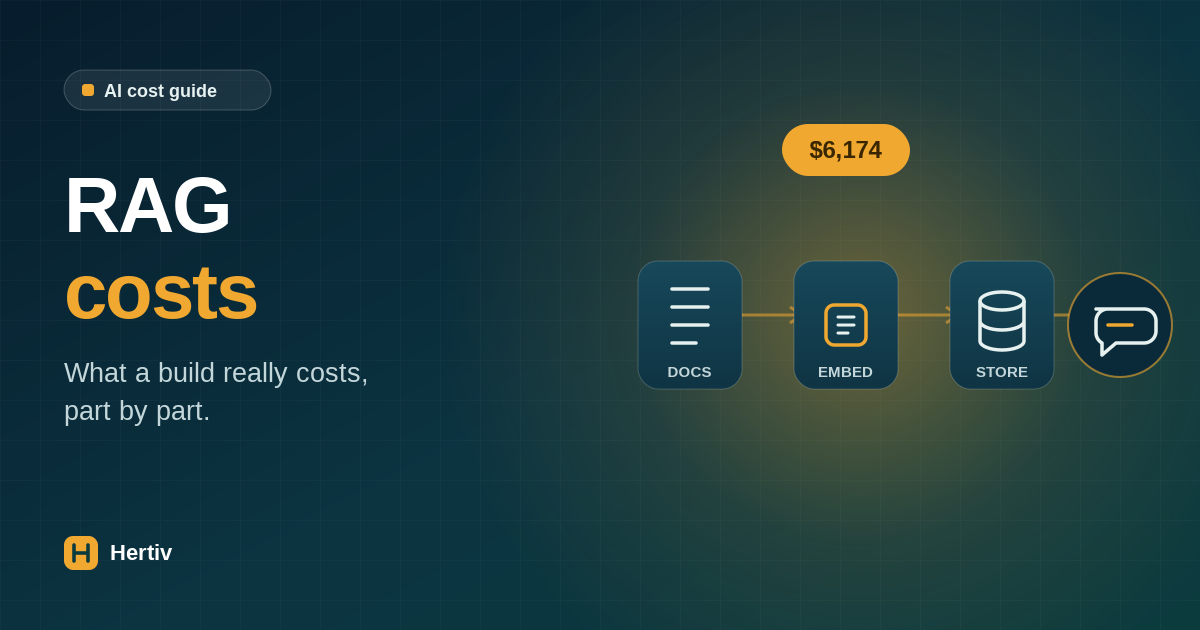
The first month total is $6,000 for the build plus $4 for embedding plus $170 running, or $6,174. The evaluation finds that 15 percent of answers need a source the system missed, so the team spends one more week, $2,000, adding those documents. The pilot still comes in under $8,200, and the team now has real numbers for the full rollout.
What are the common mistakes?
The most common RAG development mistakes are skipping evaluation, feeding the system messy documents, and judging the build by demo answers instead of test questions.
- No evaluation set. Without fixed test questions, nobody can tell whether a change made the system better or worse.
- Messy documents in, wrong answers out. Outdated pages and duplicate files get retrieved and quoted, so clean the sources first.
- Chunks too large or too small. Large chunks bury the answer; tiny chunks lose the context. Test both before you commit.
- No refusal behaviour. A system that always answers will invent one when the documents have nothing, so teach it to say it does not know.
- Ignoring running cost. A model that is fine for a pilot can get expensive at ten times the volume, so price the run before you scale.
Key takeaways
- RAG development cost is mostly engineering time, not model calls
- Document preparation and accuracy checks are where budgets usually grow
- Start narrow: one document set, one user group, one question type
- Price the build and the run separately, and hold back a reserve for fixes
- An evaluation set is the only way to prove the system works before launch
Frequently asked questions
How much does it cost to build a RAG system?
A small pilot usually costs a few thousand dollars in engineering time plus a small monthly running cost, while a production system with large, messy document sets and strict accuracy checks can cost several times more. The build dominates the first year, and the running cost stays small until usage grows.
What is the cheapest part of a RAG build?
Embedding is usually the cheapest part, because turning text into vectors costs very little at most volumes. The expensive parts are document preparation, retrieval tuning and evaluation, which are all engineering time rather than usage fees.
Does a bigger document set always cost more?
It costs more to prepare and to store, but the increase is usually modest compared with engineering time. The bigger risk is quality: a large set with outdated or duplicate documents produces worse answers, so cleaning matters more than size.
Should we use a hosted vector store or run our own?
A hosted store is cheaper to start and needs no maintenance, which suits most pilots. Running your own makes sense when you need full control over data location or when usage is high enough that hosting fees pass the cost of running it yourself.
How do you test a RAG system before launch?
Build a set of real questions with known answers, run them through the system, and score how many answers are correct, grounded in the documents and complete. Repeat the set after every change, so you can see whether the system improved or got worse.
Can RAG replace fine-tuning?
Often, yes, when the goal is to answer from your own documents. RAG is cheaper to update, because you change the documents rather than retraining a model. Fine-tuning fits better when you need a consistent style or behaviour that documents alone cannot teach.


