How Much Does Prompt Engineering Cost?
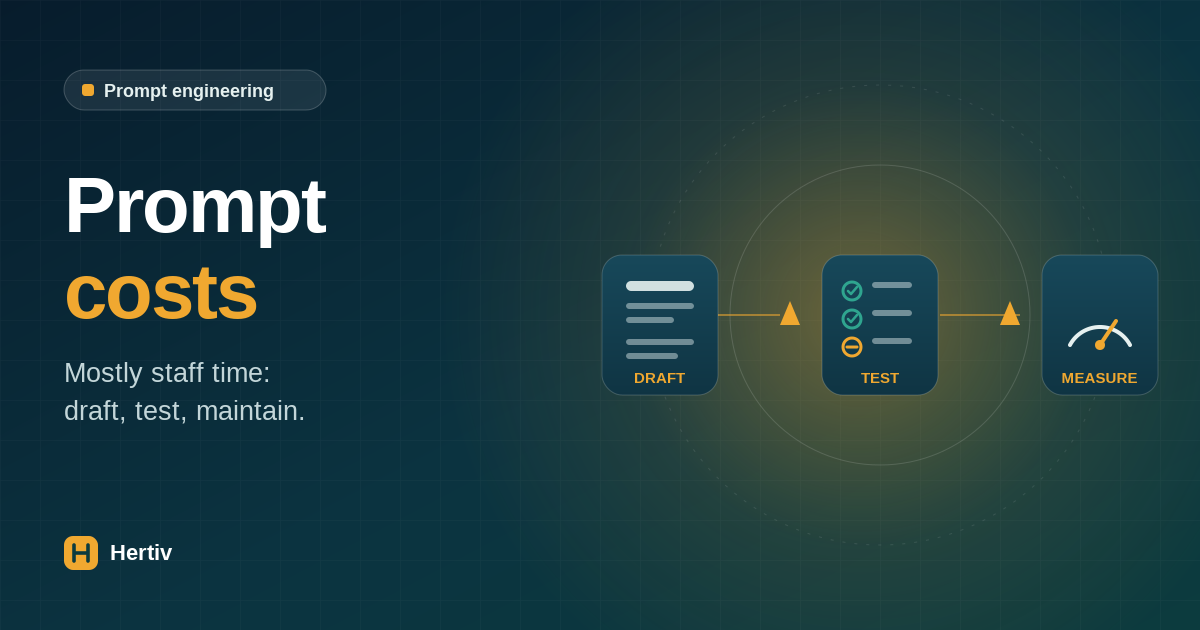
Prompt engineering cost is mostly staff time: writing, testing and maintaining prompts. Learn what drives the cost and how to budget for a first project.
On this page
Short answer
Prompt engineering costs a team mainly in staff time, plus the model calls used during testing. A small project with a few dozen prompts typically takes a few weeks of part-time work from one or two people, while a large prompt library with evaluation and maintenance can take a dedicated role. The biggest cost driver is testing prompts against real cases, not writing the first draft.
What is prompt engineering cost?
Prompt engineering cost is the money and time a team spends to write, test and maintain the prompts that drive a language model. It is not the price of the model itself. It is the work around the model: drafting instructions, trying them on real inputs, checking the outputs and fixing the prompts that fail.
Most of the cost is staff time. A prompt that looks like two paragraphs of text can take hours to get right, because each version has to be run against real cases and reviewed. The model calls used during testing are usually a small share of the total, unless the test set is very large.
The table below shows where the cost sits for a typical first project.
| Cost part | What it covers | Share of the budget |
|---|---|---|
| Drafting prompts | Writing first versions for each task | Small |
| Testing prompts | Running prompts on real cases and reviewing output | Largest |
| Evaluation set | Collecting cases with known good answers | Medium |
| Model calls | API charges for test runs | Small |
| Maintenance | Updating prompts when the model or data changes | Ongoing |
For teams starting out, what prompt engineering is explains the basic workflow before any budget is set.
What makes up the cost of prompt engineering?
The cost of prompt engineering comes from five parts, and staff time dominates all of them. The first part is drafting: someone who knows the task writes the instruction, the examples and the output format. The second is testing, which is where most hours go, because a prompt has to be tried on dozens of real inputs before it can be trusted.
The third part is the evaluation set. A team needs a fixed set of cases with known good answers, so each prompt version can be scored the same way. Building that set takes time up front, but it stops the team from re-testing by hand every time a prompt changes.
The fourth part is model calls. Each test run sends text to a model provider and is billed per token. For a small project this is usually a minor cost. It grows when the test set is large, the prompts are long, or the team re-runs the whole set many times a day.
The fifth part is maintenance. Prompts drift: the model is updated, the source documents change, or the task itself changes. A prompt library needs an owner who reviews failures, retires prompts that no longer work and keeps the evaluation set current.
How much does prompt engineering cost in-house?
Prompt engineering done in-house costs mainly the time of the people who already know the task. A small project, such as prompts for one support workflow, often takes one person a few weeks of part-time work: a few days to draft, a week or two to test against real tickets, and a few days to set up the evaluation set.
A larger project costs more because the prompt count grows and the testing multiplies. A library of fifty prompts is not fifty times the work of one prompt, but each prompt still needs its own test cases, and the team has to check how prompts interact when they share context or tools.
As a planning range, budget four to eight hours of work per prompt for drafting and testing, plus time to build the evaluation set. A prompt that handles a simple, well-defined task sits at the low end. A prompt that must handle edge cases, call tools or follow strict output rules sits at the high end.
Teams that already use a prompt library should look at prompt engineering tools for versioning and testing, since they cut the manual work of re-running test sets.
What does hiring a prompt engineer cost?
Hiring a prompt engineer costs what a specialist hire costs in your market, and the role is usually filled by someone who combines domain knowledge with hands-on model experience. The job is less about writing clever text and more about designing tests, reading failures and knowing when a prompt is good enough to ship.
A consultant or freelancer is the cheaper way to start. A short engagement can cover the first prompt set, the evaluation set and the testing routine, after which the internal team takes over. For pricing, see the vendor or agency site, since rates vary widely by market and scope.
Before hiring, check whether the work needs a prompt specialist at all. If the task is a single prompt for an internal tool, the domain expert who owns the workflow can usually do it with a few days of guidance. A dedicated role makes sense when prompts are a core part of the product, when there are dozens of them, or when failures reach customers directly.
Compare this with prompt engineering versus fine-tuning, since fine-tuning is a different spend with different trade-offs and should not be confused with prompt work.
How do you budget for a prompt engineering project?
You budget for a prompt engineering project by counting prompts, test cases and review hours, then adding a reserve for rework. Start from the task list, not from a round number, because the prompt count is what drives the work.
- List the tasks. Write down each job the model will do, such as drafting a reply, extracting a field or summarising a document.
- Count the prompts. Most tasks need one prompt, but a few need a chain of two or three. Count each one separately.
- Set the test set size. Plan at least twenty real cases per prompt, with known good answers for each.
- Estimate hours per prompt. Use four to eight hours as a planning range, and add time to build the evaluation set.
- Add a reserve. Add twenty per cent for prompts that fail testing and need to be rewritten or split into smaller steps.
Track the budget in hours, not in prompt count alone. Two prompts can take very different amounts of work, and the hours are what the team actually spends.
Example: a support team budgets its first prompt project
Example (hypothetical): a support team wants prompts for three tasks: drafting ticket replies, summarising long threads and tagging incoming tickets. That is three prompts to draft and test.
Drafting and testing take six hours per prompt at a planning rate of 60 dollars an hour. Three prompts at six hours is 18 hours, which is 1,080 dollars. The evaluation set needs 200 cases, and collecting and labelling them takes 15 minutes each, which is 50 hours, or 3,000 dollars at the same rate.
The build total is 1,080 plus 3,000, which is 4,080 dollars. A twenty per cent reserve for rework adds 816 dollars, bringing the budget to 4,896 dollars. The model calls for testing are a small extra cost on top, billed per token by the provider.
The team also plans one hour a week for maintenance: reviewing failed replies, updating prompts and keeping the evaluation set current. That hour is the ongoing cost, and it is what keeps the prompts working after launch.
What are the common mistakes?
The most common prompt engineering mistakes are skipping the evaluation set, testing on made-up cases, and treating the first draft as finished.
- No evaluation set. Without fixed cases and known good answers, every change is judged by feel, and quality drifts without anyone noticing.
- Testing on invented inputs. Prompts tuned on examples the team wrote themselves often fail on real customer wording.
- One giant prompt. A single prompt that tries to do everything is harder to test and fix than two or three smaller prompts.
- Ignoring the failure rate. A prompt that works nine times in ten still fails once in ten, and that failure needs a fallback path.
- No owner after launch. Prompts left unowned go stale when the model or the data changes, and nobody notices until customers complain.
Key takeaways
- Prompt engineering cost is mostly staff time, not model charges
- Testing against real cases is the largest cost part
- Budget four to eight hours of work per prompt as a planning range
- An evaluation set with known good answers is what makes cost predictable
- Add a twenty per cent reserve for prompts that fail testing
Frequently asked questions
How much does prompt engineering cost for a small project?
A small project with a few prompts usually takes a few weeks of part-time work from one or two people. The main cost is drafting and testing time, plus building an evaluation set. Model charges for testing are usually a small extra cost, billed per token by the provider.
Is prompt engineering a one-time cost?
No. Prompts need maintenance after launch, because the model is updated, source documents change and the task itself changes. Plan for a regular review hour each week, plus time to update prompts that start failing on real inputs.
What is the most expensive part of prompt engineering?
Testing is usually the most expensive part. Each prompt has to be run against dozens of real cases and the outputs reviewed by someone who knows the task. Drafting the first version is fast by comparison, and model charges are normally a small share.
Do I need to hire a prompt engineer?
Not always. A domain expert who owns the workflow can handle a single prompt with a few days of guidance. A dedicated role makes sense when prompts are core to the product, when there are dozens of them, or when failures reach customers.
How many test cases does each prompt need?
Plan at least twenty real cases per prompt, each with a known good answer. That is enough to catch common failures and to compare prompt versions fairly. Prompts that handle edge cases or call tools usually need more cases, not fewer.
Does fine-tuning cost more than prompt engineering?
Usually yes, because fine-tuning adds data preparation, training runs and ongoing model management on top of prompt work. Prompt engineering is the cheaper first step, and many teams never need fine-tuning once their prompts are tested properly.


