How to Balance the Project Management Triangle
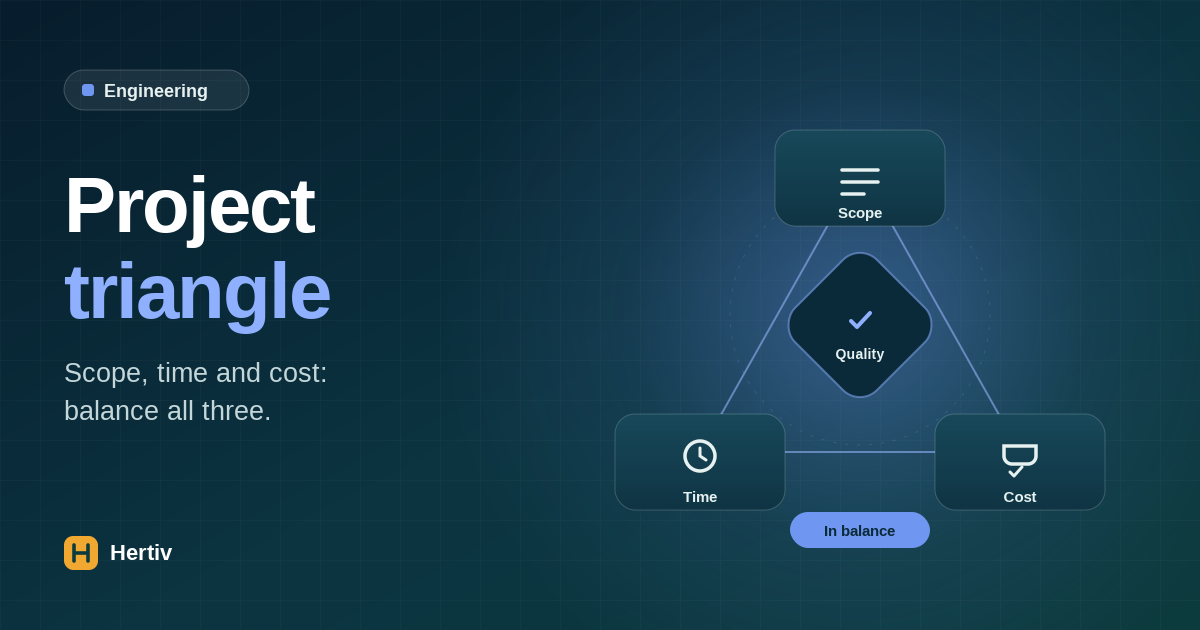
The project management triangle links scope, time and cost: change one and at least one other must move. Here is how to keep the three in balance.
On this page
Short answer
The project management triangle is a model that links three constraints of any project: scope, time and cost. You can change one of them, but at least one of the other two has to move with it. A project that tries to add features, finish sooner and spend less at the same time will fail on at least one of those promises.
What is the project management triangle?
The project management triangle is a model of three project constraints: scope, time and cost. Scope is what the project must deliver, time is the deadline, and cost is the budget. The model is also called the iron triangle, because the three sides hold each other in place.
The rule is simple. If you change one side, at least one of the other two must move. Add features and you need more time, more money, or both. Cut the deadline and you must spend more or deliver less. Cut the budget and you must accept a later date or a smaller result.
Quality sits in the middle of the triangle. When a team is squeezed on all three sides at once, quality is usually what gives way first: testing is cut, reviews are skipped and rough edges ship. That is why experienced managers treat quality as a fourth constraint to protect, not as a spare resource. For a view of how teams organise the work itself, see Agile vs Scrum project management.
What are the three corners of the triangle?
The three corners of the project management triangle are scope, time and cost, and each one is set by a different kind of decision.
- Scope. What the project delivers: features, screens, reports, integrations and the quality standard each one must meet. Scope is set by the requirements the business signs off.
- Time. The schedule: the start date, the deadline and the milestones in between. Time is set by the market, a launch event, a contract or a season.
- Cost. The budget: people, tools, licences and outside help. Cost is set by what the business can fund and what the work is worth.
Each corner has an owner. The business owns scope, because it decides what matters. The calendar or the contract owns time. Finance owns cost. A project stays in balance when those three owners agree on the same numbers, and it drifts when any one of them changes a number without telling the others.
How do the three corners affect each other?
When one corner of the triangle moves, the others have to absorb the change. The table below shows the usual trade-offs for a software project.
| Change | What moves | What it costs the project |
|---|---|---|
| Scope grows | Time or cost | Later delivery, or a bigger team and budget |
| Deadline moves earlier | Scope or cost | Fewer features, or overtime and extra staff |
| Budget is cut | Scope or time | Less delivered, or a slower schedule |
| Team loses a member | Time or scope | Later delivery, or features dropped |
| Quality standard rises | Time and cost | More testing time and review effort |
| All three are fixed | Quality | Testing and polish are squeezed out |
The last row is the one to watch. A project where scope, time and cost are all fixed is not really in balance. Something has to give, and it is almost always quality, because it is the easiest corner to cut quietly. A manager who accepts all three as fixed should say so plainly and agree what quality standard the team is allowed to drop.
How do you balance the triangle for your project?
You balance the project management triangle by fixing two corners, letting the third flex, and checking the balance at every milestone. The steps below are the usual order.
- List the scope in plain items. Write down every feature, integration and report as a separate item, so that cutting scope means cutting named items, not vague effort.
- Agree which corner is fixed. Pick the one that cannot move: a hard launch date, a fixed budget, or a must-have feature set. Say it out loud so everyone hears the same answer.
- Estimate the other two honestly. If time is fixed, estimate cost and scope from the team's real pace, not from the date the business wants. A planning tool helps here; compare project management tools for developers before you commit to one.
- Rank the scope. Mark each item as must-have, should-have or nice-to-have, so the team knows what to drop first when the triangle moves.
- Rebalance at each milestone. At every review, compare what is done against the plan and move one corner openly: drop scope, add time, or add budget.
- Protect quality with a floor. Agree the minimum testing and review the team will not skip, and treat that floor as fixed even when the other corners move.
Balancing is a habit, not a one-off plan. A triangle that is balanced at the start will drift as soon as real work begins, so the review at each milestone is where the balance is actually kept.
Which corner should you fix first?
Which corner to fix first depends on what your business cannot change. There is no universal answer, but most projects fall into one of three patterns.
Fix time first when the date is set by something outside the project: a product launch, a regulation, a season or a contract. In that case scope is the flexible corner, and the team should rank features hard so the deadline is met with the most valuable work done.
Fix cost first when the budget is capped and cannot grow. Then time is usually the flexible corner, and the team should plan a slower schedule with a smaller team. Adding people to a late project rarely helps, because new starters need time to learn the work.
Fix scope first when a specific result is non-negotiable, such as a compliance feature or a core workflow. Then time and cost both flex, and the business should expect the date and the budget to move as the work is estimated. If you need help planning the trade-offs, a partner for custom software development can estimate the scope before you commit to a date.
Example (hypothetical): a 10-week website rebuild
Example (hypothetical): a retailer plans a website rebuild with 40 features, a team of 4 developers, 10 weeks and a budget of $80,000. Each developer costs $2,000 a week, so the team costs $8,000 a week and $80,000 over 10 weeks, which matches the budget exactly.
After two weeks the business asks for the site in 8 weeks instead of 10. At the team's pace of 4 features a week, 8 weeks only delivers 32 of the 40 features, so 8 features must be cut.
The other option is a fifth developer. Five developers at $2,000 a week for 8 weeks costs $80,000, the same budget, and the team can still deliver 40 features if the extra developer is productive from week one.
The manager shows the business both options and lets it choose: 32 features in 8 weeks, or 40 features in 8 weeks with a fifth developer and a small risk that onboarding slows the team. The business picks the 32-feature version, because the 8 cut features are all nice-to-have items. The triangle stays in balance because the choice is explicit.
What are the common mistakes?
The most common mistakes with the project management triangle are fixing all three corners, hiding the trade-off, and estimating from the deadline instead of from the work.
- Fixing all three corners. A project with fixed scope, fixed time and fixed cost has no room to move. Quality is the corner that gives way, usually without anyone agreeing to it.
- Hiding the trade-off. When scope grows quietly, the team absorbs it by working longer hours. The triangle still moves, but the cost lands on the team instead of on the plan.
- Estimating backwards from the date. Starting from the deadline and fitting the work into it produces an estimate that looks good and fails late. Estimate the work first, then compare it with the date.
- No ranked scope. Without a must-have list, every feature looks equal and cutting scope becomes a fight. Rank the scope before the work starts.
- Adding people to a late project. New starters need onboarding, which slows the team before it speeds it up. It only helps when there is enough time left for them to learn the work.
Key takeaways
- The project management triangle links scope, time and cost, and one cannot move alone
- Fix two corners and let the third flex, or quality will be the corner that gives way
- Rank scope as must-have, should-have and nice-to-have before the work starts
- Rebalance the triangle openly at every milestone instead of absorbing changes quietly
- Estimate the work first, then compare the estimate with the date and the budget
Frequently asked questions
What is the project management triangle?
It is a model of three project constraints: scope, time and cost. Changing one forces at least one of the other two to move, and quality sits in the middle and is usually what suffers when all three are fixed at once.
Can you fix scope, time and cost all at once?
In practice, no. A project with all three fixed has no room to absorb change, so quality is the corner that gives way. If all three must be fixed, the team should agree openly what quality standard it is allowed to drop.
Which corner should flex when the deadline moves earlier?
Usually scope. Cutting the lowest-ranked features is the cheapest way to meet an earlier date. Adding people costs money and needs onboarding time, so it only works when the deadline still leaves room for them to learn the work.
How does the triangle apply to software projects?
The same way as to any project: features are scope, the release date is time, and the team is cost. Adding a feature means a later release or a bigger team, and cutting the budget means fewer features or a later release.
What is the iron triangle?
It is another name for the project management triangle. The name comes from the idea that the three sides hold each other in place: push on one side and the others have to move.
How often should you rebalance the triangle?
At every milestone, and whenever a change request arrives. A triangle balanced at the start will drift as soon as real work begins, so the review is where the balance is actually kept.


