Profile Matching Software: How It Works and When to Use It
Profile matching software compares two sets of profiles, such as candidates and jobs, and ranks the best fits. It saves the hours spent reading profiles by hand.
On this page
Short answer
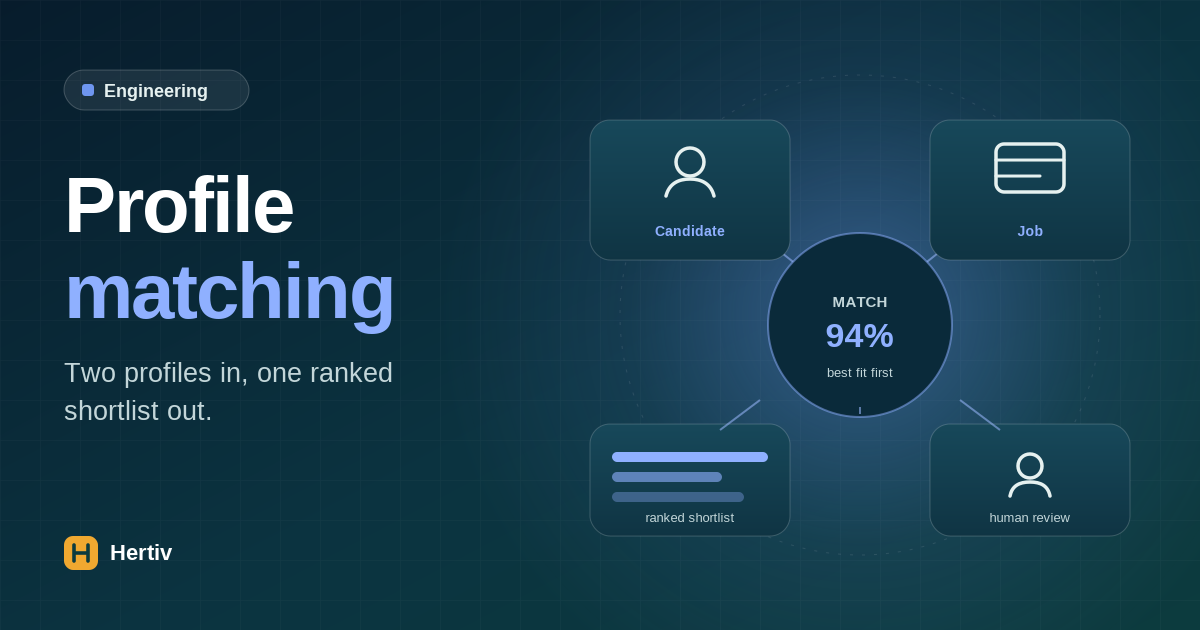
Profile matching software compares two sets of profiles, such as candidates and jobs or freelancers and projects, and ranks the best fits. It reads structured fields and free text from both sides, scores each pair on the factors that matter, and returns a ranked shortlist for a human to review.
What is profile matching software?
Profile matching software compares two sets of profiles, such as candidates and jobs or freelancers and projects, and ranks the best fits. It reads structured fields and free text from both sides, scores each pair on the factors that matter, and returns a ranked shortlist for a human to review.
A profile is a structured record of a person or a thing: skills, experience, location, availability, rates and preferences. A job or project profile lists what is needed: skills, seniority, budget, timing and working style. Matching software turns both into comparable data and finds the pairs that fit best.
The software does not hire anyone or award a project. It narrows a long list to a short one, so a human spends time on the ten best candidates instead of reading a hundred profiles. The final decision stays with a person, and that matters for both quality and fairness.
How profile matching works
Matching works in three stages: normalise, score and rank. Normalising turns messy text into comparable fields, scoring measures how well two profiles fit, and ranking orders the results so the best fits come first.
Normalising is the hardest stage. The same skill can be written ten ways, job titles vary by company, and experience can be stated in years, projects or roles. The software maps these variants to a shared set of terms, so a candidate who writes "JS" and a job that asks for "JavaScript" are recognised as the same thing.
Scoring then weighs each factor. Skills usually count most, followed by experience, location, availability and rate. Some systems use simple rules and weights; others use a model trained on past hires. Either way, the weights should be visible and adjustable, because a hidden score cannot be questioned or fixed.
| Signal | Example | Why it matters |
|---|---|---|
| Skills | JavaScript, React, testing | Core fit for the work |
| Experience | 5 years, 12 projects | Seniority and reliability |
| Location | City, time zone, remote | Working hours and travel |
| Availability | Start date, hours per week | Whether the work can start |
| Rate or salary | Hourly rate, salary band | Whether the budget fits |
| Preferences | Remote only, part time | Whether the person will accept |
Where profile matching is used
Hiring is the largest use. Recruiters match candidates to open roles, and internal mobility tools match staff to new positions. A company with hundreds of applicants per role cannot read every CV, so matching produces the shortlist that humans actually review.
Freelance and gig marketplaces are the second use. A client posts a project, and the platform matches freelancers by skill, rate, availability and past ratings. Good matching keeps clients from wading through irrelevant proposals and keeps freelancers from applying to work they cannot do.
Mentoring and coaching programmes are a third use. A mentor is matched to a mentee by goals, experience and working style, which matters more than a shared job title. The same pattern fits tutoring, where a student is matched to a tutor by subject, level and schedule.
Dating and networking apps use the same idea with different signals, but the principle is identical: two profiles, a score, a ranked list. The business cases above are the ones that most often justify buying or building the software. For hiring teams, AI agents for HR covers the wider automation around matching.
Build or buy profile matching software
Buy when matching is a feature, not the product. A hiring team that needs shortlists can buy a recruiting tool with matching built in, or a marketplace can buy a matching engine and plug it into its own product. Buying is faster and cheaper when the matching rules are standard.
Build when matching is the core of the product. A niche marketplace with unusual signals, such as certifications, safety records or equipment, may need scoring rules that no bought tool supports. Building also makes sense when the data must stay in your own systems.
| Option | Best when | Watch out for |
|---|---|---|
| Buy a tool | Matching is one feature among many | Scoring rules you cannot see or change |
| Buy an engine | Matching is core but rules are standard | Integration cost and data sync |
| Build it | Matching rules are unusual or the product | Data cleaning takes longer than the build |
Either way, budget more time for data than for software. Profiles are messy, and matching quality follows data quality. A clean set of skills and a shared vocabulary matter more than the matching algorithm. For the data work, data engineering is usually the first investment.
Data quality, bias and fairness
Matching is only as fair as its data and its rules. If past hiring favoured one group, a model trained on past hires will repeat that pattern. If a skill is written one way by one group and another way by another, the normaliser will favour the group whose wording it knows.
Three practices reduce the risk. First, keep a human in the loop: the software shortlists, a person decides. Second, audit the shortlists regularly for who is being left out and why. Third, make the scoring visible, so a candidate who asks why they were ranked low gets an answer based on stated factors.
Also check what the software reads. A system that scores based on university names or gaps in employment can quietly filter out good candidates for reasons that have nothing to do with the work. Score on skills and experience that the job actually needs, and leave the rest out of the profile.
Example (hypothetical): a freelance marketplace
Example (hypothetical): a freelance marketplace posts 200 projects a month. Without matching, staff shortlist by hand, spending 30 minutes per project reading freelancer profiles.
Manual shortlisting: 200 projects times 30 minutes equals 6,000 minutes a month, or 100 hours a month. With matching software, staff review a ranked shortlist of ten freelancers per project, taking 8 minutes per project. New shortlisting: 200 times 8 equals 1,600 minutes, or about 27 hours a month. Saving: 100 minus 27 equals about 73 hours a month.
The software costs $1,500 a month in this example, and staff time is valued at $40 an hour. The saving is worth 73 times $40, or $2,920 a month, against a cost of $1,500, leaving a net gain of $1,420 a month. The gain only holds if the shortlists are good: if staff must read fifty profiles to find ten good ones, the saving disappears. Measure shortlist quality, not just speed.
Common mistakes with profile matching
The most common profile matching mistakes are trusting the score blindly, and feeding the system messy data.
- Trusting the score blindly. A score is a ranking aid, not a decision. Always review the shortlist.
- Messy profile data. Free-text skills with no shared vocabulary make matching guesswork.
- Scoring on the wrong signals. University names and employment gaps predict little about job fit.
- No feedback loop. If hires are never linked back to scores, the system never improves.
- Over-filtering. A hard filter on one factor can remove the best candidate for the job.
- Hiding the rules. A score nobody can explain cannot be challenged or fixed.
Before building or buying, test the idea cheaply: how to validate an app idea shows how to check demand and fit before committing budget.
Key takeaways
- Matching software ranks fits; humans make the decision
- Normalising messy text into shared terms is the hardest stage
- Skills, experience, location, availability and rate are the core signals
- Matching quality follows data quality more than the algorithm
- Audit shortlists for fairness and keep scoring visible
Frequently asked questions
What is profile matching software used for?
Most often hiring, where it shortlists candidates for open roles, and freelance marketplaces, where it matches freelancers to projects. It is also used for mentoring, tutoring and internal mobility, anywhere two sets of profiles need to be paired.
How accurate is profile matching software?
It depends on the data. With clean, structured profiles and clear scoring rules, shortlists are usually good enough to save hours. With messy free text and hidden rules, shortlists can be worse than a manual search. Accuracy is measured on real hiring outcomes, not on the score itself.
Does profile matching software use AI?
Some systems use simple rules and weights, while others use models trained on past matches. Both are common, and the simpler option is often better when the rules are clear. The choice matters less than the quality of the profile data.
Can profile matching software be biased?
Yes. If past decisions favoured one group, a system trained on them will repeat the pattern, and wording differences can favour one group over another. Keep a human in the loop, audit shortlists and score only on factors the job needs.
Should I build or buy profile matching software?
Buy when matching is one feature among many and standard rules fit. Build when matching is the core of your product or needs unusual signals. Either way, budget more time for cleaning profile data than for the software itself.
What data does profile matching need?
It needs structured profiles on both sides: skills, experience, location, availability and rate or salary. Free text helps, but only after it is mapped to shared terms. Without a shared vocabulary for skills, matching is guesswork.


