How Pose Estimation Improves Accessibility in Healthcare
Pose estimation turns ordinary camera video into joint and movement data, letting clinics assess mobility and guide exercise without wearables or sensors.
On this page
Short answer
Pose estimation is computer vision that finds body joints in video and tracks how they move over time. In healthcare it helps clinicians assess gait, balance and range of motion, guide home exercise, and spot falls, using an ordinary camera instead of wearable sensors. That lowers the barrier for patients who cannot travel or wear devices.
What is pose estimation?
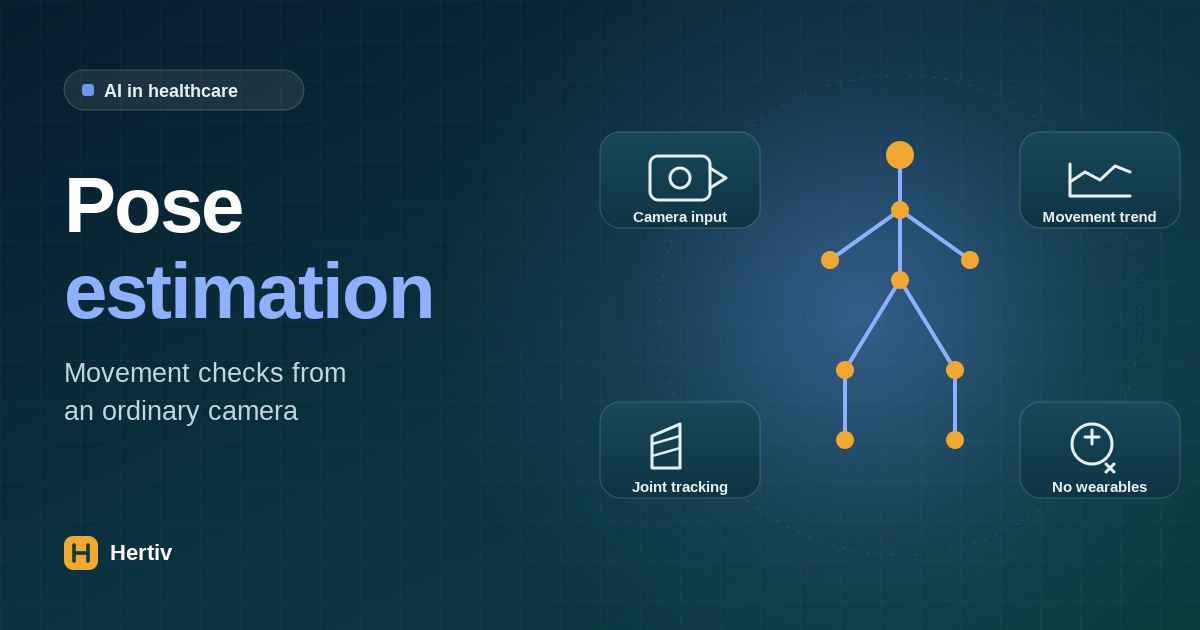
Pose estimation is computer vision that finds the positions of body joints, such as shoulders, elbows, hips and knees, in a photo or video, and tracks how they move. The output is a skeleton of points and lines that shows posture and motion without recording a detailed image of the person.
It works with an ordinary camera: a phone, laptop or wall-mounted camera is enough. The software first detects the person in the frame, then estimates the joint positions, then joins them into a moving skeleton. From that skeleton it can measure angles, speed, symmetry and range of motion.
The key point for healthcare is that nothing touches the patient. There are no sensors to wear, no markers to stick on, and no special room. That makes it usable at home, in a small clinic, or in a care home where wearable devices are impractical.
How does pose estimation work in a clinic?
A clinic pose estimation workflow has four steps, and the clinician stays in control at each one.
- Record a short movement. The patient walks, stands up, or performs a guided exercise in front of a camera.
- Extract the skeleton. The software finds the joints and tracks them through the video.
- Measure what matters. The system reports angles, stride, balance time or repetitions, depending on the test.
- Review with the clinician. The clinician compares the numbers with earlier sessions and decides the next step.
The video itself is rarely the record. Most systems keep the joint data and a short clip, and delete the raw video, which also helps with privacy. For other ways AI is used in care, see AI in healthcare examples.
Where does pose estimation improve accessibility?
Pose estimation improves accessibility where travel, cost or wearable devices get in the way of care. The table shows the main uses.
| Use | Who it helps | What it replaces |
|---|---|---|
| Remote physiotherapy checks | Patients far from a clinic | Travel for a short review |
| Gait and balance assessment | Older patients at fall risk | Specialist lab visits |
| Guided home exercise | Patients recovering at home | Paper sheets with no feedback |
| Fall detection | People living alone | Wearable fall alarms |
| Posture screening at work | Workers with desk strain | In-person ergonomic visits |
The common thread is that the patient needs only a camera and a screen. That matters most for people with limited mobility, limited income, or no transport to a specialist clinic.
Clinics that already run remote reviews can add pose checks to the same visit, without booking a new appointment. The patient joins the call, performs the guided movement, and the numbers go into the same record as the consultation notes.
What does a clinic need to run it?
A clinic needs less equipment than most people expect, but the setup still needs care.
The camera should see the whole body with steady light and a plain background. A phone on a stand works for a single patient; a fixed camera works better for a busy room. The patient needs enough floor space to walk a few steps or stand and sit safely.
On the software side, the clinic needs consent handling, a way to store joint data securely, and a clear rule for who reviews the results. The system should flag a poor-quality recording, such as a joint hidden behind furniture, rather than guessing. Wearable technology in healthcare covers the sensor-based alternative for comparison.
Staff training matters as much as the camera. A nurse or therapist should know how to position the patient, when to retake a recording, and how to explain the process in plain words. A short checklist at the door of the room, covering light, space and consent, prevents most failed sessions.
What are the privacy and accuracy limits?
Pose estimation has real limits, and a clinic should plan for them rather than discover them later.
Privacy comes first. Video of a patient is sensitive health data, so the clinic needs consent, a clear retention rule, and a reason to keep each recording. Keeping only joint data and deleting raw video is the usual approach.
Accuracy depends on light, clothing and camera angle. Loose clothes, a dark room or a side view can hide joints and skew the numbers. Pose estimation also measures movement, not strength or pain, so it supports a clinician's judgement rather than replacing it. It does not diagnose on its own.
Results also need a review routine. A clinician should look at the trend across several sessions, not a single reading, because one bad recording can look like a sudden change. Comparing this week's numbers with last month's, and checking the video when a number jumps, keeps small errors from turning into wrong decisions.
For the underlying technology, computer vision development explains how these systems are built and tested.
Example (hypothetical): a remote physiotherapy programme
Example (hypothetical): a physiotherapy clinic runs a remote programme for 120 patients a month who would otherwise travel in for short reviews.
Each remote session saves a patient 45 minutes of travel. Across 120 sessions that is 5,400 minutes, or 90 hours a month, and 1,080 hours over a year. The clinician spends 5 minutes reviewing each session's joint data, which is 600 minutes, or 10 hours a month.
The programme needs one camera per treatment room and a tablet for home sessions, plus staff time to review the data. The saving is real for patients who cannot travel easily, but the clinic still pays for the review time, so the case rests on access and outcomes, not on removing the clinician.
What are the common mistakes?
The most common pose estimation mistakes are trusting the numbers without checking the video, ignoring consent, and buying the tool before defining the clinical question.
- Trusting bad recordings. A hidden joint gives a wrong angle; flag poor video instead of reporting a guess.
- Weak consent. Patients must know what is recorded, what is kept, and who sees it.
- No clinical question. A skeleton is not a diagnosis; start from the measurement the clinician needs.
- Ignoring lighting and space. A dark corner or a cluttered room ruins accuracy.
- Replacing the clinician. The tool measures movement; the clinician decides what it means.
Key takeaways
- Pose estimation tracks body joints in video, with no sensors on the patient
- It supports gait, balance and exercise checks from an ordinary camera
- Remote sessions save travel time for patients who cannot reach a clinic
- Privacy and recording quality decide whether the results are usable
- The tool measures movement; the clinician decides what it means
Frequently asked questions
What is pose estimation in healthcare?
Pose estimation is computer vision that finds body joints in video and tracks how they move. In healthcare it measures gait, balance, range of motion and exercise form, using an ordinary camera instead of wearable sensors.
Can pose estimation replace a physiotherapist?
No. It measures movement and counts repetitions, but a physiotherapist interprets the results, checks pain and strength, and sets the treatment plan. The tool supports the clinician, it does not replace them.
Is pose estimation accurate enough for clinical use?
It is accurate enough for tracking change over time when the recording is good: steady light, full-body view and a plain background. Poor recordings give poor numbers, so the system should flag them.
Does pose estimation need special hardware?
No. A phone, laptop or fixed camera is enough. The patient needs floor space to move safely and light that shows the whole body. No sensors or markers are worn.
How is patient privacy handled?
Video is sensitive health data, so clinics need consent and a retention rule. Most systems keep the joint data and delete the raw video, and access is limited to the care team.
What is the difference between pose estimation and motion capture?
Motion capture uses markers or suits for high-precision studio work. Pose estimation uses an ordinary camera and software, which is less precise but far easier to use in a clinic or at home.


