Polygon Scaling: ZK Rollups vs Optimistic Rollups
Polygon scales Ethereum with ZK rollups like Polygon zkEVM, while optimistic rollups take a different route. This guide compares how each works and when to pick it.
On this page
Short answer
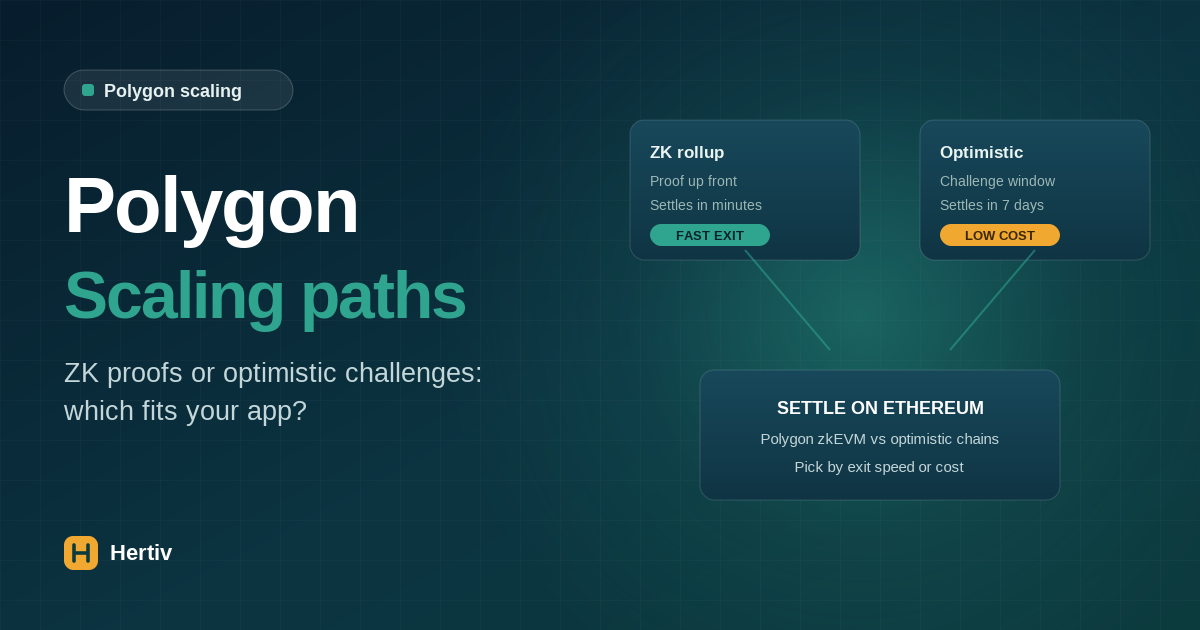
Polygon scaling relies mainly on ZK rollups such as Polygon zkEVM, which prove transactions are valid before they settle on Ethereum. Optimistic rollups assume transactions are valid and rely on a challenge window to catch fraud. ZK rollups settle faster but cost more to prove; optimistic rollups are cheaper to run but slower to finalise withdrawals.
What are ZK rollups and optimistic rollups?
A ZK rollup is a scaling solution that processes transactions off the main chain and posts a cryptographic proof that they are valid. An optimistic rollup also processes transactions off the main chain, but it assumes they are valid and gives anyone a window to challenge them with a fraud proof.
Both move work off Ethereum so that more transactions fit and fees fall, but they check correctness in opposite ways. A ZK rollup proves validity up front; an optimistic rollup checks validity only if someone disputes a result. That difference shapes cost, speed and finality.
Polygon's scaling work centres on ZK technology: Polygon zkEVM is a ZK rollup that runs Ethereum-compatible contracts, and the Polygon CDK lets teams build their own ZK chains. Optimistic rollups such as Arbitrum and Optimism run on their own stacks, and teams building on Polygon usually compare them against Polygon zkEVM rather than using both. Polygon development covers the practical side of building on the chain.
How do ZK rollups scale Polygon?
ZK rollups scale Polygon by bundling many transactions into a batch, executing them off chain, and posting a short proof to Ethereum that the batch is correct. Ethereum checks the proof instead of re-running every transaction, so the cost of the batch is shared across all the transactions inside it.
Polygon zkEVM is the main example. It is designed to run existing Ethereum contracts without changes, so a team can move a dApp to it and keep the same code. The proof is generated by a prover, which is the expensive part: proving costs more than executing, and that cost is the main trade-off of the ZK approach.
Finality is fast. Once the proof is verified on Ethereum, the batch is settled, and withdrawals do not wait for a challenge period. That matters for applications where users move funds often, such as payments and trading. The cost is prover infrastructure and the complexity of the proving system, which is why ZK rollups took longer to reach production than optimistic ones.
How do optimistic rollups work?
Optimistic rollups work by assuming transactions are valid and posting the resulting state to Ethereum without a proof. If nobody challenges the result within a set window, usually about seven days, the batch is treated as final.
The challenge window is the core of the design. Anyone watching can submit a fraud proof if a batch contains an invalid transaction, and the disputed batch is re-run to settle the question. Because challenges are rare, the system is cheap to run day to day: most batches are never disputed.
The cost is withdrawal time. Moving funds from an optimistic rollup back to Ethereum takes the full challenge window, because the funds cannot be released until the result is beyond dispute. That is acceptable for many applications, but it is a real constraint for users who need fast exits. Some services offer faster exits by taking the risk themselves, for a fee.
ZK rollups vs optimistic rollups: how do they compare?
The choice between ZK rollups and optimistic rollups comes down to what the application needs most: fast finality, low running cost, or simple tooling.
| Factor | ZK rollups | Optimistic rollups |
|---|---|---|
| How validity is checked | Cryptographic proof up front | Fraud proofs only if challenged |
| Withdrawal finality | Minutes, once the proof verifies | About seven days |
| Running cost | Higher, due to proving | Lower, most batches unchallenged |
| Tooling maturity | Newer, still evolving | More mature, widely used |
| Ethereum compatibility | High on Polygon zkEVM | High on major chains |
| Best for | Payments, trading, fast exits | General apps, lower costs |
Neither design is better in every case. A payments app that needs fast exits will usually pick ZK; a general app with tight margins may prefer optimistic. The right question is which constraint hurts more: waiting days to withdraw, or paying more to prove each batch.
When should you pick each one on Polygon?
You pick a scaling path on Polygon by matching the design to the application's needs, not by following the trend.
- Pick Polygon zkEVM when exits must be fast. Payments, trading and gaming need users to move funds quickly, and a seven-day wait is a product problem.
- Pick an optimistic rollup when running cost matters most. If the application processes many small transactions and users rarely withdraw, the lower proving cost wins.
- Pick Polygon zkEVM when you need Ethereum compatibility. Existing contracts move across with little change, which shortens the build.
- Consider the team's skills. Optimistic rollups have more mature tooling and more production examples to learn from, which matters for a small team.
- Consider liquidity. Users and funds are already on both designs, so the chain with the users your application needs may matter more than the technology.
Some teams run on both: a ZK rollup for payments and an optimistic rollup for general activity, with a bridge between them. That adds complexity, so it should be a deliberate choice, not a default. For most teams, one chain done well beats two chains done thinly.
Example (hypothetical): a payments app chooses a scaling path
Example (hypothetical): a payments app on Polygon has 50,000 users who make 2 transactions a day, which is 100,000 transactions a day. Users withdraw funds often, and a slow withdrawal is the most common support complaint.
On an optimistic rollup, a withdrawal waits about seven days, which is 168 hours. On Polygon zkEVM, the same withdrawal settles in about 30 minutes once the proof verifies, which is 0.5 hours. The difference is 167.5 hours of waiting for the same $10,000 withdrawal.
The team also counts batches: 100,000 transactions a day grouped into 100 batches of 1,000 transactions each means 100 proofs a day on the ZK path. Proving costs more per batch, but the team decides that fast exits matter more than the extra proving cost, because withdrawals are the main complaint.
The lesson is to decide by the user's pain, not by the technology. The team picked ZK because withdrawals were the problem; a different app with rare withdrawals could reasonably pick the cheaper optimistic path.
What are the common mistakes?
The most common mistakes in rollup scaling are choosing by trend, ignoring withdrawal time, and underestimating the cost of proving.
- Choosing by trend. ZK and optimistic designs both work; the right one depends on the application's needs, not on which is newer.
- Ignoring withdrawal time. A seven-day exit is a product feature users will notice, not a technical detail.
- Underestimating proving cost. ZK rollups cost more to run, and the prover is a real part of the budget.
- Assuming full Ethereum compatibility. Most contracts move across, but some rely on behaviour that differs on a rollup, so test before migrating.
- Skipping the bridge risk. Moving funds between chains depends on bridges, which are a separate security surface.
- Building on two chains at once. Running on both designs doubles the work for little gain unless the product genuinely needs both.
If you are planning a Polygon build and want the scaling choice tied to real user behaviour, Ethereum development support can map the options before code is written.
Key takeaways
- ZK rollups prove validity up front; optimistic rollups check only when challenged
- Polygon zkEVM gives fast finality, which matters most for payments and trading
- Optimistic rollups cost less to run but hold withdrawals for about seven days
- Choose by the user's pain: exit speed, running cost or tooling maturity
- Test contracts on the rollup before migrating, and do not build on two chains by default
Frequently asked questions
What is Polygon zkEVM?
Polygon zkEVM is a ZK rollup on Polygon that runs Ethereum-compatible smart contracts. It processes transactions off chain and posts a cryptographic proof to Ethereum, so existing contracts can move across with little change. It is the main ZK scaling option in the Polygon ecosystem.
How long do withdrawals take from an optimistic rollup?
Withdrawals usually take about seven days, because the funds cannot be released until the challenge window closes. Some services offer faster exits by taking the risk themselves for a fee, but the standard path waits the full window.
Are ZK rollups more expensive than optimistic rollups?
ZK rollups cost more to run because generating proofs takes real computing work, and prover infrastructure is part of the budget. Optimistic rollups are cheaper day to day because most batches are never challenged. The trade-off is speed: ZK settles in minutes, optimistic in days.
Can existing Ethereum contracts move to Polygon zkEVM?
Most can, because Polygon zkEVM is designed for Ethereum compatibility. Some contracts rely on behaviour that differs on a rollup, so the team should test on a testnet before migrating, rather than assuming everything works unchanged.
What is the Polygon CDK?
The Polygon CDK is a toolkit that lets teams build their own chains using Polygon's ZK technology. It suits teams that need a dedicated chain with their own rules, rather than sharing a public rollup with other applications.
Should a new app build on one rollup or two?
One rollup done well is usually better than two done thinly, because each chain adds testing, monitoring and bridge work. Build on both only when the product genuinely needs different properties, such as fast exits for payments and low cost for general activity.


