Pharmacy Software Development in the UAE: A Practical Guide
Pharmacy software in the UAE covers prescriptions, stock, billing and delivery, and it must fit local licensing and data rules. Here is how teams plan and build it.
On this page
Short answer
Pharmacy software is a system that helps a pharmacy manage prescriptions, stock, billing, customers and delivery, and in the UAE it must also fit local licensing, health authority and data rules. It usually covers the counter, the store room and the delivery bike in one system, so a prescription moves from the doctor's note to the customer's door without paper or re-typing.
What is pharmacy software?
Pharmacy software is a system that helps a pharmacy run its daily work: taking prescriptions, checking stock, billing customers, tracking expiry dates and arranging delivery. In the UAE, a pharmacy system also has to fit the rules of the health authority in its emirate, such as the Dubai Health Authority, the Department of Health in Abu Dhabi or the Ministry of Health and Prevention for the other emirates.
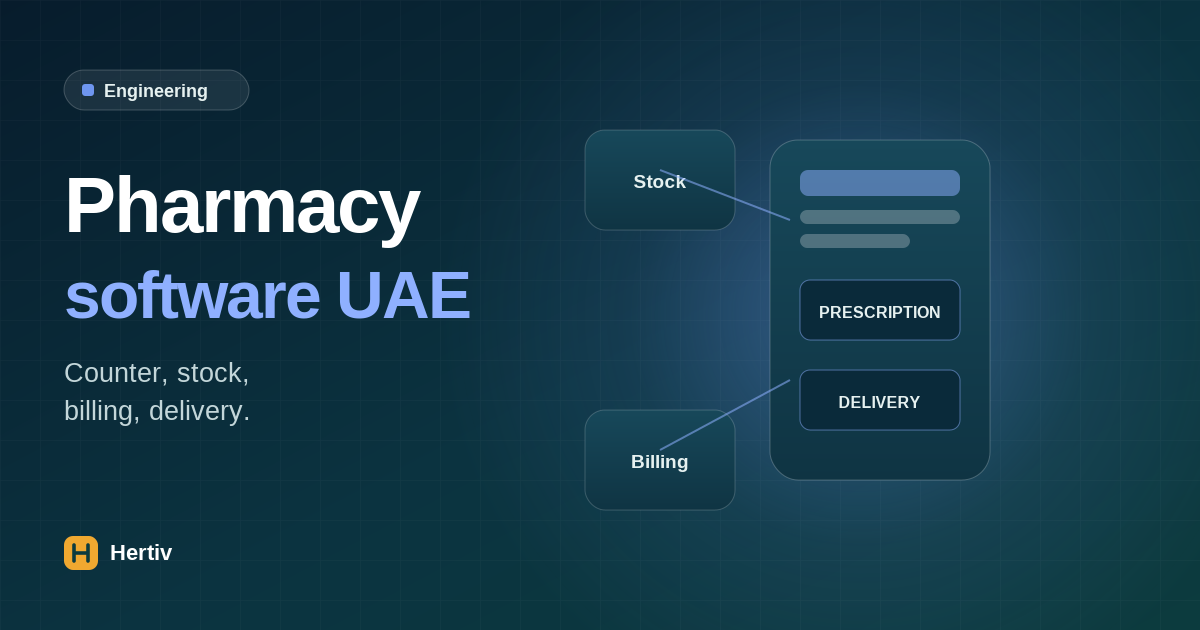
The system usually has three parts. The counter part handles prescriptions and sales, the store part tracks stock, batches and expiry dates, and the delivery part manages orders, riders and proof of delivery. A small pharmacy may use one simple system, while a chain needs all three parts to share the same data.
| Part | What it does | Who uses it |
|---|---|---|
| Counter | Prescriptions, sales, billing | Pharmacists and cashiers |
| Store | Stock, batches, expiry dates | Store staff |
| Delivery | Orders, riders, proof of delivery | Dispatch and riders |
| Reports | Sales, stock and compliance | Owner and manager |
Getting the rules right matters more than getting the features right. A system that cannot produce the records a health authority asks for will cost the pharmacy far more than a missing feature. For the wider picture on building health software, see how to build patient management software.
What features does pharmacy software need?
Pharmacy software needs features that match the daily work of a pharmacy. The core is prescription handling: recording the prescription, checking the dose and the patient's history, and flagging interactions or duplicate medicines. A system that misses a duplicate prescription is a safety risk, not just an inconvenience.
Stock control is the second core feature. The system should track each batch, its expiry date and its supplier, and warn staff before stock runs out or expires. Pharmacies lose money on expired stock, so expiry alerts are one of the most used features in practice.
Billing, insurance and delivery complete the set. The system should handle cash, card and insurance claims, including the pre-approval step many UAE insurers require, and it should track delivery orders from the counter to the customer's door with proof of delivery. A look at mobile app development shows how the delivery side is usually built.
What UAE rules shape pharmacy software?
Pharmacy software in the UAE must fit the rules of the health authority in the emirate where the pharmacy operates. Each authority sets its own licensing, record-keeping and reporting requirements, and the software must be able to produce the records those rules ask for. Teams should check the current requirements with the relevant authority before building, because the rules change.
Data protection is the second rule set. Patient and prescription data is sensitive health data, so the system must control who can see it, log who changed it and keep it inside the country where the rules require it. A system that stores patient data on servers outside the UAE without checking the rules can create a compliance problem.
Controlled medicines need extra care. Some medicines require special licences, stricter records and limits on quantities, and the software must enforce those limits rather than leaving them to staff memory. If a team is unsure which rules apply, a local health lawyer or consultant should be asked before the build starts.
How do teams build pharmacy software?
Building pharmacy software works best in six steps, starting with the rules rather than the features.
- Confirm the licensing and record-keeping rules with the relevant health authority.
- Map the daily work: counter, store, billing and delivery.
- Design the data model around prescriptions, batches and patients.
- Build the counter and store parts first, then billing and delivery.
- Test with real pharmacists using real prescriptions and real stock.
- Train staff and run the old and new systems side by side for a month.
The parallel run is the step most teams skip, and it is the one that catches the most problems. Running both systems for a month shows where the new system is slower or wrong, while the old system is still there to fall back on.
Integration matters too. A pharmacy system usually needs to connect to insurance portals, supplier ordering systems and delivery apps, so the team should confirm those connections exist before promising a launch date. For the cost side of health software, see healthcare app development cost.
Example (hypothetical): a first version for one pharmacy
Example (hypothetical): a single pharmacy in Dubai plans a first version covering the counter, stock and billing, with delivery added later. The build takes 16 weeks with a team of three: one developer, one tester and one designer, working 40 hours a week, which is 3 times 16 times 40, or 1,920 hours.
At 70 dollars an hour, the build costs 1,920 times 70, or 134,400 dollars. The team also budgets 8,000 dollars for insurance portal integration, 6,000 dollars for testing with real pharmacists and 4,000 dollars for hosting and licences, bringing the total to 152,400 dollars. A 10 percent reserve adds 15,240 dollars, giving a planned budget of 167,640 dollars.
The reserve matters because health authority checks and insurance integration often take longer than planned. A budget without a reserve forces the team to cut features or ask for more money halfway through, and both outcomes delay the launch.
What does pharmacy software cost to build in the UAE?
Pharmacy software cost depends on scope, integrations and the rules that apply. A simple system for one pharmacy, covering counter, stock and billing, costs far less than a chain system with delivery, insurance claims and multi-branch stock, because each extra part needs more design, testing and integration work.
Integrations are the biggest hidden cost. Insurance portals, supplier ordering and delivery apps each need their own connection, and each one can take weeks to test. A team that lists the integrations early can price them honestly, while a team that discovers them late will blow its budget.
Running costs continue after launch: hosting, support, updates when the rules change and help for staff. A team should budget for those from the start, because a system that cannot be updated when a health authority changes a rule becomes a liability. Prices for tools and services change often, so check the vendor site before budgeting.
What are the common mistakes?
The most common pharmacy software mistakes are building before checking the rules, skipping the parallel run, and underestimating integrations.
- Building before checking the rules. A system that cannot produce the records a health authority asks for must be rebuilt.
- Skipping the parallel run. Without a month of running both systems, problems surface only after launch.
- Underestimating integrations. Insurance and supplier connections each take weeks to test.
- Weak expiry control. Without batch and expiry tracking, stock expires unnoticed and money is lost.
- No plan for rule changes. Health rules change, so the system needs updates built into its budget.
Key takeaways
- Pharmacy software covers counter, store, billing and delivery in one system
- UAE health authority rules shape the records the system must produce
- Patient data needs access control, logging and care about where it is stored
- Run old and new systems side by side for a month before switching
- Budget for integrations and for updates when the rules change
Frequently asked questions
What is pharmacy software?
Pharmacy software is a system that helps a pharmacy manage prescriptions, stock, billing, customers and delivery. In the UAE it must also fit the licensing and record-keeping rules of the health authority in its emirate.
Do I need a licence to run pharmacy software in the UAE?
The pharmacy itself needs a licence from the health authority in its emirate, and the software must support the record-keeping that licence requires. Check the current requirements with the relevant authority before building.
What features matter most in pharmacy software?
Prescription handling, stock and expiry control, billing with insurance claims, and delivery tracking matter most. Expiry alerts and duplicate-prescription checks are the features pharmacists use every day, and they protect both safety and stock.
How long does it take to build pharmacy software?
A first version for one pharmacy usually takes three to five months, depending on scope and integrations. Insurance portals and supplier connections add time, so confirm those integrations before promising a launch date.
Can pharmacy software handle insurance claims?
Yes, most UAE pharmacy systems handle insurance claims, including the pre-approval step many insurers require. The exact flow depends on the insurer, so the team should test the claim flow with each insurer the pharmacy works with.
Does pharmacy software work for a chain of pharmacies?
Yes, but a chain needs shared stock, shared patient records and branch-level reporting, which adds design and testing work. Start with one branch, prove the system works there, then roll it out to the rest.


