How to Build a P2P Crypto Lending Platform
A P2P crypto lending platform lets borrowers pledge crypto as collateral while lenders earn interest. The build, the risks, and the steps in order.
On this page
Short answer
A peer-to-peer crypto lending platform matches borrowers who pledge cryptocurrency as collateral with lenders who fund the loan, using smart contracts to hold the collateral, release the funds and repay the lender. Building one means choosing the loan model, writing and auditing the contracts, and adding wallets, price feeds and liquidation rules. The hardest parts are not the code: they are collateral risk, oracle reliability and compliance.
What is a P2P crypto lending platform?
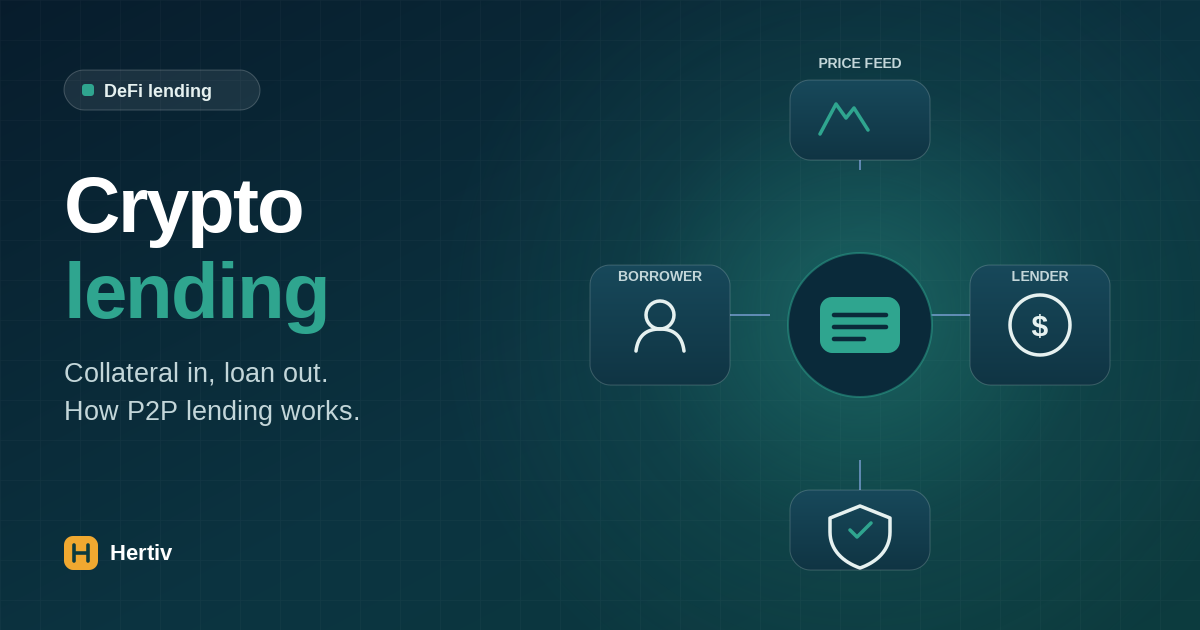
A P2P crypto lending platform is a marketplace where people lend and borrow using cryptocurrency, without a bank in the middle. A borrower locks crypto such as bitcoin or ether into a smart contract as collateral, and a lender funds the loan in stablecoins or another crypto. The contract holds the collateral, releases the loan, collects repayments and returns the collateral when the loan is paid off.
The model differs from a general peer-to-peer lending platform because the collateral is crypto and the rules are enforced by code. There is no credit file to check and no human underwriter. Instead, the loan is safe because the collateral is worth more than the loan, and the contract can sell it if its value falls too far. That over-collateral is the core of the model.
Two forms exist. In a custodial platform, a company holds the funds and runs the matching, while the contracts handle settlement. In a non-custodial platform, the contracts hold everything and the company only provides the interface. The second form is more open, but it also leaves users with no one to call when something goes wrong. Many teams start with DeFi development advice to decide which form fits their market.
How does a crypto-backed loan work?
A crypto-backed loan follows the same path every time, and each step is a job for the smart contract. The table below shows the flow from the borrower's side.
| Step | What happens | Who acts |
|---|---|---|
| 1. Pledge | Borrower locks crypto as collateral | Borrower and contract |
| 2. Fund | Lender sends stablecoins to the borrower | Lender and contract |
| 3. Price check | Oracle reports the collateral value | Price feed |
| 4. Repay | Borrower repays loan plus interest | Borrower |
| 5. Release | Contract returns the collateral | Contract |
| 6. Liquidate | Contract sells collateral if value falls | Contract and liquidator |
The key numbers are the loan-to-value ratio and the liquidation line. A common setup lends up to 66 percent of the collateral value, and starts liquidation when the collateral falls to 120 percent of the loan. The gap between those two lines is the safety margin, and it is what protects the lender when prices move fast.
What do you need before you build?
Four things must be settled before any code is written. The first is the licence question. Lending rules differ by market, and in many places a lending platform needs a licence or a licensed partner, even when the loans are crypto-backed. A lawyer should answer this first, because the answer shapes the whole product.
The second is the loan model: which assets count as collateral, which currencies are lent, the maximum loan-to-value, the interest model and the liquidation rules. These are business decisions, not technical ones, and they should be written down before development starts.
The third is the price feed. The platform needs a reliable oracle for every collateral asset, with a fallback if the main feed fails. A wrong price can liquidate healthy loans or leave bad loans open, so the oracle is one of the most safety-critical parts of the system.
The fourth is the audit plan. Lending contracts hold other people's money, so they need an independent audit and a testnet run before real funds arrive. A team that skips this step is asking users to trust unaudited code with their savings. The contract work itself is best done with an experienced smart contract development partner.
How to build a P2P crypto lending platform in 7 steps
Build in order, and do not take real funds until the audit and the testnet run are done. Each step below has a clear test that shows it is finished.
- Fix the loan model. Choose the collateral assets, the loan currency, the loan-to-value limit, the interest model and the liquidation line.
- Confirm the legal path. Get written advice on licences, identity checks and which markets you can serve.
- Design the contracts. Map the loan lifecycle: pledge, fund, repay, release, liquidate, and what happens when a price feed fails.
- Build the contracts and the interface. Write the contracts first, then the web app, wallets and dashboards around them.
- Add price feeds and monitoring. Connect an oracle per asset, add a fallback feed, and alert on every liquidation.
- Audit and test on a testnet. Run an independent audit, fix every finding, then run the full flow with test funds.
- Launch small and watch. Open with low loan limits, watch liquidations and repayments for a month, then raise limits slowly.
The wallet experience deserves care. Borrowers and lenders need to see their collateral value, their loan health and the liquidation price in plain numbers, not just in contract terms. A clear dashboard prevents most support tickets, and it also prevents the panic that comes when a user cannot tell how close their loan is to liquidation. Wallet flows are usually built with crypto wallet development help.
Example (hypothetical): a $10,000 loan
Example (hypothetical): a borrower wants a $10,000 loan in stablecoins and the platform requires 150 percent collateral. The borrower locks $15,000 worth of ether into the contract, because 150 percent of $10,000 is $15,000. The lender funds the $10,000 loan, and the borrower pays 8 percent interest a year, which is $800.
The liquidation line is set at 120 percent of the loan, which is $12,000. If the ether price falls and the collateral value drops to $12,000, the contract starts a liquidation: it sells enough collateral to repay the $10,000 loan plus the $800 interest, a total of $10,800, and returns what is left to the borrower. That leaves $1,200, which is $12,000 minus $10,800.
If instead the borrower repays on time, they pay $10,800 and the contract returns the full $15,000 of collateral, assuming the price did not move. The lender receives their $10,000 back plus the $800 interest, minus any platform fee. The example shows why the collateral ratio and the liquidation line matter more than the interest rate.
What are the risks, and how do you control them?
Price falls are the first risk. Crypto prices can drop fast, and a sharp fall can push many loans past their liquidation line at once. The controls are a conservative loan-to-value limit, a liquidation line with room to act, and a liquidation process that has been tested on a testnet under stressed prices.
Oracle failure is the second risk. If a price feed reports a wrong price, healthy loans can be liquidated or bad loans can stay open. The controls are a second feed as a fallback, a sanity check that rejects prices far from the recent range, and a pause switch that halts new liquidations while the feed is checked.
Contract bugs are the third risk, and the most expensive when they happen. The controls are an independent audit, a bug bounty, and a limit on how much value the contracts can hold at launch. Compliance is the fourth risk: lending rules change, and a platform that serves a market without the right licence can be shut down. The fix is written legal advice per market, reviewed at least once a year.
What are the common mistakes?
The first mistake is setting the loan-to-value too high. A platform that lends 90 percent of the collateral value has almost no margin when prices fall, and its liquidations will cascade. Conservative limits look boring, but they are what keep lenders' money safe.
The second mistake is trusting a single price feed. One feed is one point of failure, and attackers know it. The third mistake is launching without an audit, or with an audit whose findings were never fixed. The fourth mistake is hiding the liquidation price from users. A borrower who cannot see how close their loan is to liquidation will blame the platform when it happens.
The fifth mistake is ignoring the lender's side. Lenders need to see who borrowed, what collateral backs the loan, and what happens if the borrower does not repay. A platform that only serves borrowers will run out of lenders. Teams that plan both sides early, with crypto exchange development experience to draw on, build a market rather than a one-sided product.
Key takeaways
- A P2P crypto lending platform is a marketplace for crypto-backed loans, enforced by smart contracts.
- Over-collateral is the core safety: the collateral must be worth more than the loan.
- The loan-to-value limit and the liquidation line decide how much risk lenders take.
- Licences, oracle reliability and an independent audit come before launch.
- Borrowers need to see their liquidation price in plain numbers, not contract terms.
Frequently asked questions
Do borrowers need a credit check on a P2P crypto lending platform?
Usually not, because the loan is secured by crypto collateral worth more than the loan itself. The platform checks identity for legal reasons, but the lending decision rests on the collateral, not on a credit file. That is what makes the model work across borders.
What happens if the collateral value falls below the loan?
The smart contract starts a liquidation: it sells enough collateral to repay the lender, plus interest and fees, and returns any remainder to the borrower. The liquidation line is set above the loan value so there is normally enough collateral to cover the debt.
Who sets the interest rate?
It depends on the platform. Some let lenders and borrowers agree a rate, like a market, while others set a rate based on the asset and the loan term. Market-set rates move with supply and demand; platform-set rates are simpler but less flexible.
Is a P2P crypto loan the same as DeFi lending?
It is close, but not identical. DeFi lending usually means pooled lending through a protocol, where many lenders fund one pool. P2P lending matches one lender to one borrower. Both use smart contracts, but the matching and the risk sit in different places.
Can a lender lose money?
Yes. A lender can lose money if the collateral falls faster than the liquidation process can sell it, if a price feed fails, or if a contract has a bug. Conservative loan-to-value limits, tested liquidations and audits reduce the risk, but no lending is risk free.
Do I need a licence to run one?
In many markets, yes, or you need a licensed partner. Lending rules differ by country, and crypto collateral does not remove them. Get written legal advice for each market you plan to serve before you build.


