How P2P Crypto Exchange Development Helps Your Business
A peer-to-peer crypto exchange lets users trade directly while your platform holds escrow and takes a fee. Here is how it earns money and what launching one takes.
On this page
Short answer
P2P crypto exchange development helps your business by creating a marketplace where users trade crypto directly with each other, with your platform earning fees on trades, listings and escrow while holding no inventory. It opens markets that centralised exchanges serve poorly, especially regions with limited banking rails and local payment methods.
What is P2P crypto exchange development?
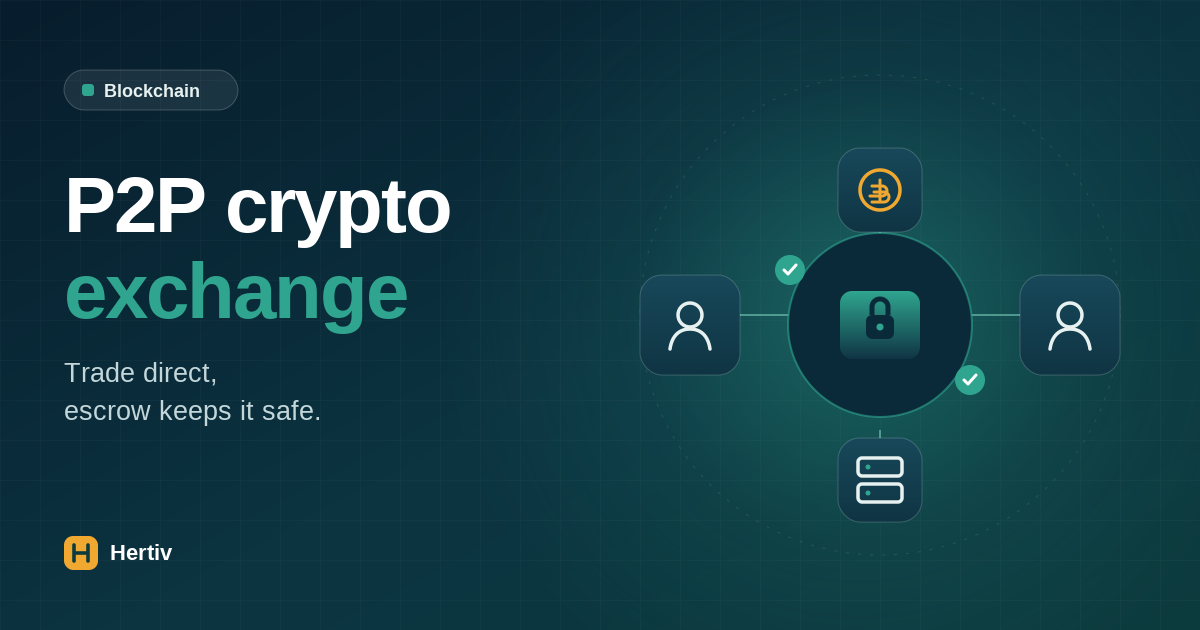
P2P crypto exchange development is building a marketplace where buyers and sellers trade cryptocurrency directly with each other, instead of trading against a company order book. The platform matches the two sides, holds the seller's crypto in escrow until payment is confirmed, and takes a fee for the service.
Unlike a centralised exchange, the platform never holds large amounts of user funds as inventory and never sets the price. Users post offers with their own price and payment method, and the market forms from those offers. That difference shapes the whole business: revenue comes from fees and services, not from trading against customers.
The model fits businesses that already serve a crypto audience, such as wallet providers, payment companies and regional fintechs, and want a trading product without running a full exchange desk.
How does a P2P exchange earn money?
A P2P exchange earns money from several small fees that add up with volume, rather than from one large charge. The mix matters, because a single fee source makes revenue fragile.
| Revenue source | How it works | Notes |
|---|---|---|
| Trade fees | A percentage of each completed trade | Main income, grows with volume |
| Escrow fees | A fee for holding funds during a trade | Often bundled into the trade fee |
| Advertised offers | Sellers pay to rank offers higher | Works once the market is busy |
| Premium accounts | Lower fees and extra limits for a subscription | Suits active traders |
| Withdrawal fees | A fee for moving funds out | Keep it low or users leave |
| Token listings | A fee to list a new asset | Review listings carefully |
Trade fees are the core, but the other sources smooth out slow months. A platform that depends only on trade fees earns little while the market is quiet.
What business problems does a P2P exchange solve?
A P2P exchange solves access problems that centralised exchanges handle badly. In many regions, users cannot easily move money to an exchange: banks block transfers, cards are declined, or the local currency is not supported. P2P trading lets them pay with local methods such as bank transfer, mobile money or cash deposits.
It also solves the trust problem of trading with strangers. Escrow holds the crypto until the buyer confirms payment, and a dispute process settles the cases where the two sides disagree. That structure lets people trade with strangers at a scale that informal chat groups cannot reach.
For the business, it solves a product problem: you can offer trading without holding inventory, setting prices or running a market-making desk. The platform is a marketplace and a referee, not a counterparty.
The model also fits niche markets that large exchanges ignore: a single country, a single language community, or a specific payment method. A small, focused market is easier to serve well than a global one, and traders in a niche often stay loyal because no larger platform serves them.
What does it take to launch one?
Launching a P2P exchange takes a working marketplace, a trustworthy escrow system and a compliance plan, in that order of risk. The technology is the smallest part of the job.
- Define the market. Pick the region, the assets and the payment methods you will support first.
- Design escrow and disputes. Decide who holds funds, how release works, and how disputes are judged.
- Plan compliance. Check licensing, identity checks and reporting duties in each market before building.
- Build matching, wallets and chat. Users need to post offers, find counterparties and talk during a trade.
- Audit the contracts and code. Any code that holds funds needs an independent review before launch.
- Launch small. Start with a few pairs and a small group of traders, then open up as the dispute process proves itself.
For the cost side, P2P crypto exchange development cost breaks down the build budget.
For the payment side of the product, how to develop a P2P payment app covers what the payment flow needs.
Example (hypothetical): a regional P2P exchange in its first year
Example (hypothetical): a small P2P exchange serves one region with 400 active traders. Each trader completes 2 trades a month, so the platform handles 400 times 2, or 800 trades a month, with an average trade size of 500 dollars.
Monthly volume is 800 times 500, or 400,000 dollars. At a trade fee of 0.5 percent, fee income is 400,000 times 0.005, or 2,000 dollars a month. Listing and premium fees add about 300 dollars a month, so total income is about 2,300 dollars a month.
Running costs are about 1,400 dollars a month for hosting, support and compliance checks, leaving about 900 dollars a month. The lesson is that a small exchange is a volume business: the model works when traders stay active, and it stalls when they drift away.
What are the common mistakes?
The most common P2P exchange mistakes are launching without a dispute process, ignoring compliance until after launch, and trusting the escrow code without an audit.
- No dispute process. Without one, a single contested trade can destroy trust in the whole market.
- Compliance as an afterthought. Licensing and identity checks shape the product; adding them late means rebuilding.
- Unaudited escrow. Code that holds user funds without an independent review is a risk to users and to the business.
- Too many pairs at launch. Thin markets mean slow trades and unhappy users.
- High withdrawal fees. Users leave when moving funds out costs more than the trade itself.
Is a P2P exchange the right move for your business?
A P2P exchange is the right move when you already have a crypto audience, a region with weak banking rails, and the patience to build trust slowly. It is a marketplace business, so its value grows with the number of active traders, not with a single launch.
Ask three questions before committing. Do you have users who already trade informally and need a safer place to do it? Can you handle licensing and identity checks in your target markets? And can you fund the platform through the quiet months before volume builds?
If the answer to all three is yes, the model is worth building. If any answer is no, a simpler product, such as a payment app or a wallet, is usually the better first step. For the build itself, crypto exchange development covers the options.
Key takeaways
- A P2P exchange is a marketplace: users trade with each other, the platform holds escrow and takes fees
- Revenue comes from trade, escrow, listing and premium fees, not from trading against users
- The model serves regions where banking rails and centralised exchanges fall short
- Escrow and a dispute process are the product: without them there is no trust
- It is a volume business, so a small exchange needs active traders to cover its costs
Frequently asked questions
How does a P2P crypto exchange make money?
Mainly from fees on completed trades, plus escrow, listing, premium-account and withdrawal fees. The platform does not hold inventory or trade against users, so income grows with trading volume rather than with price moves.
Is a P2P exchange safer than a centralised exchange?
It is different, not simply safer. Escrow protects each trade, and the platform holds no large inventory, but users still face payment fraud and disputes. Safety depends on the escrow design, the dispute process and the platform's checks.
Do I need a licence to run a P2P exchange?
Licensing depends on the country and the services offered. Many markets require registration, identity checks and reporting for money transmission. Check the rules for each target market with a lawyer before building.
What payment methods can a P2P exchange support?
Bank transfers, mobile money, cash deposits and payment apps are common, depending on the region. Supporting local methods is one of the main advantages of the P2P model over centralised exchanges.
How long does it take to build a P2P exchange?
A small marketplace with escrow, wallets and dispute handling typically takes several months from planning to a limited launch. Compliance work and security audits often take as long as the build itself.
What is escrow in P2P trading?
Escrow is a holding step: the seller's crypto is locked when a trade starts and released to the buyer only after payment is confirmed. If the two sides disagree, the platform reviews the evidence and decides who gets the funds.


