8 Open Source Thirdweb Alternatives Worth Comparing
Thirdweb speeds up Web3 development, but open source tools give you full control of your code and contracts. Compare eight options for contracts, SDKs and dApps.
On this page
Short answer
The best open source Thirdweb alternatives are Hardhat for a full contract workflow, Foundry for fast Solidity testing, Brownie or ApeWorx for Python teams, Scaffold-ETH for prototypes, Remix IDE for quick edits, and Embark or DappTools for minimal setups. Pick by your team's language and whether you need a dashboard, because none of them replaces Thirdweb's managed pieces on its own.
Which open source Thirdweb alternatives are worth comparing?
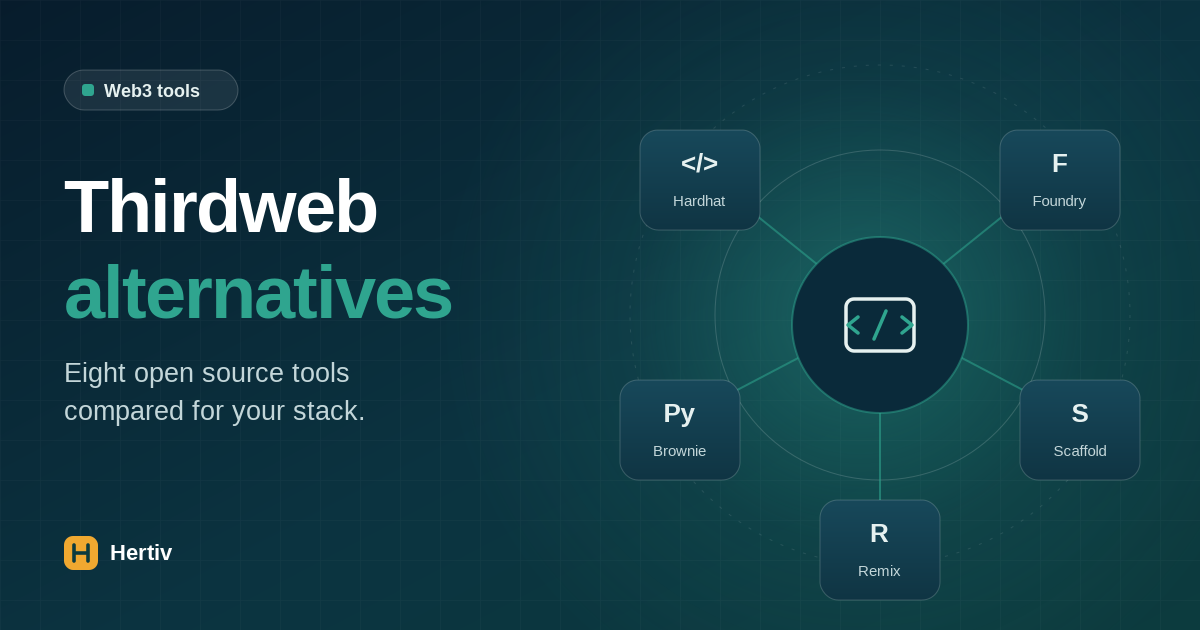
The open source Thirdweb alternatives worth comparing are Hardhat, Foundry, Brownie, Scaffold-ETH, ApeWorx, Remix IDE, Embark and DappTools. Each covers part of what Thirdweb bundles: smart contract development, testing, deployment or a front-end for your contracts.
Thirdweb gives you prebuilt contracts, SDKs and a dashboard in one place. Open source tools split that job across smaller pieces, which means more setup work but full control of your code, your contracts and your data. Use the table below to shortlist by what your team already knows.
| Tool | Best for | Language | Effort |
|---|---|---|---|
| Hardhat | Full contract workflow | JavaScript, TypeScript | Medium |
| Foundry | Fast testing in Solidity | Solidity | Medium |
| Brownie | Python teams | Python | Low to medium |
| Scaffold-ETH | Learning and prototypes | TypeScript | Low |
| ApeWorx | Python contract plugins | Python | Medium |
| Remix IDE | Quick edits in the browser | Solidity | Low |
| Embark | Full dApp framework | JavaScript | Medium |
| DappTools | Minimal Solidity tooling | Solidity | Medium |
Start with one row, not all eight. Pick the tool that matches your team's language and the part of the workflow you need first, then add others only when a gap appears.
<h3>1. Hardhat: best for a full contract workflow</h3><h3>2. Foundry: best for fast testing in Solidity</h3>
Hardhat is the most widely used open source framework for building, testing and deploying Ethereum contracts. It runs a local network, lets you write tests in JavaScript or TypeScript, and has plugins for coverage, gas reports and contract verification.
Its strength is the ecosystem. Most tutorials, templates and audit checklists assume Hardhat, so a new developer can get help quickly. The cost is setup: you assemble your own stack of plugins instead of getting a dashboard out of the box.
- Pros: large community, strong plugin system, good TypeScript support
- Cons: slower test runs than Foundry, more configuration up front
Foundry is a Solidity-native toolchain built for speed. Its test runner is fast, tests are written in Solidity itself, and it includes tools for fuzzing and for forking a live chain into a local test.
Foundry suits teams that live in Solidity and want quick feedback on contract logic. It is less friendly for front-end work, so most teams pair it with a separate JavaScript setup for the app side.
- Pros: very fast tests, Solidity-native testing, built-in fuzzing
- Cons: weaker front-end tooling, smaller plugin ecosystem than Hardhat
<h3>3. Brownie: best for Python teams</h3><h3>4. Scaffold-ETH: best for learning and prototypes</h3>
Brownie is an open source Python framework for writing, testing and deploying smart contracts. It feels familiar to Python developers, with a console for interacting with contracts and built-in support for common testing patterns.
Brownie is a good fit when your team already works in Python for data or back-end code and wants one language across the project. It is less active than Hardhat or Foundry, so check that its releases still match the chain features you need.
- Pros: Python-first workflow, interactive console, simple deployment scripts
- Cons: slower release pace, smaller community than Hardhat
Scaffold-ETH is an open source starter kit that pairs Hardhat contracts with a working front-end. It ships with example contracts, a wallet connection and a simple interface, so you can see a dApp running in minutes.
Use it for learning, hackathons and early prototypes. It is not a production framework on its own: you will replace its example contracts and harden the front-end before a real launch.
- Pros: working dApp in minutes, good for learning, clear examples
- Cons: example code needs replacing, not built for production as shipped
<h3>5. ApeWorx: best for Python contract plugins</h3><h3>6. Remix IDE: best for quick edits in the browser</h3>
ApeWorx, often called Ape, is a Python framework for smart contract development built around plugins. You install only the pieces you need, such as a compiler, a test runner or a deployment plugin, and the framework ties them together.
Ape suits teams that want a Python workflow with more structure than Brownie and a plugin system they can extend. Its community is smaller than Hardhat's, so expect to read source code when a plugin behaves oddly.
- Pros: plugin-based design, Python-native, good for custom workflows
- Cons: smaller community, some plugins are lightly maintained
Remix IDE is a browser-based editor for writing, compiling and deploying Solidity contracts. You open it, paste a contract, and deploy to a test network without installing anything on your machine.
Remix is best for quick experiments, teaching and debugging a single contract. It is not a project framework: large codebases with tests and deployment scripts belong in Hardhat or Foundry instead.
- Pros: nothing to install, fast for small contracts, built-in debugger
- Cons: no project structure, weak for large codebases
<h3>7. Embark: best for a full dApp framework</h3><h3>8. DappTools: best for minimal Solidity tooling</h3>
Embark is an open source framework that covers contracts, front-end and deployment in one project. It watches your files, recompiles contracts on change, and serves a development interface for the dApp.
Embark fits small teams that want one tool for the whole dApp instead of wiring several together. Its community is smaller than Hardhat's, so verify that it supports the chain and compiler version you plan to use.
- Pros: single framework for contracts and front-end, live reload, built-in deployment
- Cons: smaller community, fewer plugins than Hardhat
DappTools is a set of minimal command-line tools for Solidity development, built around a simple testing library. It appeals to developers who prefer small, Unix-style tools over a large framework.
Choose DappTools when you want tight control and are comfortable assembling your own workflow. It demands more manual setup than Hardhat or Foundry, and its documentation assumes you already know the basics.
- Pros: minimal and composable, strong testing library, no framework lock-in
- Cons: more manual setup, steeper learning curve for beginners
How to choose the right Thirdweb alternative
Choose by language and workflow, not by feature count. The right tool is the one your team can run, test and debug without a long learning curve.
- List what Thirdweb does for you today: contracts, SDKs, dashboard, deployment or all four.
- Match each job to a tool above, starting with the language your team already uses.
- Try the top two on a small contract: write it, test it and deploy it to a test network.
- Check the release history and community size before committing to a niche tool.
- Plan the missing pieces, such as a dashboard or SDK, and decide whether to build or buy them.
If you need a managed dashboard and prebuilt contracts, an open source stack will not replace Thirdweb on its own. If you need control, auditability and no vendor lock-in, the open source route is usually worth the extra setup. For teams building the whole product, dApp development covers how these tools fit into a full build.
What are the common mistakes?
The most common mistakes are picking a tool for its popularity, mixing too many tools, and skipping the audit step because the code is open source.
- Choosing on hype. A fast test runner does not help if your team writes JavaScript and the tool is Solidity-only.
- Running three frameworks at once. Pick one primary toolchain and add small tools around it.
- Skipping contract audits. Open source does not mean safe; contracts still need review before they hold real value.
- Ignoring the front-end. Contracts are half the product. Budget time for the wallet connection and interface.
- No deployment plan. Decide how contracts reach test and main networks before the first line of code.
If your contracts will hold user funds, a smart contract audit is the right step before launch, whichever tool you built with.
Key takeaways
- Hardhat and Foundry cover most contract work; pick by your team's language
- Scaffold-ETH and Remix IDE are best for learning and quick experiments
- Python teams should shortlist Brownie or ApeWorx
- No single open source tool replaces Thirdweb's dashboard and prebuilt contracts
- Contracts still need review before they hold real value, whatever tool built them
Frequently asked questions
Is Thirdweb itself open source?
Parts of Thirdweb are open source, including its contract templates and SDKs, but the hosted dashboard and managed services are not. Teams that want full control usually replace the hosted pieces with tools like Hardhat or Foundry and build their own interface.
Which Thirdweb alternative is best for beginners?
Scaffold-ETH is the easiest starting point because it ships a working dApp with example contracts and a front-end. Remix IDE is also good for learning Solidity, since it runs in the browser with nothing to install.
Can I use Hardhat and Foundry together?
Yes, many teams do. A common split is Foundry for fast contract tests and Hardhat for deployment scripts and plugins. Keep one as the primary toolchain so the project does not end up with two conflicting setups.
Do open source tools cost less than Thirdweb?
The tools themselves are free, but you pay in setup and maintenance time. Thirdweb charges for hosted services, so compare the subscription cost against the engineering hours your team would spend building and running the same pieces.
Which alternative works best with React front-ends?
Hardhat and Scaffold-ETH pair well with React, since both are JavaScript-first and have templates for front-end integration. Foundry teams usually add a separate JavaScript project for the interface. Keeping contracts and the interface in one workflow also makes testing changes faster.
Do I still need an audit if I use open source tools?
Yes. Open source tooling does not make your contracts safe. Any contract that holds user funds should be reviewed by a qualified auditor before deployment, regardless of which framework wrote it.


