8 Open Source Polymath Alternatives Worth Comparing
Polymath focuses on security token issuance, but alternatives cover the same ground. Compare eight options, from Polymesh to Ravencoin, and pick by rules.
On this page
Short answer
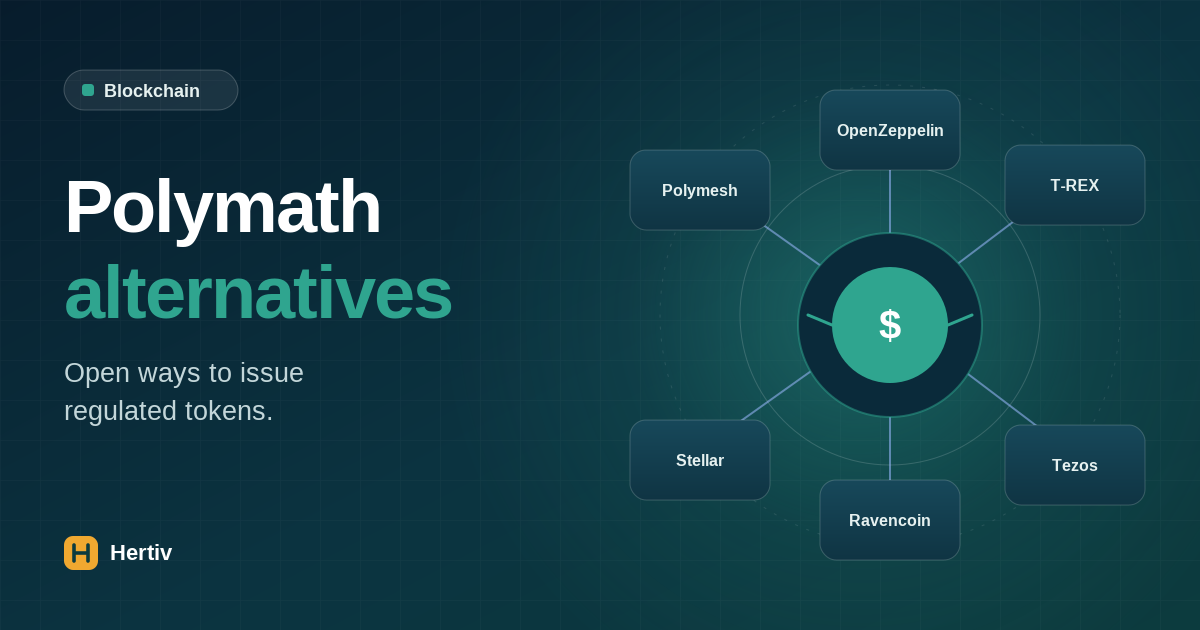
Polymath is known for security token issuance, but several open source alternatives cover the same ground, from Polymesh and T-REX to OpenZeppelin, Stellar and Ravencoin. The right choice depends on your compliance rules, your chain and your team: regulated funds need identity and transfer controls built in, while simple asset tokens may only need low fees and fast settlement.
What are open source Polymath alternatives?
Open source Polymath alternatives are tools and platforms that let you issue regulated tokens without depending on Polymath's own software. Polymath built its name on security token issuance, and its Polymesh chain is designed for regulated assets, but teams that want open code, a different chain or a simpler setup have several options.
| Platform | Best for | Token standard |
|---|---|---|
| Polymesh | Regulated security tokens | Polymesh native |
| T-REX (ERC-3643) | Compliant token issuance | ERC-3643 |
| OpenZeppelin Contracts | Audited smart contract code | ERC-20, ERC-721, ERC-1155 |
| Stellar | Fast, low-cost asset issuance | Stellar assets |
| Algorand | Fast settlement with controls | Algorand Standard Assets |
| Tezos | On-chain governance | FA2 |
| ERC-1400 | Standard token contract | ERC-1400 |
| Ravencoin | Simple asset issuance | Ravencoin assets |
The right choice depends on what you are issuing and where. A regulated fund needs identity checks and transfer rules built in, while a simple asset token may only need a chain that is cheap and easy to use. Read the options below with your own rules in mind.
<h3>1. Polymesh: best for regulated security tokens</h3><h3>2. T-REX (ERC-3643): best for compliant token issuance</h3>
1. Polymesh is a public blockchain built for regulated assets, and it grew out of Polymath's work on security tokens. Identity is part of the chain: every account is linked to a verified identity, and transfer rules can be enforced at the chain level. That makes it a natural fit when your token must follow securities rules from day one.
Pros: identity and compliance built into the chain; designed for regulated assets; settlement is fast and final.
Cons: a smaller ecosystem than Ethereum; fewer developers and tools; migrating an existing token takes work.
2. T-REX (ERC-3643) is an open-source suite of smart contracts that adds compliance to Ethereum tokens. It uses an identity registry and transfer rules so that only verified investors can hold a token, and issuers can freeze or force transfers when rules require it. If you want to stay on Ethereum and keep your token standard, T-REX is the closest open-source match to Polymath's approach.
Pros: runs on Ethereum with familiar tooling; identity and transfer rules built in; widely used for compliant issuance.
Cons: needs Ethereum gas fees; setting up the identity registry takes planning; compliance logic must be configured carefully.
<h3>3. OpenZeppelin Contracts: best for audited smart contract code</h3><h3>4. Stellar: best for fast, low-cost asset issuance</h3>
3. OpenZeppelin Contracts is an open-source library of audited smart contract code for Ethereum and compatible chains. It does not issue tokens for you; it gives you tested building blocks for ERC-20, ERC-721 and ERC-1155 tokens, plus access control and upgrade patterns. Teams that want full control over their token logic start here and add their own compliance rules.
Pros: widely audited and battle-tested code; flexible enough for any token design; large community and documentation.
Cons: you build the issuance flow yourself; compliance features must be added, not included; needs a smart contract development team that can review the code.
4. Stellar is a public blockchain built for payments and asset issuance, with low fees and fast settlement. Issuing an asset on Stellar is a built-in operation, not a smart contract, so a team can create and distribute a token quickly. It suits simple asset tokens and payment use cases more than complex compliance rules.
Pros: cheap and fast transactions; asset issuance is built in; simple to operate.
Cons: limited smart contract logic for complex rules; fewer compliance tools than purpose-built platforms; less suited to heavy regulation.
<h3>5. Algorand: best for fast settlement with controls</h3><h3>6. Tezos: best for on-chain governance</h3>
5. Algorand is a public blockchain with fast finality and low fees, and its Algorand Standard Assets let you issue tokens with built-in controls such as clawback and freeze. Those controls help issuers meet compliance needs without writing custom contracts. Algorand suits teams that want speed and simple asset controls in one place.
Pros: fast settlement and low fees; asset controls built in; simple token issuance.
Cons: smaller developer ecosystem than Ethereum; fewer issuance tools; compliance features are basic compared with dedicated platforms.
6. Tezos is a public blockchain known for on-chain governance and formal verification of smart contracts. Its FA2 token standard supports fungible and non-fungible tokens in one contract, and the chain can upgrade itself without hard forks. Teams that value long-term governance and contract safety look at Tezos.
Pros: on-chain upgrades without forks; formal verification for safer contracts; FA2 covers many token types.
Cons: smaller ecosystem for security tokens; fewer issuance tools; learning curve for new developers.
<h3>7. ERC-1400: best for a standard token contract</h3><h3>8. Ravencoin: best for simple asset issuance</h3>
7. ERC-1400 is a proposed standard for security tokens on Ethereum that adds partitions, transfer restrictions and document handling to the ERC-20 model. It is a contract pattern rather than a platform, so teams use it as the base for a token that must carry compliance data. If you want a standard that other tools can recognise, ERC-1400 is the reference point.
Pros: designed for security tokens from the start; transfer rules and documents built in; works with Ethereum tooling.
Cons: a standard, not a finished product, so you build the rest; less widely used than ERC-20; needs legal and technical review.
8. Ravencoin is a blockchain forked from Bitcoin that is built for issuing assets. Creating a token is a native operation, and the chain is simple to run and understand. It suits teams that want a straightforward asset token without smart contract complexity, though it offers little in the way of built-in compliance.
Pros: simple asset issuance; no smart contract code needed; easy to understand and operate.
Cons: almost no built-in compliance; small ecosystem; limited tooling for issuance and management.
How to choose
Choose by matching the platform to your compliance needs first, then to your chain and team. A regulated fund needs identity and transfer rules; a simple asset token may only need low fees and fast settlement.
- List your rules. Write down who can hold the token, where they can be, and what transfers must be blocked.
- Pick the chain. Stay on Ethereum if your team and tools are there; move if fees or speed demand it.
- Check the identity model. Make sure the platform can verify holders and enforce your rules.
- Test the issuance flow. Issue a test token end to end before you commit to a platform.
- Plan for audits. Get the contracts and the issuance process reviewed before real investors join.
Do not pick a platform because it is popular. Pick the one whose compliance model matches your rules and whose chain your team can run. See what a security token is for the basics behind these choices.
What are the common mistakes?
The most common mistake is picking a platform before writing down the rules the token must follow. A platform that cannot enforce your transfer rules will cost more to fix later than a slower start would have.
- Ignoring identity. A token that anyone can hold may break securities rules, so check the identity model first.
- Assuming open source means free. The code may be free, but audits, hosting and legal review are not.
- Skipping the audit. Even audited libraries need a review of your own contracts and settings.
- Forgetting the investor flow. Issuance is only half the job; investors also need a way to buy, hold and transfer.
- Locking into one chain. A token that cannot move or be listed where investors are may limit your options later.
If you are weighing platforms, a security token comparison can help you see how each token type fits your plan.
Key takeaways
- Polymath alternatives range from purpose-built chains to open contract libraries.
- Polymesh and T-REX lead for regulated issuance, with identity and transfer rules built in.
- OpenZeppelin gives you audited building blocks, but you add compliance yourself.
- Stellar, Algorand, Tezos and Ravencoin trade compliance depth for speed and simplicity.
- Write down your token rules before you pick a platform, then test the full issuance flow.
Frequently asked questions
What is Polymath used for?
Polymath is a platform for issuing security tokens, which are digital tokens that represent regulated assets such as shares. Its Polymesh chain adds identity and compliance to the chain itself, so transfers can follow securities rules. Open source alternatives cover the same job with different chains and contract models.
Is Polymesh the same as Polymath?
No. Polymath is the company and platform behind security token issuance, while Polymesh is the public blockchain it built for regulated assets. Polymesh is open source and can be used on its own, which is why it appears in this list as an alternative.
Do I need a lawyer to issue a security token?
Yes, in practice. Security tokens fall under securities rules that vary by country, so legal advice is part of the plan, not an optional extra. The platform handles the technical side, but a lawyer confirms what your token can and cannot do.
What is the cheapest way to issue a token?
Simple asset tokens on low-fee chains such as Stellar or Ravencoin cost the least to issue, because the operation is built in and fees are low. Regulated tokens cost more, because identity checks, audits and legal review add up. The cheapest option is not the right one if it cannot enforce your rules.
Can I move a token from one platform to another?
Moving a token between chains is possible with bridges or re-issuance, but it is not simple and it can break compliance rules if the new chain cannot enforce them. Choose the chain with migration in mind, and check how the platform handles transfers before you commit.
Are open source alternatives safe to use?
Open source code can be reviewed by anyone, which is a strength, but it does not guarantee safety. Audited libraries such as OpenZeppelin are widely used, yet your own contracts and settings still need a review. Treat an audit as part of the budget, not an optional step.


